Hello! Welcome to the next lesson in our RTOS module.
In our last session, we dissected the causes of deadlock and explored practical prevention strategies, focusing on the critical technique of enforcing a strict lock ordering. Deadlock is one of the two most dangerous hazards in concurrent programming. Today, we confront the other: priority inversion.
While deadlock causes a system to grind to a halt, priority inversion introduces a more insidious failure mode, particularly in real-time systems. It can cause high-priority, time-critical tasks to miss their deadlines, not because they are directly blocked, but due to an unfortunate interaction between tasks of different priorities. This exact issue famously caused system resets on the Mars Pathfinder lander. Understanding and preventing it is non-negotiable for senior embedded roles.
Today's learning outcome is to explain priority inversion with a concrete scenario and compare the Priority Inheritance Protocol (PIP) vs. the Priority Ceiling Protocol (PCP) as solutions.
1. The Priority Inversion Problem
Let's start with a clear definition and analogy.
Priority Inversion Prevention in Real-Time Systems
This article provides a fantastic analogy for priority inversion. Understanding this is key to grasping the core problem.
Read the 'Concept' and 'Why it matters' sections at the very beginning of the document.
As the article describes, priority inversion is like an ambulance (high-priority task) getting stuck behind a slow truck (low-priority task). The real problem—and the reason it's called unbounded priority inversion—occurs when regular traffic (medium-priority tasks) starts passing the slow truck, indefinitely delaying the truck from moving out of the way of the ambulance.
The Concrete Scenario: Unbounded Priority Inversion
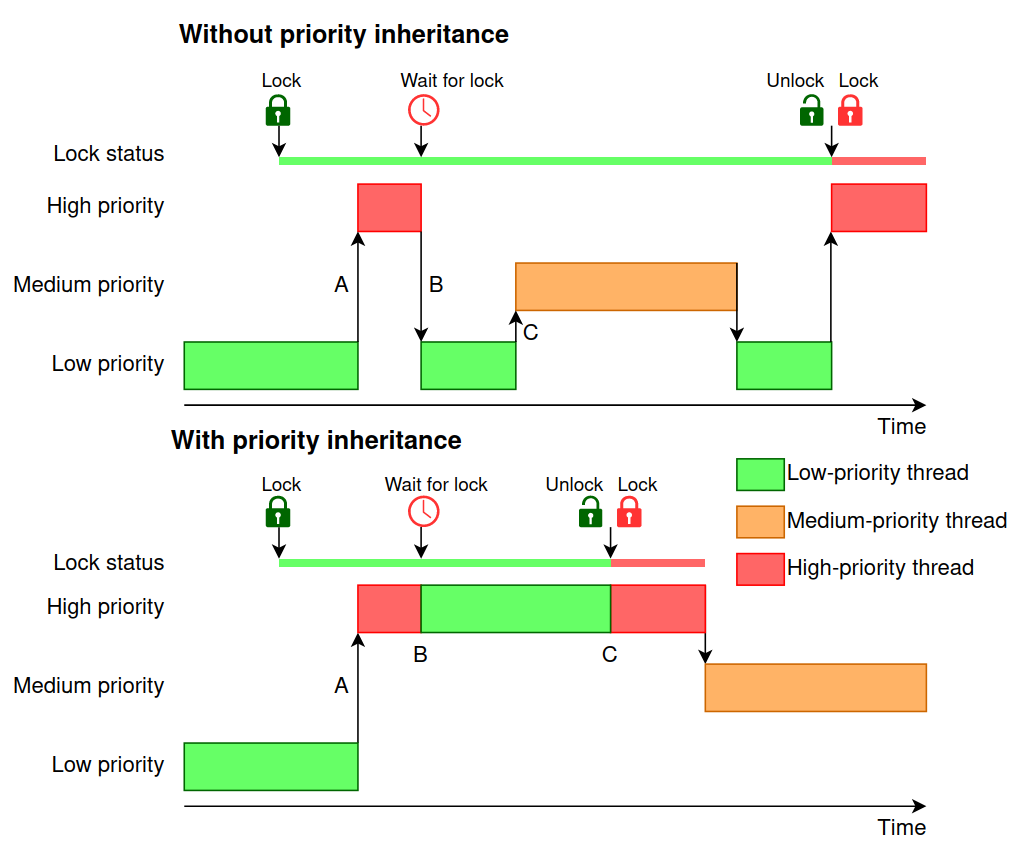
Let's formalize this with a classic three-task scenario in a preemptive, priority-based RTOS:
- Task L (Low Priority) starts running and acquires a mutex to access a shared resource (e.g., a serial port).
- Task H (High Priority) becomes ready to run. Since it has higher priority, it preempts Task L.
- Task H attempts to acquire the same mutex that Task L holds. The mutex is locked, so Task H enters a blocked state, waiting for the mutex to be released.
- The scheduler sees that Task H is blocked and resumes the next highest-priority ready task. In this state, that is Task L.
- Task M (Medium Priority), which does not use the mutex at all, becomes ready to run.
- Because Task M has a higher priority than Task L, Task M preempts Task L.
- This is the critical failure point. Task H, our most important task, is waiting for a mutex held by Task L. But Task L cannot run to release the mutex because it is being preempted by the less important Task M. The execution of Task M (and any other medium-priority tasks) can delay Task H for an unpredictable, or "unbounded," amount of time.
This scenario violates the fundamental principle of a priority-based scheduler: a high-priority task is being indirectly blocked by a lower-priority task.
2. Solution 1: Priority Inheritance Protocol (PIP)
The Priority Inheritance Protocol is a dynamic, elegant solution to unbounded priority inversion. The core idea is to temporarily boost the priority of the task holding the resource.
This short video from Phil Koopman provides a very clear visual explanation of how Priority Inheritance works.
Watch the entire video. It directly maps to the scenario we just discussed and shows how the priority 'hoisting' solves the problem.
Let's re-run our scenario with a mutex that supports Priority Inheritance:
- Task L (Low Priority) acquires the mutex.
- Task H (High Priority) preempts Task L and attempts to acquire the same mutex.
- Task H blocks. As a side effect of this blocking action, the RTOS kernel identifies that Task L holds the needed resource. It immediately and temporarily "hoists" the priority of Task L to be the same as Task H's priority.
- Task M (Medium Priority) becomes ready.
- However, the scheduler now sees Task L running at a high priority. Task M cannot preempt Task L.
- Task L finishes its critical section, releases the mutex, and its priority is immediately restored to its original low level.
- The mutex is now free. Task H, being the highest-priority waiting task, unblocks, acquires the mutex, and begins execution.
The priority inversion is now bounded. The maximum time Task H will have to wait is limited to the duration of Task L's critical section, which is a predictable worst-case scenario.
For a deeper dive into PIP, especially its behavior with nested locks, the following article is excellent.
Embedded.com - How to use priority inheritance
This article provides a rigorous, step-by-step breakdown of PIP, including more complex scenarios with multiple tasks and resources.
Read the section titled 'Priority inheritance protocol'. Pay close attention to the step-by-step examples in Figures 5, 6, and 7 to see how the priority hoisting and restoration works in practice. Note the discussion on its pros (good average-case performance) and cons (potential for deadlock with nested locks).
3. Solution 2: Priority Ceiling Protocol (PCP)
The Priority Ceiling Protocol is a more static, preventative approach. It stops unbounded priority inversion from ever happening, but with different trade-offs.
How it works:
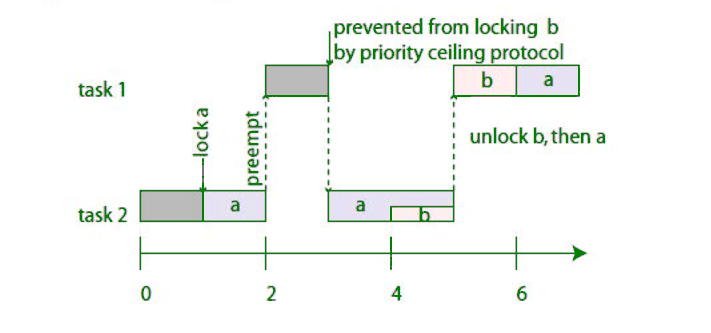
- Static Analysis: Before runtime, each shared resource (mutex) is assigned a "priority ceiling." This ceiling is set to the priority of the highest-priority task that will ever use that resource.
- Priority Hoisting on Acquisition: When any task successfully acquires a mutex, its priority is immediately raised to that mutex's priority ceiling. The priority is lowered back to its original value only when the task releases the mutex.
Let's see how this prevents our problem scenario:
- The mutex is assigned a priority ceiling equal to Task H's priority.
- Task L acquires the mutex. Its priority is immediately raised to the ceiling (Task H's priority).
- Task M becomes ready.
- The scheduler sees Task L running at the high ceiling priority. Task M cannot preempt it. The situation where Task M could cause an unbounded delay is prevented from the start.
PCP also has a more fundamental rule that prevents deadlock: a task is only allowed to acquire a lock if its current priority is higher than the priority ceilings of all other locks currently held by other tasks. This makes the system extremely predictable.
Embedded.com - How to use priority inheritance
Let's return to the Embedded.com article to understand the mechanics and trade-offs of PCP.
Read the section titled 'Priority ceiling protocol'. Focus on how it works, its advantages (prevents deadlock, good worst-case analysis), and its disadvantages (poor average-case response, unnecessary blocking of medium-priority tasks).
4. Interview Focus: PIP vs. PCP Comparison
In an interview, you'll be expected to articulate the trade-offs between these two protocols. This demonstrates a deep understanding of system design.
| Feature | Priority Inheritance Protocol (PIP) | Priority Ceiling Protocol (PCP) |
|---|---|---|
| Mechanism | Dynamic. Priority is hoisted only when a higher-priority task actually blocks on a resource. | Static/Preventative. Priority is hoisted immediately upon acquiring a resource, regardless of contention. |
| Overhead | Lower average overhead. No overhead if there is no resource contention. | Higher average overhead. Priority changes occur on every lock/unlock, even without contention. |
| Predictability | Harder to analyze. Worst-case blocking time can be complex to calculate, especially with chained blocking (T1 waits for T2, T2 waits for T3...). | Highly predictable. Provides a tighter, mathematically provable upper bound on blocking time. |
| Deadlock | Does not prevent deadlock. If tasks acquire multiple nested locks, deadlock is still possible. | Prevents deadlock among the set of resources managed by the protocol. |
| System Impact | More "permissive." Only affects tasks when contention happens. Generally results in better average-case system responsiveness. | More "restrictive." Can cause a low-priority task to block medium-priority tasks that don't even use the shared resource. |
| Typical Use Case | General-purpose real-time systems where average performance is important and deadlocks are handled by other means (e.g., lock ordering). | Hard real-time, safety-critical systems (e.g., avionics, medical) where predictability and provable correctness are paramount. |
To solidify this knowledge, consider how you'd answer these typical interview questions.
Priority Inversion Prevention in Real-Time Systems
This guide contains a list of direct, interview-style questions about priority inversion. Thinking through your answers is excellent preparation.
Read the 'Interview Questions' section. Pay special attention to 'Compare priority inheritance vs priority ceiling protocols.' and 'Design a system to prevent priority inversion.'
Conclusion
You have now mastered the concepts behind priority inversion, a subtle but critical topic for building reliable real-time systems. Being able to clearly explain the problem and articulate the trade-offs between PIP and PCP is a significant differentiator in interviews for senior embedded roles.
Key Takeaways:
- Priority Inversion is when a high-priority task is forced to wait for a lower-priority task, leading to missed real-time deadlines.
- The most dangerous form is unbounded priority inversion, where a medium-priority task preempts the low-priority task holding a resource needed by the high-priority task.
- Priority Inheritance Protocol (PIP) solves this dynamically by boosting the low-priority task's priority upon contention, offering good average-case performance.
- Priority Ceiling Protocol (PCP) solves this statically by boosting the task's priority upon acquisition to a pre-configured ceiling, offering superior predictability and deadlock prevention at the cost of higher average overhead.
- The choice between PIP and PCP is a classic engineering trade-off: flexibility and average performance (PIP) vs. predictability and provable safety (PCP).
Preview of the Next Lesson:
We've now tackled the two primary concurrency hazards: deadlock and priority inversion. Our next topic moves to the boundary between hardware and software. We will explore how to safely and efficiently handle interrupts in an RTOS environment by implementing deferred interrupt handling, a pattern where the short, fast Interrupt Service Routine (ISR) signals a dedicated task to do the longer processing work.