In our previous lesson, we established the fundamental difference between traditional programming and machine learning, noting that ML creates a "model" by learning rules from data. This sets the stage for today's topic, where we will explore a specific and highly influential class of models that are at the heart of modern AI services like Amazon Bedrock.
This lesson will define what a "foundation model" is and explain its crucial role in the development of current AI applications. Understanding this concept is essential, as these are precisely the types of models you will learn to customize in AWS Bedrock.
From Specialized Models to a General Foundation
In your experience as a product manager, you've seen how software is often built for specific purposes. A feature for processing payments has its own logic, while a feature for generating user reports has different, separate logic. Historically, much of machine learning followed a similar path. An AI team would:
- Build a model specifically for analyzing customer sentiment.
- Build another, completely separate model for translating text.
- Build yet another model for classifying images.
Each task required a unique, custom-built model trained from the ground up—a process that is both time-consuming and expensive.
Foundation models represent a paradigm shift. Instead of building many small, specialized models, the industry has moved toward building single, massive, and highly versatile models that can serve as a starting point—a foundation—for a wide variety of tasks.

What is a Foundation Model?
At its core, a foundation model is a very large machine learning model that has been trained on a massive, broad set of data. This extensive training gives it a general "understanding" of patterns, language, and concepts, which can then be adapted to more specific problems.
To get a formal definition, let's turn to Amazon Web Services (AWS), the provider of the Bedrock service.
Foundation Models in Generative AI Explained - AWS
This article from AWS provides a clear and direct definition of foundation models and their unique characteristics.
Please read the first two sections of the article: the definition and the unique features. Focus on how these models differ from traditional, task-specific ML models.
As the article highlights, the key characteristics of foundation models are their size and adaptability. They are not built for one job but are designed to be a flexible starting point for many.
To better understand where foundation models fit within the broader landscape of artificial intelligence, the following video provides a helpful visual hierarchy.
Machine Learning vs. Deep Learning vs. Foundation Models
This video from IBM Technology visually places foundation models within the context of AI, ML, and Deep Learning.
Watch the segment from where foundation models fit. Pay attention to the explanation that these models act as a "base or a foundation for a multitude of applications."
The Role of Foundation Models: A Multi-purpose Engine
So, what is the practical role of a foundation model? Think of it as a powerful, general-purpose engine. You wouldn't build a new engine from scratch for every type of vehicle (a car, a boat, a generator). Instead, you'd start with a powerful base engine and adapt it for each specific use case.
Foundation models function in the same way for AI applications. A single, pre-trained foundation model can be adapted to perform many different tasks, often with minimal extra effort. This process of adaptation is a key theme we will return to throughout this course, especially when we discuss "fine-tuning."
This diagram provides an excellent overview of this process. A single foundation model, after its initial training, can be adapted to power a wide range of applications.
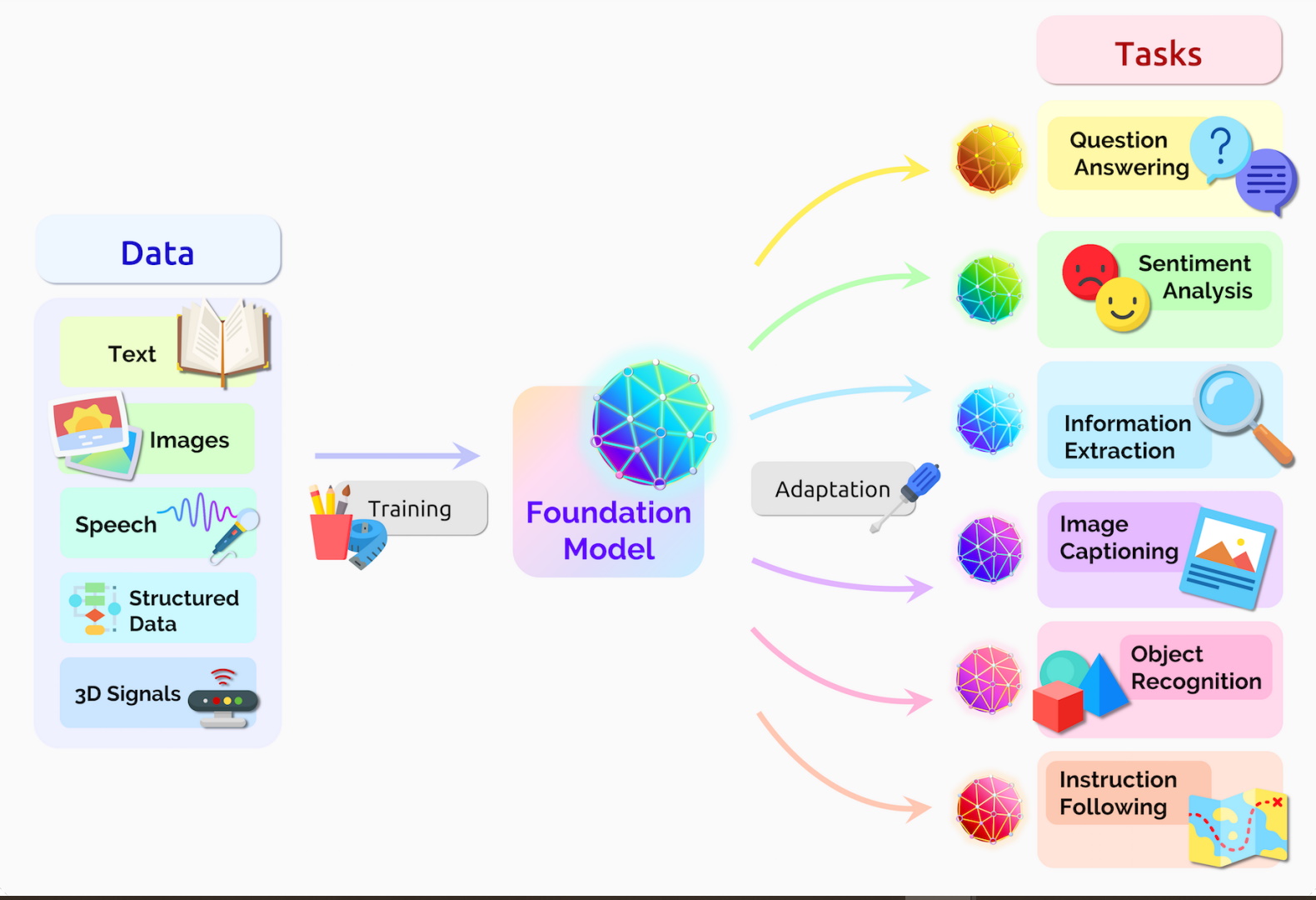
The range of applications is vast and growing. Let's explore some of the common use cases, which demonstrate the significant role these models play in modern technology.
[PDF] AI Foundation Models – Explained
This document from the Computer & Communications Industry Association lists many of the downstream applications that foundation models enable.
Please read the section titled "How can foundation models be used?". As you read through the list of applications—from text generation and data analysis to automation—consider how such capabilities could be leveraged in the financial and ERP systems you have managed.
These capabilities, such as language processing, code generation, and visual comprehension, are what make foundation models the engine behind many of the AI tools you see today, including those available in Amazon Bedrock like models from AI21 Labs (Jurassic), Anthropic (Claude), and Amazon's own Titan series.
Conclusion
In this lesson, we have defined foundation models and explored their transformative role in the field of AI.
Here are the key takeaways:
- Definition: A foundation model is a large-scale machine learning model trained on a vast amount of general data.
- Paradigm Shift: They represent a move away from building single-purpose, "task-specific" models from scratch.
- Role and Value: Their primary role is to serve as an adaptable, reusable base for a wide variety of downstream applications, making AI development faster and more accessible.
These concepts are the bedrock of... well, Bedrock! The service is built entirely around providing access to these powerful, pre-trained foundation models. In our next lesson, we will focus on the most prominent type of foundation model: Large Language Models (LLMs), which specialize in understanding and generating human text.