Hello! Welcome to your third lesson in the JavaScript Core Concepts module.
In our last lesson, you learned how to write clean and concise code using arrow functions, especially as callbacks for array methods. Today, we'll continue our journey into modern JavaScript by exploring destructuring.
This lesson addresses the learning outcome: Apply destructuring to extract values from objects and arrays efficiently. Destructuring is a powerful syntax that allows you to "unpack" values from data structures like arrays and objects directly into variables. It dramatically reduces repetitive code, making your logic cleaner and easier to read. This skill is not just a convenience; it's a fundamental pattern in modern frameworks like React for handling component properties (props) and managing data.
1. What is Destructuring?
Before ES6, if you wanted to get values from an array or an object, you had to access them one by one.
The Old Way (Arrays):
const userDetails = ["John", "Doe", 30];
const firstName = userDetails[0];
const lastName = userDetails[1];
const age = userDetails[2];
The Old Way (Objects):
const user = {
  name: "Jane Doe",
  email: "jane.doe@example.com",
  isAdmin: false,
};
const name = user.name;
const email = user.email;
This is repetitive and verbose. Destructuring provides a single, expressive statement to achieve the same result.
The New Way (Arrays):
const userDetails = ["John", "Doe", 30];
const [firstName, lastName, age] = userDetails;
The New Way (Objects):
const user = {
  name: "Jane Doe",
  email: "jane.doe@example.com",
};
const { name, email } = user;
As you can see, destructuring makes your intent clear and your code much more concise. Let's dive into how it works for both arrays and objects.
2. Array Destructuring
Array destructuring unpacks values based on their position (or index) in the array. Since you have a background in Python, you might find this similar to tuple unpacking.
To see the core patterns in action, the following video provides a clear walkthrough.
Why Is Array/Object Destructuring So Useful And How To Use It
The video 'Why Is Array/Object Destructuring So Useful And How To Use It' by Web Dev Simplified clearly explains the fundamentals of both array and object destructuring. We'll start with the array-focused sections.
Watch from 00:46 to 02:36 and then from 04:54 to 06:05. Pay attention to how destructuring works positionally, how to skip elements, and how to set default values when destructuring the return value of a function.
Here’s a summary of the key array destructuring patterns:
-
Basic Assignment: Variables on the left correspond to elements on the right by their index.
const scores = [98, 85, 91]; const [highScore, secondScore] = scores; // highScore is 98, secondScore is 85 -
Skipping Elements: Use commas to skip elements you don't need.
const rgb = [255, 128, 0]; const [r, , b] = rgb; // r is 255, b is 0. The 'g' value is skipped. -
Default Values: You can provide a default value for a variable in case the element at that position is
undefined.const settings = ["dark"]; const [theme, fontSize = 14] = settings; // theme is 'dark', fontSize is 14 -
Swapping Variables: Destructuring offers an elegant way to swap the values of two variables without a temporary variable.
let a = 10;
let b = 20;
[a, b] = [b, a]; // a is now 20, b is now 10
Test your understanding!
You have an array that represents a user's location: ['New York', 'NY']. However, sometimes the state is missing: ['Los Angeles'].
Write a single destructuring assignment that extracts the city and state. The state variable should default to 'CA' if it's not present in the array.
Show answer
// For the first case: ['New York', 'NY']
const [city, state = 'CA'] = ['New York', 'NY'];
// city will be 'New York', state will be 'NY'

// For the second case: ['Los Angeles']
const [city2, state2 = 'CA'] = ['Los Angeles'];
// city2 will be 'Los Angeles', state2 will be 'CA'
3. Object Destructuring
Object destructuring is even more common in web development. Unlike arrays, it unpacks properties based on their key name, not their position. This makes it incredibly flexible.
Let's continue with the Web Dev Simplified video to see how this works.
Why Is Array/Object Destructuring So Useful And How To Use It
Now let's look at object destructuring, which is what you'll use constantly when working with API data and React components.
Watch from 06:24 to 09:30. Focus on the key differences from array destructuring: using property names, renaming variables with the colon syntax, and destructuring nested objects.
The infographic below serves as a fantastic quick reference for the most common object destructuring patterns.
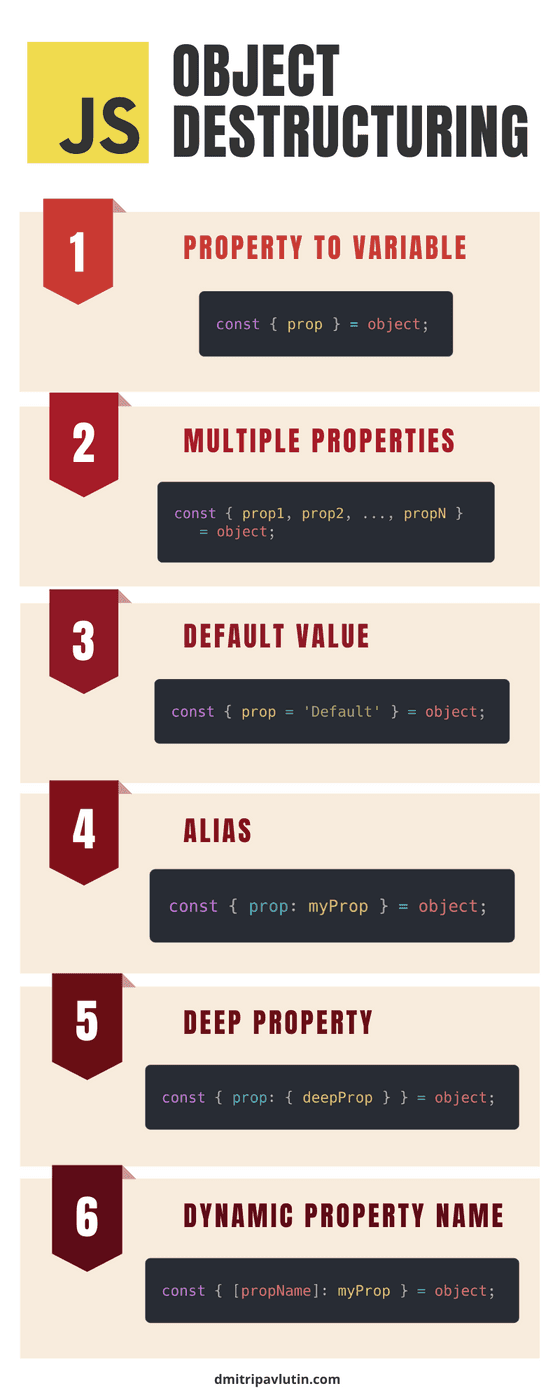
Here’s a breakdown of the essential patterns:
-
Basic Assignment: The variable names must match the object's property keys.
const person = { name: 'Alice', age: 30 }; const { name, age } = person; // name is 'Alice', age is 30 -
Renaming (Aliasing): Use a colon (
:) to assign a property's value to a variable with a different name.const product = { id: 'xyz-123', price: 99.99 }; const { id: productId, price } = product; // productId is 'xyz-123', price is 99.99 -
Default Values: Provide a default value for properties that might not exist on the object.
const config = { theme: 'dark' }; const { theme, animations = true } = config; // theme is 'dark', animations is true -
Nested Destructuring: You can "reach into" nested objects to pull out properties directly.
const user = {
  id: 1,
  info: {
    name: 'Bob',
    email: 'bob@example.com'
  }
};
const { id, info: { name, email } } = user; // id is 1, name is 'Bob', email is 'bob@example.com'
For a detailed text-based guide that you can refer back to, this article is excellent.
Essential Tips for Effective Destructuring in JavaScript
The article 'Essential Tips for Effective Destructuring in JavaScript' from dev.to provides clear code examples and explanations for all the patterns we've discussed.
Skim through the sections 'Destructuring Arrays' and 'Destructuring Objects'. Use this as a reference to solidify your understanding of the syntax for renaming, default values, and nested destructuring.
4. The Killer Feature: Destructuring in Function Parameters
One of the most powerful and common uses of destructuring is directly in a function's parameter list. This is a pattern you will see everywhere in React for accessing component props.
Instead of passing a whole object and then accessing its properties inside the function, you can unpack the properties you need right in the function signature.
Why Is Array/Object Destructuring So Useful And How To Use It
This final clip from the Web Dev Simplified video demonstrates what is arguably the most important application of destructuring for your goals as a web developer.
Watch from 10:45 to 12:26. Observe how destructuring the function argument makes the function body cleaner and its dependencies more explicit.
Let's compare the before and after:
Without Destructuring:
function displayUser(user) {
  console.log(`Name: ${user.name}`);
  console.log(`Email: ${user.email}`);
}

displayUser({ name: 'Charlie', email: 'charlie@example.com' });
With Destructuring:
function displayUser({ name, email }) {
  console.log(`Name: ${name}`);
  console.log(`Email: ${email}`);
}

displayUser({ name: 'Charlie', email: 'charlie@example.com' });
Notice how the second version is cleaner. It also clearly documents which properties of the user object the function actually depends on. You can even combine this with default values: function displayUser({ name, email, status = 'active' }).
Conclusion
You've now added another crucial ES6 feature to your toolkit. Destructuring is more than just syntactic sugar; it fundamentally changes how you access and use data, leading to more readable, maintainable, and expressive code.
Key Takeaways:
- Destructuring lets you unpack values from arrays or properties from objects into distinct variables.
- Array destructuring is position-based. You can skip elements with commas and provide default values.
- Object destructuring is name-based. You must use variable names that match the property keys, but you can rename them using the colon syntax (
key: newName). - Default values can be provided for both arrays and objects to handle missing data gracefully.
- The most powerful application is destructuring in function parameters, which makes functions cleaner and more self-documenting—a core pattern in modern frameworks.
In our next lesson, we'll expand on a concept we touched upon today. We will focus on the spread and rest operators. You've already seen the rest operator (...) used within destructuring to gather remaining elements. Next, you'll master both operators to effectively manipulate arrays, objects, and function arguments.