In our last session, you completed a demanding back-to-back simulation of the IELTS Listening and Reading sections, a crucial exercise for building the mental stamina required on test day. This prepared you for the marathon of focus needed for the first half of the exam. Today, we turn our attention to the final, interactive component: the Speaking test.
Your goal for this lesson is to record and review a full mock Speaking test, assessing your performance against the band descriptors for fluency, vocabulary, and grammar. This process is vital for tackling the "thinking delay" you've mentioned. By recording your performance, you create objective data—much like a performance log in a system—that allows for a precise, analytical review. This isn't just practice; it's a diagnostic session to identify specific areas for improvement as we target your Band 7 goal.
1. Simulating the Full Speaking Test
The IELTS Speaking test is a short but intense 11-14 minute conversation divided into three parts. To practice effectively, we need to simulate this structure as closely as possible. Since you are practicing solo, we will use a guided video that acts as your virtual examiner.
Your Task:
You will need a quiet space and a device to record your voice (your smartphone's voice memo app is perfect). You are going to complete a full mock test by following the prompts in the video below.
IELTS Speaking Practice Test with Answers - 2025 New Test!
This video from E2 IELTS provides a complete, timed Speaking practice test. The presenter will act as the examiner, asking you questions and providing the appropriate pauses and time limits for each part.
Follow the video's instructions precisely. Start your recording, then play the video. Part 1: Watch from the beginning until the questions. Pause the video after each question, speak your answer for about 20-30 seconds, and then resume. Part 2: Continue to the section starting at Part 2. Use the 1-minute preparation time to jot down notes as instructed. Then, when prompted, speak for the full 2 minutes on the topic. Part 3: Proceed to the section from Part 3. Pause after each question to give your more detailed, abstract answer, aiming for 30-40 seconds per response. Keep your recording running throughout the entire test. Do not stop to correct yourself or re-record answers. The goal is to capture a realistic performance.
2. The Assessment Framework: Deconstructing Band 7
Now that you have your recording, it's time for the review phase. In software development, you wouldn't deploy code without testing it against specifications. Similarly, we will assess your speaking performance against the official IELTS criteria.
Below are the public band descriptors for the Speaking test. Your target is a solid Band 7.
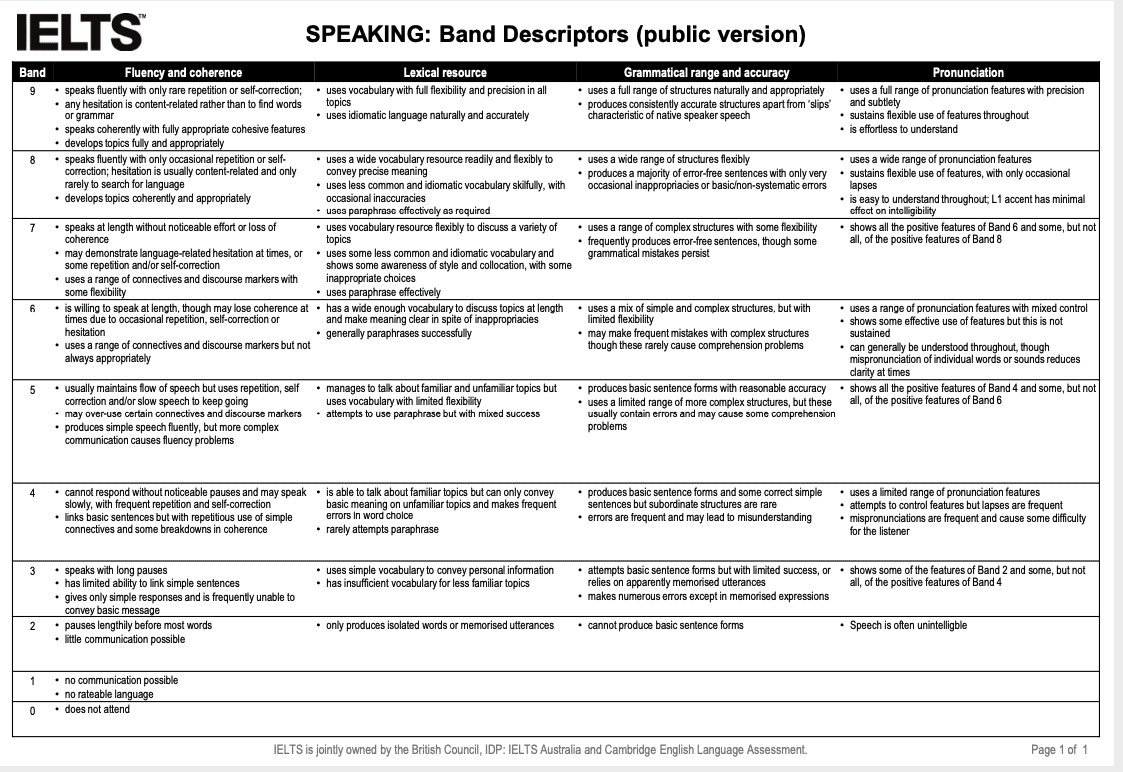
Let's translate the Band 7 requirements into a "Quality Assurance Checklist" you can use to analyze your recording.
Band 7 "QA Checklist"
Fluency & Coherence (FC)
- Performance Spec: Speaks at length without noticeable effort or loss of coherence. May demonstrate language-related hesitation at times, or some repetition and/or self-correction. Uses a range of connectives and discourse markers with some flexibility.
- Your Check:
- Did I speak continuously, or were there long, awkward pauses while I searched for words?
- Were my hesitations to think about the content (which is fine) or to search for language (which is a weakness)?
- Did I use linking words like
however,therefore,as a result, or phrases likeon the other hand,in addition to thatto structure my answers?
Lexical Resource (LR - Vocabulary)
- Performance Spec: Uses vocabulary resource flexibly to discuss a variety of topics. Uses some less common and idiomatic vocabulary and shows some awareness of style and collocation, with some inappropriate choices.
- Your Check:
- Did I use precise vocabulary, or did I rely on simple words like "good," "bad," or "interesting"?
- Did I try to paraphrase the question rather than repeating the examiner's words?
- Did I use any topic-specific vocabulary or natural-sounding word combinations (collocations)?
Grammatical Range & Accuracy (GRA)
- Performance Spec: Uses a range of complex structures with some flexibility. Frequently produces error-free sentences, though some grammatical mistakes persist.
- Your Check:
- Did I use a mix of sentence types, including complex sentences (e.g., using relative clauses like
...which is why...or conditional clauses likeIf I had more time, I would...)? - What were my recurring grammatical errors? (e.g., subject-verb agreement, tenses, articles like 'a/an/the').
- Did I use a mix of sentence types, including complex sentences (e.g., using relative clauses like
Pronunciation (P)
- Performance Spec: Shows all the positive features of Band 6 but not all, of the positive features of Band 8. Is easy to understand throughout; L1 accent has minimal effect on intelligibility.
- Your Check:
- Was my speech clear and easy to follow?
- Did I use sentence stress to emphasize key words?
- Did my intonation (the rise and fall of my voice) sound natural?
3. Guided Review and Analysis
Before you analyze your own recording, it's helpful to see how an expert assesses a real candidate. The following video shows a candidate taking a full test and receiving detailed feedback for a Band 7.0 score. This will calibrate your understanding of the criteria.
IELTS Speaking Test band 7.0 with feedback
This video from Ross IELTS Academy features a full mock test followed by a detailed, criterion-by-criterion analysis.
First, watch the candidate's complete test from the beginning to the end of the test. Then, pay very close attention to the feedback section. As the examiner provides feedback, cross-reference his points with the Band 7 criteria in the "QA Checklist" above. Notice how he points out specific examples of strengths and weaknesses for each category.
4. Your Self-Assessment and Action Plan
Now, apply the same rigorous analysis to your own performance. Listen to your recording from the first exercise. As you listen, use the "QA Checklist" to take notes. Be objective—your goal is to identify bugs to fix.
- Listen to your entire recording once without stopping to get an overall impression.
- Listen again, pausing after each answer. Assess it against the four criteria.
- Identify one or two high-priority issues for each of the four areas (FC, LR, GRA, P). For example:
- FC: "Too many 'um's between ideas. Need to use linking words instead."
- LR: "Relied on the word 'important' six times. Need to learn synonyms like 'crucial', 'vital', 'essential'."
- GRA: "Made several mistakes with past tense verbs."
- P: "My sentence stress is a bit flat, making me sound monotonous."
To help you address these issues, especially fluency, you can adopt a daily practice routine.
IELTS Speaking Practice at Home: How to Practice IELTS Speaking Alone — SpeakPrac
This article from SpeakPrac outlines effective solo practice techniques. It reframes practice as a "speaking gym," a concept that aligns well with the systematic improvement required in your field.
First, read the section on the Instant Reaction Method. This directly targets the "thinking delay" by training your brain to connect thoughts to words faster. Next, focus on the Progress Tracker Loop. This is exactly what you are doing in this lesson: recording, listening, and analyzing. The article provides clear points on what to listen for, reinforcing our "QA Checklist."
By consistently applying this record-and-review cycle, you will turn abstract goals into concrete, measurable progress.
Conclusion
In this lesson, you have moved from being a test-taker to a test-analyst. You've simulated a full IELTS Speaking test, learned to use the official band descriptors as your assessment tool, and created a specific, actionable plan for improvement.
Key Takeaways:
- Recording is non-negotiable: It provides the objective data needed for effective self-assessment.
- The Band Descriptors are your blueprint: Use them as a clear set of specifications to measure your performance and guide your practice.
- Analysis drives improvement: A successful review identifies not just errors, but the patterns behind them, allowing you to create targeted "fixes" for your next practice session.
In our next lesson, we will zoom out to look at the big picture of test efficiency. You will learn to analyze your timing strategies across all sections, identifying opportunities to improve your speed and decision-making under pressure, ensuring you can complete every part of the test to the best of your ability.