Welcome to this session on building your test-day endurance. In our last lesson, you successfully completed a full, timed IELTS Writing section, applying a structured strategy to manage the 60-minute timeframe. That was a crucial step in preparing for the pressure of the exam. Today, we will build on that experience by simulating the first half of the test day.
The goal of this lesson is to complete a full Listening and Reading section back-to-back to simulate test day conditions. This is not just about practicing questions; it's about training your focus and stamina for the continuous 1 hour and 40 minutes these two sections demand. This sustained concentration is similar to managing a complex project phase or a long debugging session—it requires both sharp skills and the mental energy to apply them over an extended period. We will briefly review the strategy for this block before you dive into the timed simulation.
1. The Marathon Method: Building Stamina and Focus
The IELTS Listening and Reading sections are a test of endurance as much as they are a test of English. The Listening test lasts for about 40 minutes (30 minutes of audio plus 10 minutes for answer transfer), followed immediately by the 60-minute Reading test. That's 100 minutes of intense focus with a challenging mental switch in the middle.
A very effective way to prepare for this is what some IELTS experts call the "marathon method"—gradually building up your ability to maintain peak concentration.
Get BAND 9 After Using These Listening Tips
This video from IELTS Advantage introduces a powerful analogy for building listening stamina. While it focuses on listening, the principle applies perfectly to our back-to-back task today.
Please watch the segment on the marathon method. The key idea is to treat your focus like a muscle that needs to be trained progressively. Today's session is a significant part of that training.
The transition from Listening to Reading is a critical moment. Listening requires you to follow an external pace set by an audio recording, which you will only hear once. Reading, by contrast, requires you to actively manage your own time across three passages. Practicing this switch is vital for test day.
2. Strategy for the 100-Minute Block
Let's quickly refresh the core strategies for each section.
Listening (~40 minutes):
- Use the pause time effectively: Before each section, read the upcoming questions to predict the context and the type of information you need to listen for (e.g., a name, a date, a reason).
- Listen for signposts: Pay attention to words that structure the talk, like "firstly," "however," or "in conclusion." They signal what's coming next.
- Don't get stuck: If you miss an answer, leave it and refocus on the next question. You can't rewind the audio.
- Answer transfer: You have 10 minutes at the end to transfer your answers to the answer sheet. Use this time carefully to check for spelling and grammar.
Reading (60 minutes):
- Strict time management: Allocate a maximum of 20 minutes per passage. This is non-negotiable.
- Skim and scan: Don't read the entire passage in detail at first. Skim the passage to get the main idea, then scan for keywords from the questions to locate the relevant section.
- Read for detail: Once you've located the relevant part of the text, read it carefully to confirm your answer.
- Transfer answers as you go: There is no extra time at the end of the Reading test to transfer answers. Fill in your answer sheet after completing each set of questions.
Now, it's time to put this into practice.
3. Practice: The Back-to-Back Simulation
You will now complete a full Listening and Reading test without a break. This exercise is designed to mimic the pressure and duration of the real exam.
- Find a quiet space where you will not be interrupted for the next 1 hour and 40 minutes.
- Turn off your phone and any other potential distractions.
- You will need a pencil and the official answer sheets for this practice.
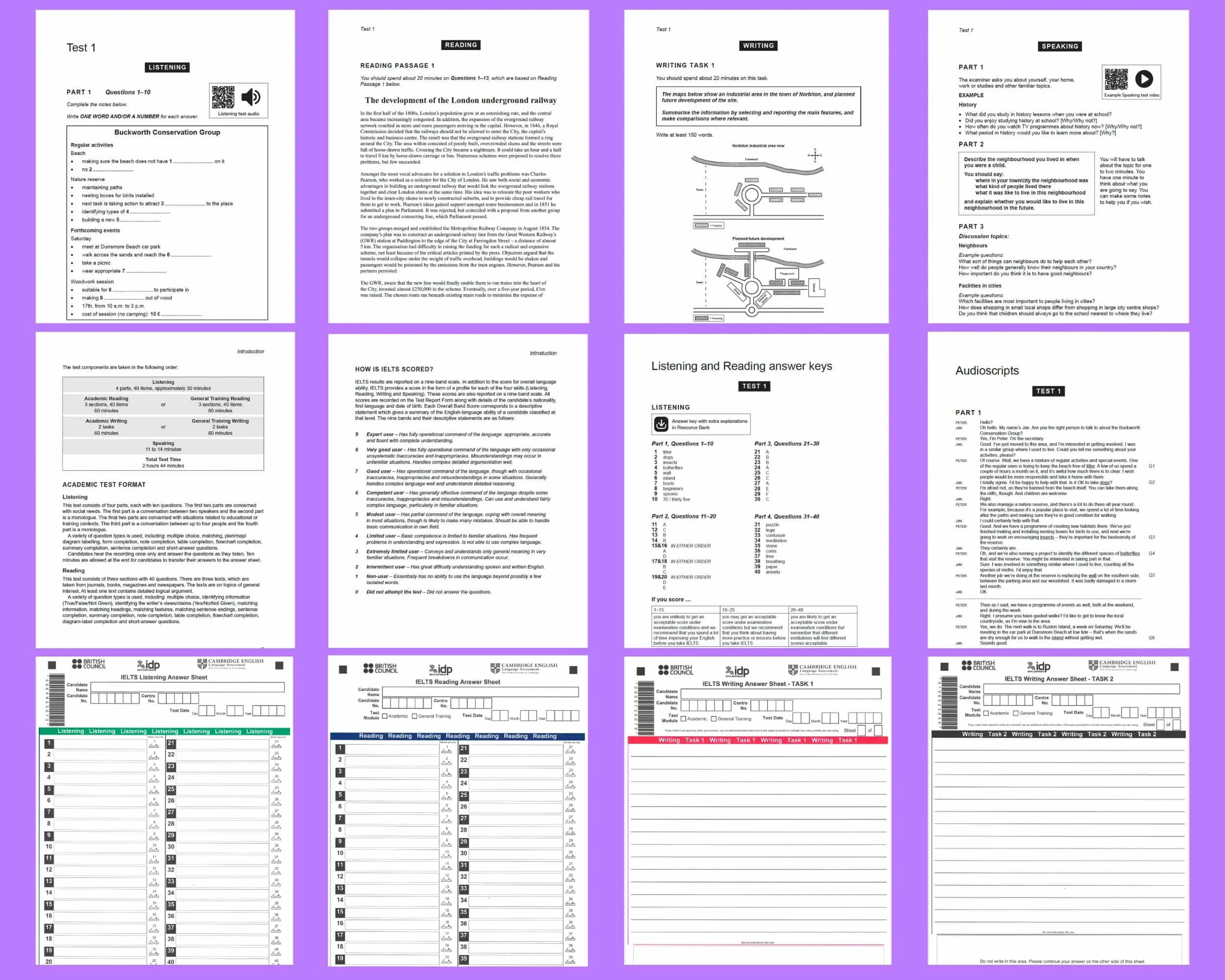
The practice test we will use is provided in the following PDF resource from Magoosh. It includes links to the audio, the test questions, and the answer keys.
[PDF] Practice Test - Cloudfront.net
Before you begin, please open this comprehensive practice test PDF. It contains everything you need for this simulation.
First, read the introductory sections, "What You'll Need" and "Practice Test Tips." Then, download and print the official answer sheets using these links within the PDF: Listening Section Answer Sheet Reading Section Answer Sheet
Step 1: The Listening Test (40 Minutes)
- Navigate to the "IELTS Listening Practice Test" section in the PDF you just opened.
- Click the "IELTS Listening Practice Test Audio" link. The audio will open and play in a new browser tab.
- Do not pause the audio once it begins. Follow the instructions you hear.
- Write your answers in the question booklet (or on scrap paper) as you listen.
- After the audio finishes, use the 10-minute transfer time to copy your answers to your printed Listening Answer Sheet.
Step 2: The Reading Test (60 Minutes)
- Immediately after your 40 minutes for the Listening test are up, set a new timer for exactly 60 minutes.
- Navigate to the "Academic Reading" section of the Magoosh PDF.
- Work through the three reading passages and 40 questions.
- Remember to write your answers directly onto your printed Reading Answer Sheet. There is no extra time for transfer.
- Stop exactly when the 60-minute timer ends.
4. Review and Error Analysis
Once you have completed the full 100-minute simulation, it's time to assess your performance. This is the quality assurance phase, where you diagnose issues to prevent them from recurring.
The Magoosh practice test PDF contains the answer key and detailed explanations for every question.
- Grade your tests: Use the answer key at the end of the PDF to mark your Listening and Reading answer sheets. Calculate your raw score (the number of correct answers out of 40) for each section.
- Analyze your errors: For every question you got wrong, perform a root cause analysis. Ask yourself:
- Listening:
- Was it a lapse in concentration? Did my mind wander? (Stamina issue)
- Was I tricked by a distractor? (e.g., an answer that was mentioned but then corrected).
- Did I mishear a key word, number, or spelling?
- Did I run out of time during answer transfer or make a simple copying error?
- Reading:
- Did I run out of time? If so, on which passage? (Pacing issue)
- Did I misunderstand the question type (e.g., True/False/Not Given vs. Yes/No/Not Given)?
- Was it a vocabulary problem where an unknown word blocked my understanding?
- Did I get stuck between two plausible options in a multiple-choice question?
- Did I find the right information but misinterpret it?
- Listening:
This systematic analysis is the most effective way to turn practice into progress. It moves you from simply "doing tests" to strategically improving your test-taking process.
Conclusion
Congratulations on completing this demanding practice session. By tackling the Listening and Reading sections back-to-back, you have taken a significant step in preparing for the mental and logistical challenges of the actual IELTS test.
Key Takeaways:
- Stamina is a skill: Sustaining high-level focus for over an hour and a half is a skill that must be trained through simulations like this one.
- Pacing is critical: The Reading test is a race against the clock. The 20-minute-per-passage rule is your most important time management tool.
- Error analysis drives improvement: The real learning happens when you diagnose why you made a mistake, not just that you made one.
You have now completed timed, sectional practice for both Writing, Listening, and Reading. The final piece of the puzzle is the Speaking test. In our next lesson, you will undertake a full mock Speaking test, recording and analyzing your performance to fine-tune your fluency, vocabulary, and delivery under pressure.