In our last lesson, you acted as a performance analyst, dissecting your Listening and Reading mock tests to build a detailed error log. This diagnostic approach, much like debugging a complex system, is essential for turning raw data into an actionable improvement strategy. You've identified the "what" and "why" of your errors in receptive skills; now, it's time to apply that same critical lens to your productive skills.
This lesson focuses on the Writing section of your mock test. You will learn to self-assess your Task 1 and Task 2 responses not as the writer, but as an examiner. The goal is to objectively evaluate your performance against the official IELTS band descriptors. By understanding precisely how an examiner grades your work across the four key criteria—Task Achievement, Coherence and Cohesion, Lexical Resource, and Grammatical Range—you can pinpoint your weakest areas and make your future practice significantly more effective.
1. Adopting the Examiner's Perspective
The greatest challenge in self-assessment is objectivity. As the writer, you know the intended meaning behind your sentences, so your brain automatically fills in logical gaps or clarifies ambiguous phrasing. An examiner, however, can only assess the words on the page. To grade yourself accurately, you must learn to detach from your intentions and evaluate the final output as a neutral observer would.
Let's begin by exploring this crucial shift in perspective.
How to Self-Assess IELTS Writing Accurately
This article from Learn English Weekly clearly explains the difference between simply 'checking' your work and truly 'assessing' it against official standards.
Read the section "Why self-assessment is difficult" to understand the core problem of writer's bias. Then, focus on the distinction between checking and self-assessing. Finally, read the sections on starting with task completion and assessing structure before details. This hierarchy—task completion first, then structure, then language—is how examiners approach your essay.
2. Understanding the "Scoring Specification": The Band Descriptors
Before you can assess your writing, you must thoroughly understand the criteria used for evaluation. Think of the official IELTS band descriptors as the technical specification against which your work is measured. Your target is a Band 7, so we need to know exactly what that requires for each of the four marking criteria.
First, take a look at the official band descriptors for both writing tasks. These tables are your primary reference for this entire exercise.
IELTS Writing Task 1 Band Descriptors

IELTS Writing Task 2 Band Descriptors
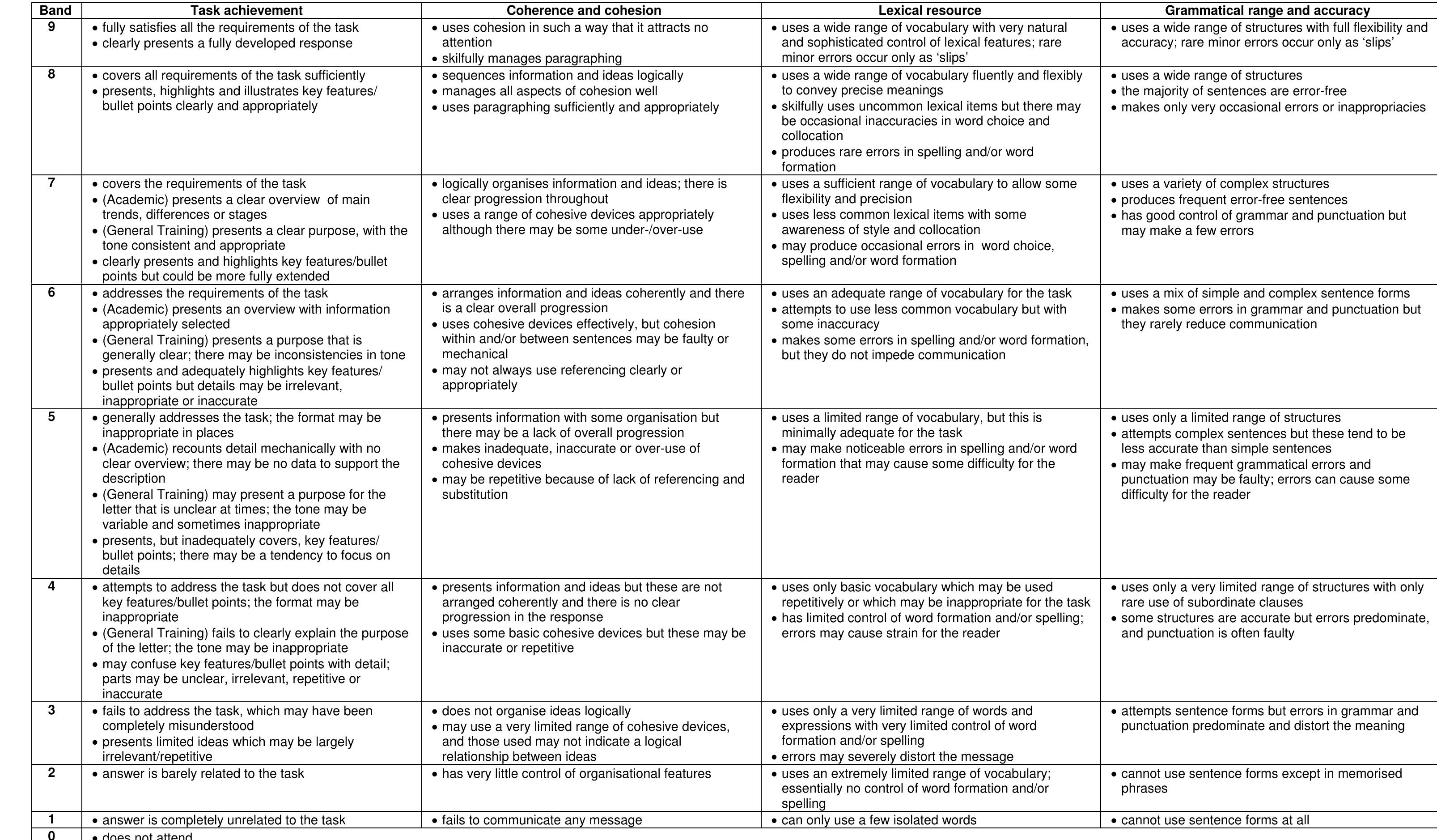
To bring these criteria to life, let's watch a detailed video explanation. The presenter breaks down what examiners are looking for in each of the four categories, providing the foundational knowledge you need for your self-assessment.
IELTS Writing Guide | Band Descriptors Explained
This video from English Pro Tips provides a clear, structured explanation of the four IELTS Writing criteria.
Watch the following segments to get a solid grasp of each criterion: Task Achievement: Pay close attention to the need to address all parts of the question and develop your ideas. Coherence and Cohesion: Note the explanation of logical structure, linking words, and referencing. Lexical Resource: Focus on the requirements for range, topic-specific vocabulary, and paraphrasing. Grammatical Range and Accuracy: Understand the difference between simple and complex structures and the importance of accuracy.
3. Practical Self-Assessment: Your Mock Test Essays
Now, it's time to apply this knowledge. Take out the Task 1 and Task 2 essays you wrote during your mock test. You are going to analyze them systematically, criterion by criterion. A helpful way to visualize the difference between a good-enough response (Band 6) and a strong one (Band 7+) is to see them side-by-side.
This next video provides exactly that, with an ex-examiner giving feedback on real student essays. Watching this will sharpen your eye for the subtle but critical differences that separate a Band 6 from a Band 7.
IELTS Writing Task 2: Band 6 vs. Band 7+ | Ex-examiner’s Feedback
This video from Fastrack IELTS compares Band 6 and Band 7+ essays for each of the four criteria, offering invaluable insights from an ex-examiner's perspective.
As you watch, think about your own essays. For Task Response, watch from this section. Does your essay fully develop its points like the Band 7+ example, or are the ideas a bit "jumpy" like the Band 6? For Coherence and Cohesion, watch from this segment. Is your paragraphing logical with a clear central topic in each, or do the ideas seem disconnected? For Lexical Resource, review the comparison from this part. Does your vocabulary show precision and good collocations, or are there some awkward word choices? For Grammatical Range and Accuracy, watch the analysis from this section. Do you have a good mix of sentence structures, or do you rely on the same patterns?
Your Self-Assessment Checklist
Use the questions below, derived from the resources, to guide your analysis. Go through your Task 1 and Task 2 essays separately. For each question, find specific evidence in your writing and make notes. Refer back to the band descriptor images to help you decide where your performance fits.
IELTS Writing Band 7 Requirements Explained - Speechful AI
This article provides a concise summary of Band 7 requirements and common mistakes. It will serve as an excellent reference for your checklist.
As you work through your self-assessment, refer to the tables and lists in this article. Specifically, use the breakdown in the section "The Four Scoring Criteria" to understand the Band 7 standard. Also, review the list of "Common Mistakes" to see if you have made any of these Band 6-level errors.
1. Task Achievement / Task Response
- Task 1: Did I write a clear, one-paragraph overview summarizing the most significant trends/features? Did I group data logically into body paragraphs and make explicit comparisons?
- Task 2: Did I address all parts of the question? (e.g., if it asks for two views and my opinion, are all three present?). Is my own position clear in the introduction and consistent throughout? Are my main ideas supported with specific explanations or examples?
2. Coherence and Cohesion
- Is the overall structure logical (e.g., Intro-Body-Body-Conclusion for Task 2)?
- Does each body paragraph have a clear topic sentence that states the main idea?
- Are my linking words used effectively and naturally, or are they repetitive and mechanical (e.g., starting every paragraph with "Firstly," "Secondly," "Finally")?
- Did I use referencing (e.g.,
it,they,this issue) to avoid repetition and improve flow?
3. Lexical Resource (Vocabulary)
- Did I use a good range of vocabulary, or did I repeat the same words frequently?
- Did I manage to use any less common or topic-specific words correctly?
- Are my collocations natural (e.g.,
significant increase,heavy traffic)? - Are there any spelling or word-form errors? If so, do they make my meaning difficult to understand?
4. Grammatical Range and Accuracy
- Is there a mix of simple sentences and complex sentences (e.g., using clauses with
while,although,if,who)? - How many sentences are completely free from grammatical errors?
- Are there any repeated, systematic errors (e.g., with articles
a/an/the, subject-verb agreement, or verb tenses)? - Is my punctuation (commas, full stops) used correctly?
After analyzing each criterion for both tasks, try to assign a tentative band score (e.g., 6, 6.5, 7) for each of the four criteria for both Task 1 and Task 2. This will give you a clear, data-driven picture of your current strengths and weaknesses.
Conclusion
In this lesson, you've stepped into the role of an IELTS examiner. You've learned to look beyond the surface of your writing and assess it critically against the official scoring standards. This process of objective self-assessment is one of the most powerful tools in your preparation, as it ensures your practice is targeted and efficient.
Key Takeaways:
- Accurate self-assessment requires shifting from a writer's subjective viewpoint to an examiner's objective one.
- Your writing is judged on four equally important criteria: Task Achievement, Coherence and Cohesion, Lexical Resource, and Grammatical Range and Accuracy.
- A Band 7 performance requires not only good language but also fully addressing the task, structuring ideas logically, and developing them with support.
- By systematically analyzing your own work, you can identify your primary weaknesses and focus your efforts on the areas that will yield the greatest score improvement.
In our next session, we will complete our diagnostic review of the mock test by turning to the Speaking section. You will learn how to record, transcribe, and assess your performance against the Speaking band descriptors, preparing you for the final phase of targeted practice before your exam.