In our last session, you completed a full-length mock test for the Listening, Reading, and Writing sections. That was a demanding task designed to build stamina and test your time management under pressure, much like a final User Acceptance Test (UAT) before a major system goes live. You executed the plan; now it's time to analyze the output.
Today, we will shift from execution to diagnostics. This lesson is dedicated to scoring your Listening and Reading sections and, more importantly, analyzing your incorrect answers to find systematic patterns. Your goal is to move beyond simply knowing your score to understanding precisely why you lost marks. This data-driven approach will be the foundation for targeted practice in the final phase of your preparation.
1. Scoring Your Mock Test: The Quantitative Analysis
First, let's establish your baseline performance. You will need the answer sheets from your mock test and the answer key provided in the practice booklet you downloaded from the E2 IELTS video.
Step 1: Mark Your Listening & Reading Answers
Using the answer key, carefully mark your Listening and Reading papers. Be strict with yourself:
- Spelling: Any spelling mistake, even a minor one, makes the answer incorrect.
- Word Limit: If a question specifies "NO MORE THAN TWO WORDS," an answer with three words is incorrect, even if the words themselves are right.
- Plurals: If the correct answer is "students" and you wrote "student," it is incorrect.
Count the total number of correct answers (out of 40) for each section.
Step 2: Convert Your Raw Score to a Band Score
Your raw score translates into an IELTS band score. The table below shows the approximate conversion for the Academic module. Find your number of correct answers for Listening and Academic Reading to see your estimated band score for each.

Take note of these two band scores. They are your current benchmarks. However, a score is just a single data point. The real value lies in understanding the errors that produced it.
2. The Philosophy of Error Analysis
In software development, finding out a build failed is the first step. The critical work is in reading the logs to find the root cause of the failure. The same principle applies here. Simply re-doing tests without analysis is like repeatedly running a failing program hoping it will magically work. We need to debug our performance.
To begin, let's watch a short video that frames the improvement process as a system with four essential components. This will help you understand why error analysis is a non-negotiable part of your strategy.
Why is my IELTS Reading Score NOT Increasing?
This video from IELTS Advantage, "Why is my IELTS Reading Score NOT Increasing?", uses a powerful analogy to explain why many students' scores plateau.
Watch from the beginning to understand the "four tires" analogy for improvement. Then, continue watching the section on practice tests, which explains how to use them for weakness analysis rather than just for timed practice.
3. Building Your Error Log: A Systematic Approach
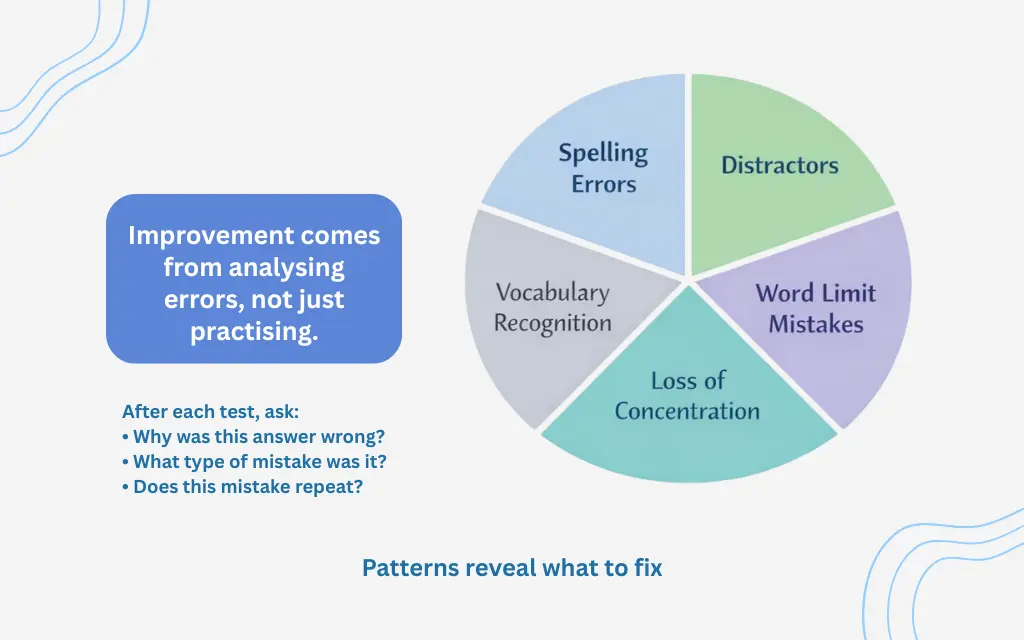
To analyze your errors effectively, you need a system. We will use an Error Log. This is a structured document (a spreadsheet is ideal) where you record every mistake, categorize it, and determine its root cause. This creates a database of your personal performance challenges, allowing you to prioritize what to fix.
We will use a comprehensive guide to help structure this log.
IELTS Error Log Template: How to Track and Fix Weaknesses
This guide from BabyCode provides a detailed framework for creating and using an error log. Its systematic nature is perfect for a structured approach to improvement.
First, read the introduction to understand why systematic tracking is so effective. Find the section "Understanding Error Patterns" to learn about different types of errors, such as systematic vs. random, and how to analyze their impact. Next, review the proposed log structures. Skim the section "Complete Reading Error Log Template" and the section "Complete Listening Error Log Template". Pay close attention to the "Error Category" column in the tables and the detailed "Error Category Classifications" described below them.
Now, open a spreadsheet or a notebook and create your own error log based on these templates. For every incorrect answer on your Listening and Reading tests, create an entry. Your goal is to fill out at least these columns:
| Test Section | Question # | My Answer | Correct Answer | Error Category | Analysis/Reason |
|---|
The "Error Category" and "Analysis" columns are the most important. To fill them accurately, you need to become familiar with the common types of errors and traps in the IELTS exam.
Analyzing Reading Errors: Recognizing the Traps
Many Reading section errors are not due to a lack of vocabulary, but rather to falling for carefully designed "traps" that test critical thinking. The following resource details these traps. Use it to help you identify the reason for your mistakes.
IELTS Reading Traps – Avoid Tricky Questions and Distractors
This article from Learn English Weekly breaks down the most common traps in the IELTS Reading test.
Skim through the different traps described, starting from Trap 1 to the section on how traps differ by question type. As you read, think about your own incorrect answers. For example, if you chose an answer because it contained the same keywords as the passage, your error category might be "Matching Words, Not Meaning."
Analyzing Listening Errors: Identifying the Weakness
Listening errors also fall into predictable categories. Was the issue spelling, concentration, or a specific type of question? This video provides an excellent diagnostic tool.
The ONLY IELTS Listening Strategy You Need
In "The ONLY IELTS Listening Strategy You Need" from IELTS Advantage, the presenter explains how to diagnose weaknesses by looking at where your errors occur in the test.
Watch the different "student profiles" described from this segment. As you watch, compare these profiles to your own answer sheet. Did you struggle with a specific question type, like maps or multiple choice? (Section-specific weakness) Were your answers correct but spelled wrong? (Spelling weakness) Did most of your errors occur in Section 3? (Difficulty with multi-speaker conversation) Did you lose marks mainly in Section 4? (Difficulty with academic monologues) Did you simply lose focus or not understand a key word? (Concentration/Vocabulary weakness) Use this analysis to fill in the "Error Category" column for your Listening mistakes.
Conclusion
In this lesson, you have transitioned from a test-taker to a performance analyst. You've calculated your baseline scores for Listening and Reading, but more importantly, you have begun the critical process of error analysis. By creating a systematic error log, you are turning your mistakes into actionable data.
Key Takeaways:
- Your band score is a result; your errors are the cause. Focusing on the cause is the only way to change the result.
- IELTS errors are often predictable and fall into categories like misunderstanding traps, vocabulary gaps, or specific skill weaknesses.
- An error log is your primary tool for identifying recurring patterns and prioritizing your study efforts, ensuring you focus on the issues with the highest impact on your score.
In our next lesson, we will apply this analytical mindset to your writing. You will self-assess the Task 1 and Task 2 essays you wrote, using the official IELTS band descriptors to evaluate your performance on criteria like Task Achievement, Coherence and Cohesion, Lexical Resource, and Grammatical Range and Accuracy. This will complete our comprehensive review of your mock test performance.