Welcome to the first lesson of Module 6. In the previous module, we established a robust framework for conquering Writing Task 1, culminating in writing a complete, timed response. You learned how a methodical approach—analysis, planning, writing, and reviewing—is key to performing well under pressure.
Today, we transition to Writing Task 2, the academic essay. This task is worth twice as many marks as Task 1, making it a critical component of your overall writing score. Our goal in this lesson is to master the very first, and most crucial, step: to analyze Task 2 prompts to identify the essay type (Opinion, Discussion, Problem-Solution, etc.).
Think of this as the requirements analysis phase of a project. Just as misinterpreting a client's requirements can derail an entire development cycle, misidentifying the essay type guarantees a low score in "Task Response," regardless of how well you write. By learning to deconstruct the prompt systematically, you ensure your essay is perfectly aligned with the examiner's expectations from the very beginning.
1. The Landscape of Task 2 Essays
Before we dive into the analysis technique, it's helpful to understand the main categories of essays you'll encounter. While the topics can vary widely, the underlying question types are surprisingly consistent. There are five common types of Task 2 essays.
The following video provides a concise and effective overview of these types. The presenter uses the single topic of "social media" to demonstrate how different instruction words change the entire focus of the essay. This will give you a clear, high-level understanding of the landscape.
Understand All IELTS Writing Essays in 15 Minutes
This video from Fastrack IELTS breaks down the five main essay types in a clear, comparative way. Pay close attention to how the same general topic is framed differently for each question type.
Watch the video from the beginning until the end (the full video). As you watch, note down the five essay types discussed: Problem-Solution Agree-Disagree (Opinion) Two Views and Your Opinion (Discussion) Advantages and Disadvantages Two Direct Questions
As you saw, the core task changes significantly based on the prompt's instructions. An Opinion essay asks for your view, while a Discussion essay requires you to explore two opposing views before giving your own. Confusing these would be a critical error.
2. A Systematic Method for Prompt Analysis
To avoid any confusion, we will use a simple but powerful three-step method to break down any Task 2 question. This involves identifying three types of words within the prompt. In your work, you're used to parsing technical specifications; this process is very similar, requiring you to isolate key functional requirements from the surrounding text.
IELTS Writing Task – How To Understand Task 2 Questions
This guide from IELTS Jacky provides an excellent, structured method for analyzing prompts. It's a reliable technique to ensure you never misinterpret a question.
First, read the introduction to understand the common mistakes candidates make. Then, focus on the section "Analysing IELTS Writing Task 2 Questions". This section introduces the three crucial types of words you must identify: Topic words: These tell you the general subject. Other keywords: These narrow down the topic to a specific area. Instruction words: These tell you exactly what to do and define the essay type. Continue reading to see how these instruction words define the task. Getting this part right is essential for your "Task Response" score.
Let's summarize this powerful method:
- Step 1: Identify Topic Words. What is the broad subject? (e.g.,
environment,education,technology) - Step 2: Identify Other Keywords. What is the specific issue or argument within that topic? (e.g.,
increasing the cost of fuel,banning mobile phones in schools) - Step 3: Identify Instruction Words. What are you being asked to do? This is where you identify the essay type. (e.g.,
To what extent do you agree or disagree?,Discuss both views and give your opinion.,What are the causes and what can be done?)
This analytical process should take no more than two minutes at the start of your 40-minute writing time, and it is the most important investment you can make.
3. Practice: Putting Theory into Action
Now, let's apply this method. The best way to internalize this skill is through practice.
First, return to the IELTS Jacky article you just read and complete the short practice exercise.
IELTS Writing Task – How To Understand Task 2 Questions
This section provides three sample questions for you to analyze using the method you just learned.
Find the section titled "Practice Questions". For each of the three questions, take a moment to identify the topic words, other keywords, and instruction words. Once you've done that, scroll down to the "Answers" section to compare your analysis with the provided breakdown.
Let's try a few more. For each prompt below, identify the three types of words and determine the essay type.
Prompt 1:
Some people think governments are responsible for people’s health. Others believe it is an individual’s responsibility.
Discuss both these views and give your own opinion.
- Topic Words:
people's health - Other Keywords:
governments are responsiblevs.individual's responsibility - Instruction Words:
Discuss both these views and give your own opinion. - Essay Type: Discussion Essay. You must cover three parts: the government responsibility view, the individual responsibility view, and your own opinion.
Prompt 2:
In many cities of the world, traffic congestion is a serious problem.
What are the causes and what can be done about it?
- Topic Words:
traffic congestion - Other Keywords:
serious problem in many cities - Instruction Words:
What are the causes and what can be done about it? - Essay Type: Problem-Solution Essay. You must cover two parts: causes of the problem and solutions to the problem.
Prompt 3:
An increasing number of young people are traveling overseas to study.
Is this a positive or a negative development?
- Topic Words:
young people traveling overseas to study - Other Keywords:
increasing number - Instruction Words:
Is this a positive or a negative development? - Essay Type: This is a variation of an Opinion Essay or can be seen as an Advantages & Disadvantages Essay. You must decide if the trend is positive, negative, or a mix, and then justify your position.
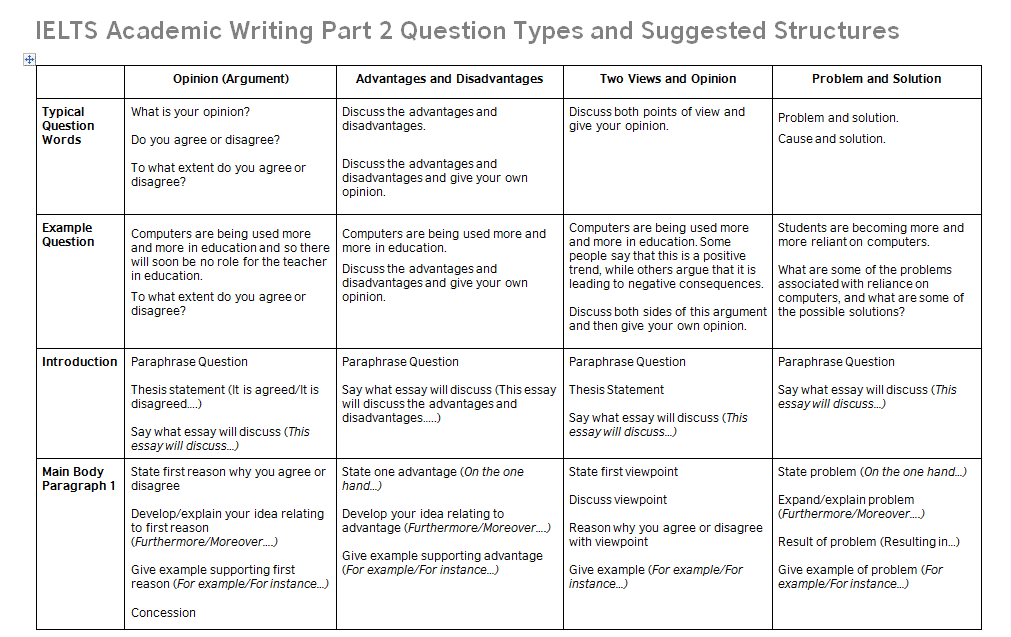
The following table provides a useful summary of the common question types and their typical phrasing. You can use it as a quick reference guide.
Conclusion
In this lesson, we have established the critical first step for success in Writing Task 2: accurately analyzing the prompt. By moving from a general guess to a systematic deconstruction, you can guarantee that your essay directly addresses every part of the question.
Key Takeaways:
- Task 2 is Worth Double: It accounts for two-thirds of your writing score, so mastering it is essential.
- There Are 5 Main Essay Types: Opinion, Discussion, Problem-Solution, Advantages & Disadvantages, and Two-Part Question. Identifying the correct type is your first job.
- Use the 3-Step Analysis Method: Always identify the Topic Words, Other Keywords, and Instruction Words to fully understand the prompt's requirements. This structured approach prevents misinterpretation and sets you up for a high score in Task Response.
In our next lesson, we will build directly on this foundation. Now that you can accurately identify what the question is asking, we will learn how to create a 5-minute essay plan with a clear thesis statement, topic sentences, and supporting points. This planning stage is the bridge between understanding the question and writing a coherent, high-scoring essay.