Welcome to your third lesson. In our previous session, we drilled down into the specifics of Java's type system, focusing on wrapper classes, the integer cache, and the strict rules for formatting numeric literals—all critical details for the OCP exam.
Building on that foundation, today's lesson addresses the logical next step: what happens when these different numeric types interact? We will explore the Java compiler's rules for automatically promoting numbers in expressions, the risks and requirements of explicit casting, and the often-counterintuitive results of numeric overflow. Mastering these concepts is essential, as they form the basis for a large category of OCP questions designed to test your understanding of the compiler's behavior.
By the end of this lesson, you will be able to accurately predict the results of expressions involving mixed numeric types, including those that require casting and those that might lead to overflow.
1. Numeric Promotion: The Unspoken Rules of Arithmetic
When you perform an arithmetic operation involving two numbers of different types, Java doesn't get confused. It follows a strict set of rules called numeric promotion (or widening conversion) to convert one or both operands to a common, larger type before performing the operation. This is done to prevent a loss of precision.
The rules are applied in order:
- If either operand is a
double, the other is promoted to adouble. - Otherwise, if either operand is a
float, the other is promoted to afloat. - Otherwise, if either operand is a
long, the other is promoted to along. - Otherwise, both operands are promoted to an
int.
This last rule is the source of many exam "gotchas". It means that any arithmetic operation on smaller integer types (byte, short, char) results in an int, even if the expression only contains those smaller types.
This flowchart provides a great visual of the widening conversion path.
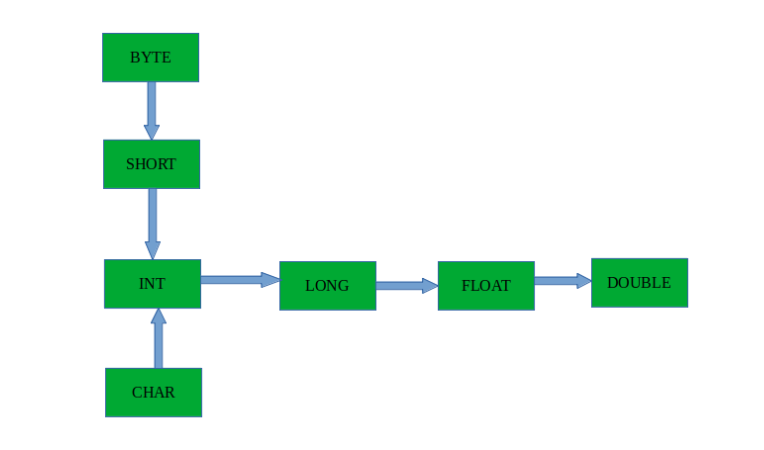
Let's watch a video that breaks down these rules from an OCP exam perspective.
Oracle Java Certification-OCA| Arithmetic Operators & Numeric Promotion in Java|#java #tutorial
This video from "Peace Of Code" is tailored for Oracle Java Certification and explains numeric promotion with the exam in mind.
Please watch the following segments: The introduction explains why numeric promotion is a key topic for the exam. The next segment clearly lays out the four rules of numeric promotion. Pay close attention to rule #3 about byte, short, and char. The examples section demonstrates these rules in action. The example involving short (short x2, short y2) is particularly important as it shows why the result of short / short is an int.
The key takeaway from the video is that an expression like short s1 = 10; short s2 = 20; results in a compile error if you try to do short s3 = s1 + s2;. The Java compiler promotes s1 and s2 to ints before the addition, making the result of the expression an int. You cannot assign an int to a short without an explicit cast.
short s1 = 10;
short s2 = 20;
// short s3 = s1 + s2; // COMPILE ERROR: Type mismatch: cannot convert from int to short
int i1 = s1 + s2;     // This works, as the result is an int.
2. Explicit Casting: Taking Control (and the Risks)
When automatic promotion isn't what you want, or when you need to assign a "larger" type to a "smaller" one, you must use an explicit cast. This is you telling the compiler, "I know what I'm doing; force this conversion."
The syntax is straightforward: you place the target data type in parentheses before the value you want to convert.
double d = 100.04;
// int i = d; // COMPILE ERROR: cannot convert from double to int
int i = (int) d; // Compiles. 'i' is now 100.
The following table visually summarizes when an assignment is directly possible versus when a cast is needed for integer types.

When you cast, you risk losing information.
- Casting from a floating-point type to an integer type truncates the decimal part. It does not round. So,
(int) 9.99becomes9. - Casting from a wider integer type to a narrower one can cause overflow.
Let's dig deeper into the mechanics of casting.
This video from Telusko provides clear analogies for widening and narrowing conversions and demonstrates the effect of casting.
Watch these parts: Implicit vs. Explicit: This part explains the core idea of widening (putting a small item in a big box) versus narrowing. Casting Syntax: Here, the video shows how to perform an explicit cast from int to byte. Floating-Point Casting: This segment demonstrates what happens when you cast a float to an int, highlighting the loss of the fractional part.
3. Overflow: When Numbers Wrap Around
Overflow is what happens when you cast a value to a smaller numeric type, and the value is too large to fit. Java doesn't throw an exception; instead, the value "wraps around." This is a critical concept for the OCP exam.
The behavior is defined by bitwise truncation. When you cast, say, an int to a byte, Java simply lops off the upper 24 bits of the int and keeps only the lowest 8 bits.
For practical purposes, when casting an integer value to a byte, the result is the original value modulo 256.
Type Conversion in Java with Examples - GeeksforGeeks
The GeeksForGeeks article provides a clear explanation and code example of this overflow behavior.
Navigate to the section titled "Narrowing or Explicit Conversion". Read through the first few examples, and then focus on the code block that starts with this example. The note right above it explains the modulo 256 behavior perfectly. The output shows that casting the int 257 to a byte results in 1 (since 257 % 256 = 1), and casting the double 323.142 first truncates it to 323, then the cast to byte results in 67 (since 323 % 256 = 67).
This wrap-around behavior applies to all narrowing integer conversions (long to int, int to short, etc.). You are not expected to calculate the exact wrapped value for large numbers in your head during the exam, but you are expected to know that overflow does not cause an error and that the value changes, often drastically (e.g., a large positive number can become a negative one).
4. The Compound Assignment Operator Trap
Here is one of the most classic OCP traps related to casting. Consider this code:
int i = 5;
long l = 10;
// i = i * l; // COMPILE ERROR: cannot convert from long to int
This fails to compile, as expected. i * l is promoted to a long, which cannot be assigned to the int variable i.
Now, what about this?
int i = 5;
long l = 10;
i *= l; // Compiles perfectly fine! 'i' will be 50.
Why does this work? Compound assignment operators (+=, -=, *=, /=, etc.) have a special property: they include an implicit cast to the type of the variable on the left-hand side.
So, i *= l; is secretly compiled as i = (int)(i * l);.
OCP 17 Exam - chapter 2 notes (numeric promotions, operators) | RG9.DEV
This blog post with OCP exam notes highlights this exact point succinctly.
Find the bullet point that begins with *=` automatically casts. This is a high-yield fact to memorize for the exam.
The exam will almost certainly present you with a situation where a compound assignment allows code to compile that would otherwise fail due to type promotion rules.
Conclusion
In this lesson, we dissected the automatic and manual ways Java handles numeric type conversions, a subject ripe for exam questions.
Here are the key takeaways:
- Numeric Promotion (Widening): Java automatically promotes operands in arithmetic expressions to avoid data loss, following the path
byte/short/char->int->long->float->double. - Casting (Narrowing): You must explicitly cast to convert a value to a smaller data type. This risks losing data either through decimal truncation (for floats/doubles) or overflow.
- Overflow: When casting to a smaller integer type, values that are too large "wrap around." This happens via bit truncation and does not throw an exception.
- Compound Assignment Operators: Operators like
+=and*=contain a hidden, implicit cast, allowing them to compile in situations where a simple assignment would fail.
Your ability to trace these promotions and casts is fundamental. In our next lesson, we will explore var for local variable type inference. Your understanding of how Java determines the final type of an expression will be the direct prerequisite for predicting the type that var infers.