Hello! Welcome to the first lesson of your course preparing you for the OCP Java SE 17 Developer certification. Your extensive experience with Java 17 and 21 provides a fantastic foundation. This course is designed not to teach you Java from scratch, but to channel your practical knowledge into the specific, deep, and sometimes tricky format required to excel in both the certification exam and technical interviews.
Today, we will begin by deconstructing the exam itself. The goal is to give you a clear, strategic overview of what you're up against. By the end of this lesson, you will be able to describe the structure, scoring, topic weighting, and question style of the OCP Java SE 17 Developer (1Z0-829) exam. Understanding the battlefield is the first step to victory.
1. The Exam Blueprint: Structure, Scoring, and Time
Let's start with the fundamental numbers that define the exam. These details come from both official sources and the experiences of recent test-takers. A great source for this is first-hand accounts from developers who have recently passed the exam.
Sharing my experience of passing Java 17 (1Z0-829) exam (OCPJP forum at Coderanch)
Please read the first half of this forum post on Coderanch, written by a developer who recently took the exam. It provides a direct look at the exam's structure and the online proctoring experience.
Focus on the numbered points in the post. Specifically, read from the beginning of the post down to the section detailing the exam parameters. Also, note the author's point about the absence of a notepad.
As you've just read, the key parameters for the OCP Java SE 17 Developer exam (1Z0-829) are:
- Number of Questions: 50
- Duration: 90 minutes
- Passing Score: 68% (This means you need to answer at least 34 questions correctly)
The most critical implication here is time management. With 90 minutes for 50 questions, you have an average of 1 minute and 48 seconds (108 seconds) per question. This is not a lot of time, especially for complex code analysis. Speed and accuracy are paramount.
A crucial point from the reading is the lack of a virtual notepad. This is a significant constraint. You cannot jot down variable values or trace loop iterations externally. All code analysis must happen in your head. This dramatically increases the cognitive load and means that a deep, intuitive understanding of Java's rules is more effective than trying to mechanically trace code on the spot. Throughout this course, we will focus on building that intuitive understanding.
2. Topic Weighting: Where to Focus Your Efforts
Not all topics are created equal on the exam. While you, as an experienced developer, are familiar with the breadth of the Java ecosystem, certification success requires a strategic allocation of your study time. Oracle does not provide an official breakdown, but respected training providers like Enthuware compile data from test-takers to create a reliable estimate.
OCP Java 17 Certification 1Z0-829 Question Distribution
This article from Enthuware provides an estimated distribution of questions across the various exam topics. It's an invaluable guide for prioritizing your studies.
Read the introduction to understand how this data was compiled, from the start of the article. Then, carefully examine the table of topics and their expected question counts.
Let's summarize and analyze the key takeaways from that distribution table:
| Exam Topic | Expected Number of Questions |
|---|---|
| High Weight (Focus Areas) | |
| Java OOA (Overloading, Overriding, Interfaces) | 4 – 6 |
| Streams | 4 – 6 |
| Concurrency | 3 – 5 |
| Java I/O | 3 – 5 |
| Modules | 3 – 5 |
| Medium Weight (Core Knowledge) | |
| Arrays and Collections | 2 – 4 |
| Exception Handling | 2 – 4 |
| Java OOA (Core Object-Oriented Analysis) | 2 – 4 |
| String/Text Manipulation | 2 – 4 |
| Lower Weight (Don't Ignore!) | |
| Date/Time API | 1 – 3 |
| Sealed Classes | 1 – 3 |
| JDBC | 1 – 3 |
| Localization | 1 – 3 |
| Arithmetic/Boolean Expressions | 1 – 2 |
| Records | 1 – 2 |
| Lambda | 1 – 2 |
| All others | 0 – 2 |
This data tells a clear story. Mastery of core object-oriented principles, the Stream API, and Concurrency is non-negotiable. Given your backend experience, you've likely worked extensively with these. Our goal will be to sharpen that experience, focusing on the specific rules, edge cases, and "gotchas" that the exam loves to test. Topics like Modules and the intricacies of the I/O and NIO.2 APIs are also heavily weighted and often less frequently mastered in day-to-day work, making them prime candidates for focused study.
3. Question Style: It's All in the Details
OCP exam questions are specifically engineered to be tricky. They test your knowledge of the Java Language Specification (JLS), not just your ability to write functional code. Expect questions that hinge on subtle distinctions, operator precedence, implicit language behaviors, and edge cases.
Let's look at two typical examples of question formats.
This format—a small code snippet with the question "What will be the output?"—is extremely common. It requires you to act as the compiler and the JVM, meticulously executing the code in your head.
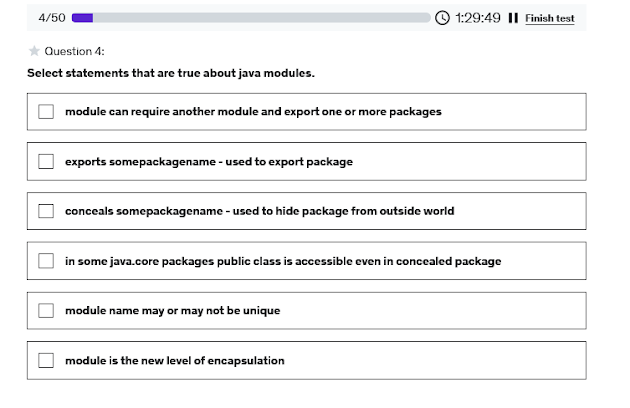
This "select all that apply" format can be challenging. Fortunately, as confirmed by test-takers in the Coderanch forum post you reviewed, the exam will tell you how many correct answers to select (e.g., "Select 2 correct answers").
Sharing my experience of passing Java 17 (1Z0-829) exam (OCPJP forum at Coderanch)
Let's quickly revisit the Coderanch forum post to confirm one important detail about multiple-choice questions.
Scroll down into the comments section of the post to find the exchange about the number of correct answers. Look for the question by user Peter Ho and the final confirming answer from another user, which states that the exam specifies the number of choices.
This is a small but vital piece of information that helps manage the exam's difficulty.
A Note on Java Versions
The exam you are preparing for is for Java 17, an LTS (Long-Term Support) release. You mentioned you're already working with Java 21, which is excellent. However, for the exam, you must adopt a "Java 17 mindset." This means:
- Any question that can be solved using a feature introduced after Java 17 (like String Templates or Record Patterns from Java 21) is either a distractor or the feature is not the intended solution.
- Your deep knowledge of the language will be an asset, but you must be careful to answer based on the features and API available in Java SE 17.
This focus on LTS versions is standard practice for Oracle certifications.
Preparing for the Java 21 Certification (or Learning New Features)
This short clip from a presentation by Jeanne Boyarsky (a co-author of the leading OCP study guides) provides some context on why certifications are tied to LTS releases.
Watch from this brief segment to understand the lifecycle of Java certifications in relation to the main Java release schedule.
Conclusion
Let's consolidate what we've learned. You are facing a challenging but predictable exam. Success hinges on a strategy built around these key facts:
- Structure: The exam is 50 questions in 90 minutes, with a 68% passing score. Time pressure is a major factor.
- Mental Gymnastics: The absence of a notepad means you must be ableto trace code and logic mentally.
- Topic Focus: Your preparation should prioritize heavily-weighted topics like advanced OOA (overriding/interfaces), Streams, Concurrency, Modules, and I/O.
- Question Style: Expect tricky code snippets and "select N" conceptual questions that test deep, precise knowledge of Java 17's features and rules.
You have the experience. This course will provide the structure and focus to translate that experience into certification.
In our next lesson, we will dive into our first technical topic: "Distinguish between primitive types, their wrapper classes, and identify illegal numeric literal patterns (binary, hex, underscores)." This is a foundational area where the exam loves to ask tricky questions about seemingly simple concepts, making it the perfect place to begin our journey.