Hello! Welcome back to your wedding dress project.
In our last lesson, you mastered the critical process of preparing and cutting your delicate silk organza and chiffon. That was a game of precision and control, setting the stage for successful construction. Now, with your fabric pieces perfectly cut, we need to prepare your sewing machine for the first stitch.
This lesson focuses on a seemingly small but absolutely crucial detail: selecting the correct microtex needle size and thread weight for delicate silks. Just as in product design where specifying the right components is essential for the final product's function and finish, choosing the right needle and thread is non-negotiable for achieving a professional, damage-free result on your gown. Getting this right prevents pulled threads, puckering, and visible holes—the tell-tale signs of incorrect tool selection.
1. The Point of Precision: Choosing the Right Needle
Sewing on tightly-woven, delicate fabrics like silk organza and chiffon with a standard needle is a recipe for disaster. The slightly rounded tip of a universal needle can snag and pull the fine threads of the fabric, or create holes that don't "heal" back into the weave.
The solution is a specialized needle called a Microtex needle.
Schmetz Microtex Needles: Ultimate Guide
To understand why this needle is the industry standard for fine fabrics, let's look at its design. The "Schmetz Microtex Needles: Ultimate Guide" provides an excellent overview.
Please read the first two sections, '1. Introduction to Schmetz Microtex Needles' and '2. Technical Specifications and Key Features'. Pay close attention to the description of its 'very slim acute point' and the table comparing it to a Universal needle.
As you read, the key takeaway is that the Microtex needle's sharp, slender point is engineered to pierce the fabric cleanly, creating a perfect stitch without distorting the surrounding weave.
Selecting the Correct Needle Size
Now that you know the type of needle, you need to select the right size. Needle sizes are typically given with two numbers, such as 70/10. The first number (70) is the European metric size (NM), which is the diameter of the needle blade in hundredths of a millimeter (e.g., NM 70 = 0.70 mm). The second number (10) is the American size. For both systems, the smaller the number, the finer the needle.
For your silk organza and chiffon, you need a very fine needle.
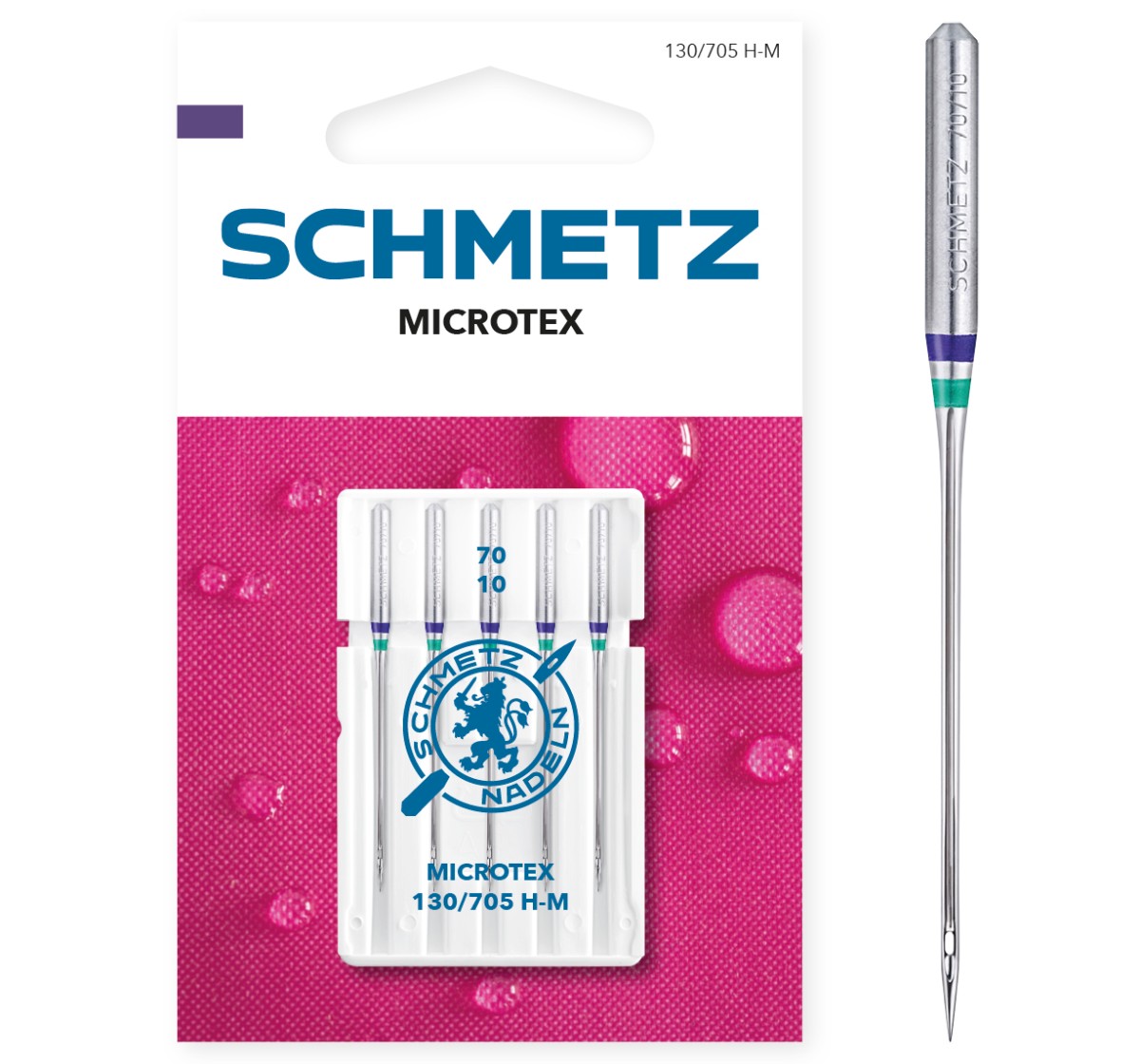
The chart below provides a fantastic visual guide for matching fabric weight to needle size. Your silks fall squarely into the 'Very Fine' category.

Based on this, your ideal choices are:
- Microtex Needle, size 60/8 or 70/10
For even more specific recommendations, the Schmetz company provides a very useful guide.
The official "Needle ABC" guide from Schmetz is an authoritative resource. It not only provides specific recommendations for your fabrics but also explains an alternative needle type you might encounter.
Please review the following sections in this PDF: Find the description for the Microtex needle (page 19). Read the description for the Black Super Fine needle (page 20), which is another excellent choice for sheers. In the 'ABC of fabrics' section (starting on page 46), find the entries for Chiffon, Organza, and Silk to see the specific size recommendations (typically 60 or 70).
One crucial rule: Always start a significant project with a brand new needle. Needles dull over time, and a dull needle will cause the very problems you're trying to avoid.
2. The Invisible Partner: Selecting the Right Thread
Just as a bulky needle can damage sheer fabric, a standard-weight thread can overwhelm it. All-purpose thread is often too thick and heavy, resulting in seams that are visible, stiff, and prone to puckering.
For delicate silks, you need a thread that is both strong and incredibly fine.
My TOP SECRET TIPS for sewing with "Silky Fabrics". You can do it! Chiffon here we come!
Let's watch two short clips that explain the ideal thread characteristics and give specific recommendations.
First, watch the segment from 15:44 to 16:43 in the 'My TOP SECRET TIPS' video from Lifting Pins and Needles. The presenter explains why she prefers a fine polyester thread over cotton for its strength and fineness.
How to Sew Lightweight or Sheer Fabrics (Organza, Tulle, Chiffon)
Now, this clip from WonderFil Specialty Threads introduces the concept of thread 'weight' and recommends specific types for sheer fabrics.
Watch from 01:06 to 01:51. Note the recommendations for an 80-weight (80wt) cottonized polyester for construction and an even finer 100-weight (100wt) for tasks like rolled hems.
The key concept here is thread weight (wt). Unlike needles, with thread, the higher the weight number, the finer the thread. An 80wt or 100wt thread will virtually disappear into the fabric, creating delicate, flat seams.
3. The Perfect Pair: Testing Your Combination
You have your needle and thread selected. Now, how do you ensure they are a good match?
- The Eye Test: The thread should pass through the eye of the needle without friction.
- The Slide Test: This simple, brilliant test from the Schmetz ABC guide confirms a perfect match.
Let's go back to the Schmetz "Needle ABC" guide for this practical test.
Please find the section titled 'Does the selected needle size match the thread?' on page 10. Read the description of the 'slide test' you can perform.
This test ensures the thread has enough room in the needle's groove and eye, which prevents shredding and tension issues. The video from WonderFil also provides a perfect pairing recommendation.
How to Sew Lightweight or Sheer Fabrics (Organza, Tulle, Chiffon)
This final short clip confirms the ideal pairing of the tools we've selected.
Watch from 01:51 to 02:13. It explicitly recommends pairing a fine thread with a 70/10 or 80/12 microtex needle—confirming our choices.
4. Prototype Your Seam: The Final Check
You would never launch a product without user testing. Similarly, you should never sew your final garment without first testing your setup on a scrap of the exact same fabric. This is your prototyping phase, where you validate your material and tool choices.
My TOP SECRET TIPS for sewing with "Silky Fabrics". You can do it! Chiffon here we come!
Let's watch a demonstration of this crucial final step from Lifting Pins and Needles.
Watch the segment from 16:43 to 18:26. Observe how the presenter sews on a scrap of chiffon to check the stitch quality and tension. This is exactly what you should do before starting on your skirt panels. You are checking for any puckering, pulling, or skipped stitches.
Conclusion
You have now completed the meticulous "tooling" phase for sewing your sheer skirt layers. By specifying the exact needle and thread, you have set yourself up for beautiful, professional-quality seams that honor the delicate nature of your chosen fabrics.
Key Takeaways:
- Needle Type: Use a Microtex or Black Super Fine needle.
- Needle Size: Select a fine size, either 60/8 or 70/10. Always start a project with a new needle.
- Thread Type: Use a fine, strong polyester thread.
- Thread Weight: Choose an 80wt thread for construction seams.
- Test Everything: Always sew a test seam on a scrap of your fashion fabric to ensure the needle, thread, and machine tension are working in harmony before you touch your final garment pieces.
In our next lesson, we will put these tools to work. We will cover the specific techniques for sewing seams on sheer fabric without puckering and then focus on executing a perfect French seam, the ideal seam finish for your sheer skirt layers.