Introduction
Welcome to your first lesson in this hands-on data science course! Our goal throughout this journey is to build a complete data science project from the ground up, focusing on the practical skills used in professional settings. This first module, "Project Foundation and Data Acquisition," lays the critical groundwork for everything that follows.
Today, we'll tackle the most fundamental step in any data science project: translating a real-world business question into a concrete data science problem statement. Before writing a single line of code, a data scientist must first deeply understand the problem they are trying to solve. This lesson will equip you with a structured approach to move from a vague, high-level business goal to a specific, measurable, and solvable problem that can be addressed with data.
From Vague Idea to Specific Questions
In a business environment, data science projects rarely begin with a perfectly curated dataset and a clear objective. Instead, they typically start with a broad, often ambiguous, business need. A stakeholder might say, "We need to increase our revenue," or "How can we cut our operational costs?" These are business goals, not data science problems. Your first job as a data scientist is to act as a translator.
This translation process involves breaking down the high-level goal into smaller, more specific questions that can actually be answered with data. This requires asking clarifying questions, understanding the business context, and collaborating with stakeholders to uncover the real pain points and opportunities.
Let's explore this with a case study. The article "Business Problem Solving with Data Science" introduces a fictional company, 'YumEats!', facing a common challenge: expanding operations while trying to increase revenue and cut costs.
Business Problem Solving with Data Science - Medium
This article provides an excellent walkthrough of how a vague business mandate is progressively refined into actionable data science problems. It emphasizes the crucial role of stakeholder discussions and asking the right questions.
As you read, please focus on the following parts: Start by reading the initial problem description for the 'YumEats!' company. Notice how broad and multi-faceted it is. Next, review the section that explains why the journey from a business problem to a data science problem is not a linear path. Pay close attention to the discussion on working with stakeholders and how their high-level questions (e.g., "How to increase revenue?") need to be translated. Finally, read the sections on framing the problem and the guidelines for asking good follow-up questions. See how the broad goals are broken down into a list of potential data science sub-problems.
As you can see, a single business objective can spawn numerous potential data science projects, such as predicting user churn, recommending restaurants, or identifying fraudulent orders. The key is to deconstruct the big problem into smaller, manageable pieces.
A Live Brainstorming Example
To see this process in action, let's watch a data scientist, Ken Jee, go through this exact exercise. He starts with a few broad areas of interest and methodically narrows them down to a specific, well-defined project idea. This is a perfect illustration of moving from a general interest to a concrete plan.
Data Science Project from Scratch - Part 1 (Project Planning)
This video, "Data Science Project from Scratch - Part 1," gives you a real-time look at the project planning and idea generation phase.
Please watch two key segments: First, watch the part where he discusses the two main approaches to finding a project idea, data-first vs. problem-first. For this course, we will be focusing on the problem-first approach, as it more closely mirrors how projects are initiated in a business context. Next, and most importantly, watch the whiteboard brainstorming session. Observe how he starts with high-level topics ("sports," "data science careers") and progressively refines his thinking to land on a specific and actionable problem: predicting data science salaries based on job title, company information, and geography.
Crafting a Concrete Problem Statement
Once you've narrowed your focus to a specific question, the next step is to formalize it into a problem statement. A well-crafted problem statement acts as your North Star for the entire project, ensuring that your work remains focused and aligned with the original goal.
A quantitative problem statement, like the one we aim to create, identifies a specific, measurable issue and defines the key variables and objectives.
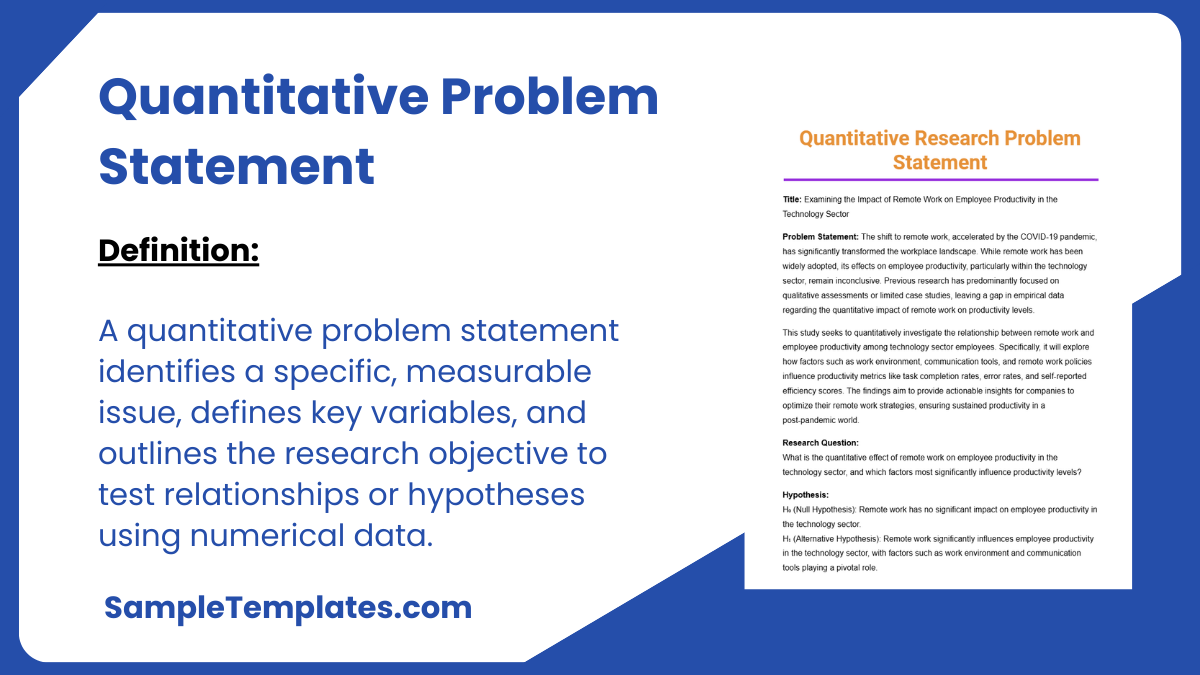
The most effective way to ensure your problem statement is concrete and actionable is to use the SMART framework. This acronym helps you check that your statement is:
- Specific: Clearly and narrowly defined.
- Measurable: Quantifiable, so you know what success looks like.
- Action-Oriented: Framed in a way that suggests a path to a solution.
- Relevant: Aligned with broader business goals.
- Time-Bound: Having a defined timeframe (where applicable).
The following reading provides a great breakdown of the SMART framework and gives several practical examples of transforming vague goals into sharp, SMART problem statements.
Business Problem framing in the age of data analytics
This article provides a structured guide to creating effective problem statements using the SMART criteria.
Please focus on these sections: Read the section "Crafting Smart Problem Statements" to understand the definition and importance of each component of the SMART framework. Next, review the numerous examples provided for different industries (Retail, Healthcare, etc.). Pay attention to how an initial vague problem is assessed against SMART criteria and then reframed into a much more precise statement. Finally, read the first two questions in the FAQ section for a concise summary of what it means to frame a business problem and how to do it using the SMART approach.
To give one last, very direct example, let's look at how an analyst might approach measuring the success of a new product feature.
Learn how to SOLVE a data analytics case study problem
In this video, Jay Feng demonstrates how to tackle a data analytics case study by immediately framing the problem in a measurable way.
Watch the segment from problem statement to proposed metric. Notice how the business question—"how would you measure the success of this new feature?"—is immediately translated into a tangible, measurable comparison: creating a table that shows the "purchase completion rate" for users who used the audio chat versus those who did not. This is a perfect example of making a problem Measurable.
Conclusion
In this lesson, we established the critical first step of any practical data science project: problem framing. You learned that this process is about translating broad, ambiguous business goals into focused, actionable data science problems.
Here are the key takeaways:
- Start with the "Why": Real-world projects begin with a business need, not a dataset. Your first task is to understand this need by asking questions and engaging with the context.
- Deconstruct the Problem: Break down large, vague goals into smaller, more specific sub-problems that can be tackled with data analysis.
- Be SMART: Use the SMART framework (Specific, Measurable, Action-Oriented, Relevant, Time-Bound) to craft a precise and concrete problem statement. This statement will guide your entire project.
By mastering this initial step, you ensure that your technical work is directly aimed at solving a meaningful problem and delivering value.
In our next lesson, we will move from planning to execution. With a clear problem in mind, the next logical step is to acquire the data needed to solve it. We'll dive into Python and the pandas library to learn how to load datasets from CSV files and perform an initial inspection.