Introduction
In our last module, we explored the physics of sound, culminating in an analysis of how the harmonic content of basic synthesizer waveforms defines their timbre. We established that the fundamental frequency of a sound determines its pitch. Now, we will begin to bridge the gap between the continuous world of frequency and the discrete, structured world of music.
This lesson marks our entry into the second module, "Pitch, Intervals, and the Piano Roll." We will tackle this module's first learning outcome: to identify notes on a piano roll and relate them to their pitch and frequency. You'll learn the standard conventions for naming and organizing pitches and see how they are visually represented in the digital audio workstation (DAW), the primary environment for electronic music production. This will provide the essential vocabulary and visual framework for all subsequent topics on melody and harmony.
From Frequency to Notes: The Chromatic Scale
In Western music, we don't use the infinite continuum of possible frequencies. Instead, we work with a discrete set of standardized pitches called notes. The foundational organizing principle for these notes is the octave. As we covered previously, an octave represents a doubling of frequency (a 2:1 ratio), which our ears perceive as the "same" note at a higher or lower pitch.
Within each octave, the space is divided into 12 equally spaced steps. The distance between two adjacent steps is called a semitone or a half-step. This 12-note division is known as the chromatic scale.
To understand this system, let's watch a short video that introduces the standard naming conventions and structure.
What are the frequencies of musical notes? Musical tuning systems - Ep. 03
The video "What are the frequencies of musical notes?" by AwesomeAcoustics provides a clear and concise introduction to the modern system of note naming.
Please watch the first two sections. First, watch the segment from the introduction. This covers the layout of the piano keyboard, the seven primary note names (A, B, C, D, E, F, G), and the concept of sharps (#) and flats (b) for the black keys. Pay attention to the idea of enharmonic equivalence, where a single black key can have two names (e.g., C# is the same note as Db). Next, watch from the chromatic scale. This part formally defines the semitone, introduces the chromatic scale (all 12 notes in sequence), and explains how octaves are numbered to give each note a unique identifier (e.g., A4, C5).
As the video explains, the piano keyboard provides a physical and visual layout of the chromatic scale. The pattern of white and black keys repeats for each octave.
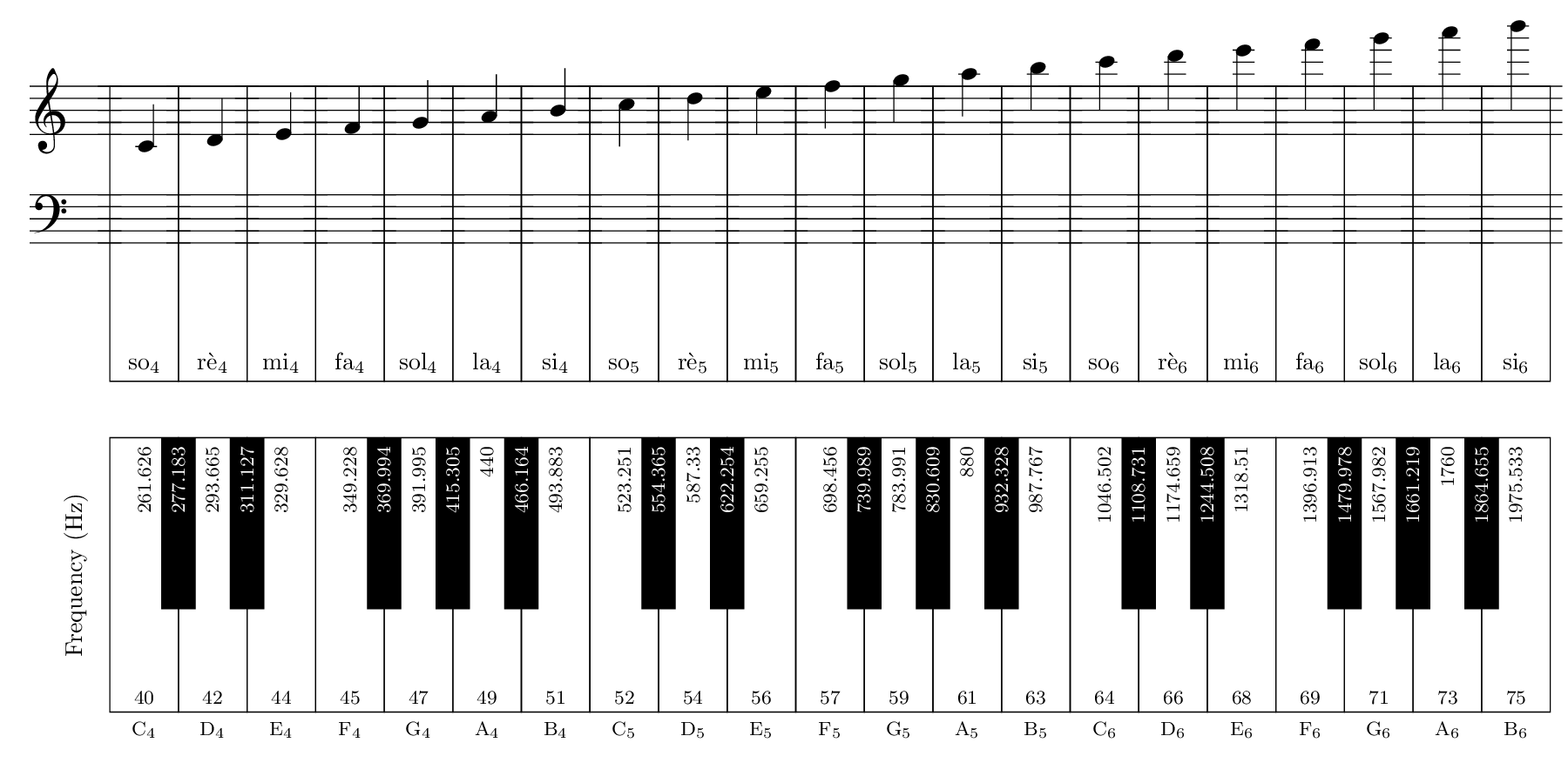
The Piano Roll: A Virtual Representation
In electronic music production, you will rarely interact with a physical piano or traditional sheet music. Your primary interface for composing melodies and harmonies is the piano roll. A piano roll is a graphical representation of musical notes on a two-dimensional grid.
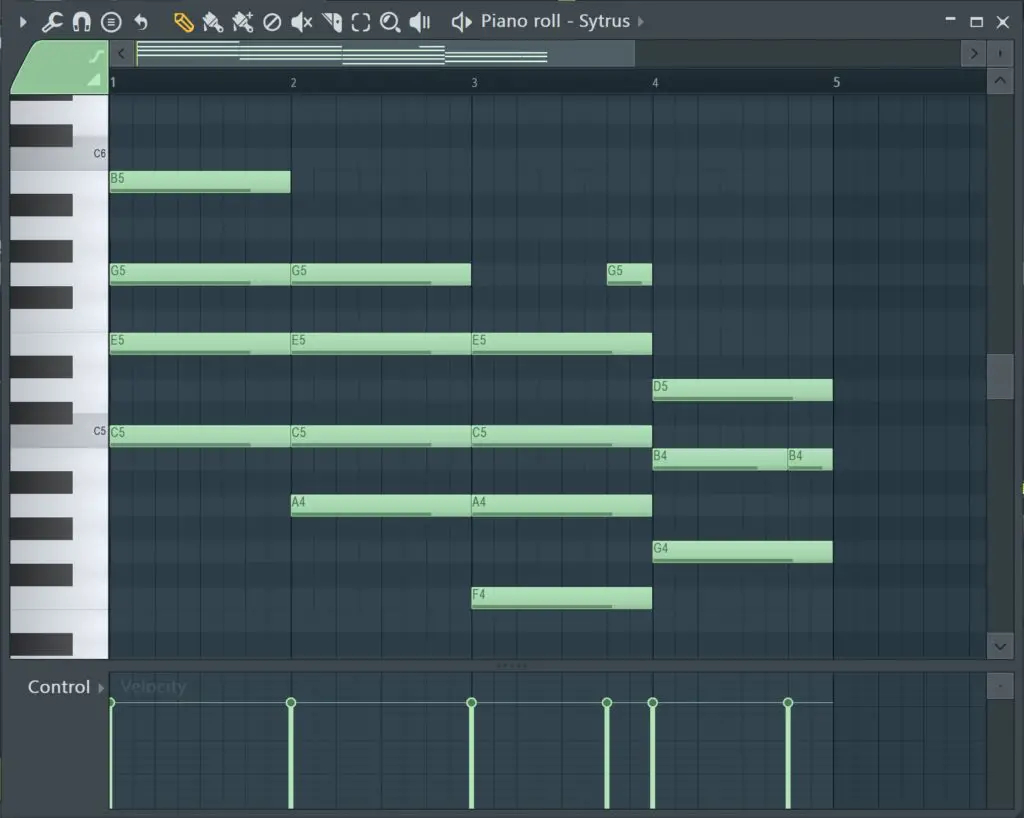
As you can see in the image:
- The Vertical Axis is Pitch: The piano keyboard graphic on the left serves as a guide. Each horizontal row corresponds to a single note of the chromatic scale. Moving up the grid increases the pitch.
- The Horizontal Axis is Time: Time moves from left to right, typically measured in bars and beats.
- Notes: The colored blocks (in this case, green) represent the musical notes themselves. Their vertical position determines their pitch, their horizontal position determines when they are played, and their length determines their duration.
The piano roll is your canvas. Being able to look at this grid and instantly recognize the notes is the foundational skill we are building in this lesson. For example, you can see a long note on the C5 row, followed by a shorter one on the G5 row, and so on.
The Mathematics of Pitch: MIDI and Frequency
Now, let's formalize the connection between a note's position on the piano roll and its physical frequency. This will directly leverage the concepts from our first module.
As you know from your physics background and our previous discussions, human perception of pitch is logarithmic. To create the perception of equally spaced pitch steps (semitones), the underlying frequencies must increase exponentially. This is the principle behind 12-Tone Equal Temperament (12-TET), where the frequency ratio between any two adjacent semitones is constant: the twelfth root of two ().
This reading from an article framed around Richard Feynman's work on physics and music provides an excellent summary.
Music and Physics - Reading Feynman
This article eloquently connects the physical and mathematical principles of sound to their musical application.
Please read the section Tones, noise and notes. Focus on the explanation of the logarithmic frequency scale, how frequencies double per octave, and the derivation of the frequency ratio between notes as a power of 2^{1/12}.
To work with notes in a digital environment, we use a universal standard called MIDI (Musical Instrument Digital Interface). In the MIDI standard, every possible note is assigned a unique integer called a MIDI note number, ranging from 0 to 127.
- Middle C (C4) is assigned MIDI note number 60.
- Moving up or down by one semitone corresponds to adding or subtracting 1 from the MIDI number. So, C#4 is 61, D4 is 62, and B3 is 59.
- The note A4, the standard tuning reference, is MIDI note number 69.
This standardization allows us to define a precise mathematical formula to find the frequency of any note, given its MIDI number . The formula uses A4 (MIDI note 69) with its standard frequency of 440 Hz as the reference point:
Let's break this down:
- calculates the number of semitones between our note and the reference note A4. The result is positive if the note is higher than A4 and negative if it's lower.
- converts this semitone distance into an octave distance.
- calculates the frequency multiplier relative to the reference. Since each octave is a factor of 2, this exponential term scales the frequency correctly.
- scales the result by the reference frequency of A4.
This elegant formula underpins all modern digital music systems. For a detailed reference, the following webpage is invaluable.
MIDI note numbers and center frequencies - Inspired Acoustics
This page from Inspired Acoustics provides the definitive formula and a comprehensive lookup table.
First, read the brief text to see the formula presented, confirming what we've just discussed. Then, take a look at the extensive table. You don't need to memorize it, but familiarize yourself with its structure. See if you can find C4 (Middle C) and confirm its MIDI number is 60 and its frequency is approximately 261.63 Hz. This table will be a useful resource throughout your music production journey.
Conclusion
In this lesson, we have established the crucial link between the abstract world of frequency and the practical conventions of music. We have moved from a continuous spectrum to a discrete set of notes, represented visually by the piano roll and numerically by MIDI numbers.
Here are the key takeaways:
- The chromatic scale consists of 12 notes per octave, with each step called a semitone.
- The piano roll is the primary interface for composing in a DAW, with pitch on the vertical axis and time on the horizontal.
- MIDI note numbers provide a standard numerical label for every note, with C4 = 60 and A4 = 69.
- The frequency of any note can be calculated using the formula , which mathematically encodes the principles of 12-Tone Equal Temperament.
You now possess the foundational knowledge to read and interpret the language of pitch in a digital environment.
In our next lesson, we will build directly on this foundation. Now that we can identify individual notes, we will begin to explore the relationships between them. We will learn to define, name, and recognize the intervals that are the fundamental building blocks of all melodies and chords.