Introduction
In our previous lessons, we built a comprehensive understanding of pitch, from its physical basis in frequency to the mathematical compromises of tuning systems, which we quantified using cents. We concluded by noting that pitch is just one dimension of sound. The other, equally crucial dimension is timbre—the character or quality that distinguishes a violin from a guitar, even when they play the same note at the same volume.
This lesson serves as the capstone for our first module, bridging the physics of acoustics directly to the practice of electronic music synthesis. We will fulfill this module's final learning outcome: to analyze the harmonic content of basic synthesizer waveforms (sine, square, saw, triangle) as practical examples of the harmonic series. We'll revisit the harmonic series, not as an abstract concept, but as the concrete set of ingredients used to build the foundational sounds of synthesis. By the end of this lesson, you will understand why these simple geometric shapes produce such distinct timbres and how this knowledge forms the bedrock of sound design.
From Complex Waves to Simple Sines: Fourier's Insight
The key to understanding timbre lies in a powerful mathematical principle discovered by Joseph Fourier. As a physicist, you are likely familiar with Fourier analysis. The core idea, as it applies to sound, is that any periodic waveform can be expressed as a sum of sine waves at various frequencies, amplitudes, and phases. These component sine waves are the harmonics of the sound.
The lowest frequency in this sum is the fundamental frequency, which determines the pitch we hear. The other sine waves, whose frequencies are integer multiples of the fundamental, are the overtones or harmonics. The specific combination of these harmonics—which ones are present, and their relative amplitudes—is what defines a sound's unique timbre.
The process of building a complex wave from simple sine waves is called Fourier synthesis, or more commonly in the music world, additive synthesis. This is not just a theoretical model; it's a practical method for creating sound.
The video below gives an excellent overview of this concept, introducing the idea that different combinations of harmonics produce different timbres.
Oscillators, harmonics, and a way to think of synthesized sound
The video "Oscillators, harmonics, and a way to think of synthesized sound" by Sound + Voltage provides a clear introduction to Fourier's discovery and its application in synthesis.
Please watch the section from introducing Fourier. The presenter connects Fourier's work on heat propagation to the analysis of sound waves and defines additive synthesis.
The Basic Synthesizer Waveforms
In subtractive synthesis, the most common type of synthesis, a sound is created by starting with a harmonically rich waveform from an oscillator and then using a filter to remove or attenuate certain harmonics. The choice of the initial waveform is therefore the most fundamental decision in sound design. Let's analyze the four standard waveforms.
1. The Sine Wave
The sine wave is the simplest possible periodic waveform. It consists of only the fundamental frequency and has no additional harmonics or overtones. Its sound is often described as pure, round, or plain. Because all other periodic waveforms are built from sine waves, you can think of it as the foundational element of sound.
2. The Sawtooth Wave
The sawtooth (or saw) wave is one of the most useful and common waveforms in synthesis. It has a sharp, bright, and "buzzy" character. Its richness comes from its harmonic content: a sawtooth wave contains all integer harmonics (1, 2, 3, 4, 5, ...). The amplitude of each successive harmonic is inversely proportional to its harmonic number.
If is the amplitude of the fundamental (N=1), the amplitude of the Nth harmonic () is given by:
So, the second harmonic has half the amplitude of the fundamental, the third has one-third, and so on. This slow decay is what gives the sawtooth its dense, full-bodied sound.

3. The Square Wave
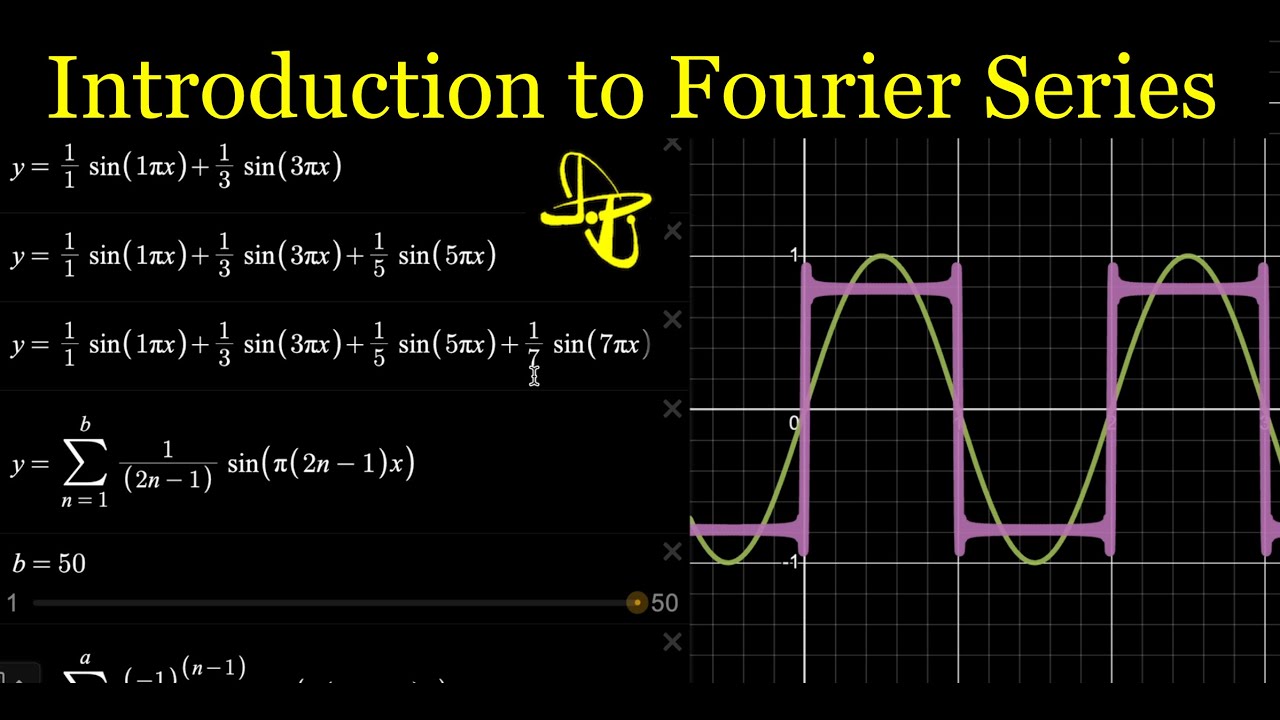
The square wave has a distinct sound that is often described as "hollow," "nasal," or "reedy." It is also very rich in harmonics, but with a crucial difference from the sawtooth: a square wave contains only odd-numbered harmonics (1, 3, 5, 7, ...).
Like the sawtooth, the amplitude of its harmonics is inversely proportional to the harmonic number:
The absence of the even harmonics (the octave, the octave-plus-a-fifth, etc.) is what creates its unique hollow timbre.
4. The Triangle Wave
The triangle wave sounds much softer and more mellow than the square or saw waves, getting much closer to a pure sine wave. This is because its harmonic content is more sparse. Like the square wave, it contains only odd-numbered harmonics (1, 3, 5, 7, ...).
However, the amplitudes of these harmonics decay much more rapidly, being inversely proportional to the square of the harmonic number:
This means the 3rd harmonic has only 1/9th the amplitude of the fundamental, and the 5th has 1/25th. The higher harmonics are so quiet that they contribute very little to the overall timbre, leaving a sound that is dominated by the fundamental.
Seeing and Hearing the Harmonics
The best way to understand these differences is to see and hear them directly. The following videos provide excellent demonstrations using spectrum analyzers and audio examples.
The Math Behind Music and Sound Synthesis
The video "The Math Behind Music and Sound Synthesis" by Gonkee provides a fantastic summary of the four basic waveforms, complete with simplified mathematical formulas, auditory examples, and animated visualizations of their construction.
Focus on the segment from the waveform analysis. It systematically breaks down the harmonic content of the square, triangle, and saw waves, explaining how their unique "recipes" result in their distinct timbres.
To see this from a more hands-on, hardware-focused perspective, the next resource is perfect. It uses a modular synthesizer and a spectrum analyzer to show the harmonic content in real-time.
Oscillators, harmonics, and a way to think of synthesized sound
Returning to the "Oscillators, harmonics, and a way to think of synthesized sound" video, we can now appreciate the core analysis.
First, watch the demonstration of how the waveforms sound different despite having the same pitch from the initial comparison. Then, observe the spectrum analysis from sine vs. square, where you can see the single peak of the sine wave versus the multiple peaks of the square wave. Finally, watch the detailed breakdown from the harmonic recipes, which clearly explains the 1/N and 1/N² amplitude rules for each waveform.
A Computational Perspective
Given your background in physics and programming, you might appreciate seeing how these concepts are implemented computationally. The following article is written as a Jupyter Notebook and uses Python libraries like numpy and scipy to generate these waveforms and analyze them using a Fast Fourier Transform (FFT).
Music Synthesis Wave Analysis With Python | Electronic Ruminations
This article from Electronic Ruminations provides a practical, code-based exploration of the topic. It's a great way to see the theory put into practice using tools you are already familiar with.
Start by reading the introduction "Signals and Harmonics". Then, you can skim the code blocks in the sections "Define The Signals" and "Audio and Plot" to see how the waves are generated. The most important parts are the analyses for each wave, where the plots clearly show the waveform and its FFT spectrum: The sine wave section shows a single peak. The square wave section shows only odd harmonics. The sawtooth wave section shows all harmonics. The triangle wave section shows the faster decay of odd harmonics. Finally, read the "Summing Up" section.
Conclusion
This lesson has connected the abstract concept of the harmonic series to the concrete, practical reality of sound synthesis. The timbre of a sound is not a mysterious quality but a direct consequence of its harmonic structure, which can be precisely defined and analyzed.
Our key takeaways are:
- Fourier's Theorem: Any periodic sound can be deconstructed into a series of sine waves (harmonics). The fundamental determines pitch, while the harmonics determine timbre.
- Harmonic Recipes: The four basic synthesizer waveforms have unique and predictable harmonic content:
- Sine: Fundamental only.
- Sawtooth: All harmonics, with amplitude . This makes it the most harmonically rich.
- Square: Odd harmonics only, with amplitude .
- Triangle: Odd harmonics only, with amplitude . This makes it the most mellow of the complex waves.
- The Basis of Synthesis: This understanding is the foundation of sound design. In subtractive synthesis, we start with a rich waveform (saw/square) and sculpt it with filters. In additive synthesis, we build sounds from the ground up using sine waves.
With this, we conclude our first module on the fundamental physics of sound. We have journeyed from frequency and the harmonic series through the complexities of tuning systems, and have now arrived at the raw materials of electronic music.
In the next module, "Pitch, Intervals, and the Piano Roll," we will shift our perspective. We will move from the continuous world of frequencies and cents to the discrete world of notes and scales. You will learn the conventional language used to name, organize, and manipulate pitch in a musical context, using the piano roll editor found in every Digital Audio Workstation (DAW) as our primary tool.