Introduction
In our previous lesson, you learned the essential deconstructive skill of slicing a drum loop into its atomic components based on its transients. You now understand the signal processing behind this technique and have a practical workflow for turning any rhythmic audio into a programmable MIDI instrument. Today, we move from deconstruction to creation. This lesson focuses on the art of reassembling those slices to build new, complex, and iconic drum patterns, with a special focus on the legendary "Amen Break."
By the end of this lesson, you will be able to construct your own breakbeat patterns by rearranging, repitching, and manipulating sliced drum hits. This is the core creative process behind entire genres like jungle and drum & bass, and a fundamental skill for your explorations into breakbeat and industrial music. We will analyze the properties that make a break like the Amen so versatile and then dive into the specific techniques producers have used for decades to give it new life.
The Anatomy of a Classic: Why the Amen Break?
The "Amen Break" is a roughly six-second, four-bar drum solo performed by Gregory Coleman in the 1969 track "Amen, Brother" by The Winstons. Its ubiquity in electronic music is not accidental; its sonic and rhythmic properties make it an incredibly fertile ground for manipulation.
To understand its potential, we must first appreciate its structure. The break is more than just a sequence of hits; it's a performance filled with nuance.
- The Sound: The break was recorded to tape with a certain amount of saturation, which adds harmonic richness and presence. The drummer's performance is dynamic, with subtle variations in velocity and timbre on the ride cymbals and snares.
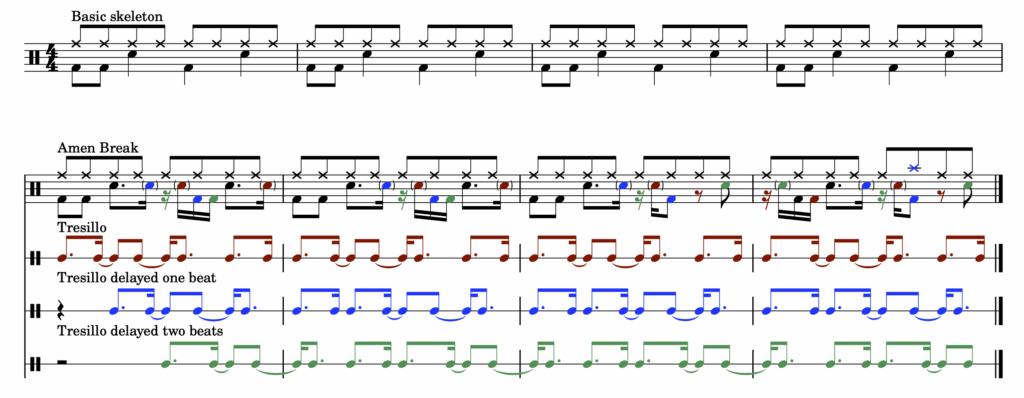
- The Rhythm: The pattern is a masterclass in tension and release. For the first two and a half bars, it establishes a solid groove. Then, things get interesting. In the latter half of the third bar, the main snare is delayed, creating a "stumbling" or "tumbling" feeling. This rhythmic displacement is a key part of its infectious character.
- The Microtiming: Like any human performance, the timing is not perfectly metronomic. These minute deviations from a rigid grid—what we call microtiming or groove—are a significant part of what gives the break its "feel." From a signal analysis perspective, the timing of the sixteenth notes varies measurably around the mean tempo.
The following article by Ethan Hein provides a superb analysis of what makes this break so compelling.
This blog post from Ethan Hein offers a historical and analytical look into the Amen break's enduring popularity.
Read the section locating the break in the original song. Then, focus on the section titled "Why do people use this beat so much?". Pay close attention to the discussion of the sound, the rhythmic pattern (including the tresillo analysis), and the concept of microtiming.
The image below, from Hein's article, visualizes the layered rhythmic complexity, showing how a simple "basic skeleton" is enriched with displaced tresillo patterns to create the final break.
The Programmer's Toolkit: Pitch and Time
Before we start chopping, it's crucial to understand how samplers manipulate the pitch and time of the slices. Your background in signal processing will make this distinction clear. Early samplers operated like tape machines: if you increased the playback speed to raise the pitch, the sample's duration would shorten. This linking of pitch and speed is a hallmark of old-school hip-hop and jungle. Modern DAWs also offer algorithms that can change pitch and time independently (time-stretching).
- Pitch-Speed Linked: Speeding up the sample raises the pitch and shortens it. This can make fast breakbeats sound thin as the bass frequencies are pitched up. Producers often compensated by layering a separate, low-frequency kick drum underneath.
- Pitch-Speed Independent (Time-stretching): The sample's length is conformed to the project tempo while its original pitch is preserved. This can retain the "weight" of the break at higher tempos but may introduce audible processing artifacts, especially when slowing a sample down significantly.
The following video demonstrates this concept perfectly.
The Amen Break - An analysis of the most important sample in history | Drum Patterns Explained
This segment from Captain Pikant's analysis clearly shows the sonic consequences of these two different sampling modes.
Watch the section from pitch-speed link vs. independent. Notice how the break's character changes dramatically when sped up in "link" mode versus "independent" (stretch) mode.
Foundational Techniques: The Chop and the Loop
Now that you have your slices from the previous lesson, you can begin reassembling them. The core idea is to identify the most rhythmically interesting or sonically unique parts of the break and use them as your primary building blocks. The last bar and a half of the Amen are particularly popular for this reason, containing clean kicks, snare shuffles, and the final crash cymbal.
Let's explore some classic rearrangement patterns. The video below by producer STRANJAH is an excellent practical guide to recreating iconic jungle patterns.
10 MOST ICONIC AMEN PATTERNS IN JUNGLE HISTORY!! | HOW TO CHOP BREAKS
This video by STRANJAH is a masterclass in practical breakbeat chopping. We'll use it to build patterns of increasing complexity. You should follow along in your DAW with the Amen slices you created in the last lesson.
First, watch how STRANJAH identifies the key sections of the Amen break that are most commonly used for chopping. He labels them 1 (kick), 2 (snare shuffle), and 3 (crash/snare). Next, create the simple but effective "Soldiers/Fade to Black" pattern by following the steps in this section. This involves simply looping sections 1 and 2 and then duplicating that loop, pitching the second iteration down. This introduces the fundamental concepts of re-sequencing and repitching. Then, build the classic "Terrorist" pattern as shown from this next example. This technique is slightly more advanced, involving looping a larger section and then programmatically adding your own kick and snare fills at the end of the phrase to create a turnaround.
This grid notation provides a clear way to visualize programming the four main parts of the Amen break in your DAW's piano roll.

Advanced Rearrangement: Rolls, Reverses, and Stutters
With the basics of looping and filling under your belt, you can explore more advanced and texturally interesting techniques that define the sound of jungle and experimental breakbeat music.
- Snare Rolls: A quintessential jungle technique, the snare roll creates a dramatic build-up of energy. It's typically created by taking a single, short snare slice and re-triggering it at a rapid rate (e.g., 16th or 32nd notes), often with an accompanying increase in velocity or filter cutoff.
- Reversing Slices: Reversing a slice, particularly a snare or crash, creates a "sucking" or "riser" effect that pulls the listener into the next beat. It's a simple but incredibly effective way to add dynamic tension.
- Stutters and Glitches: By taking a very small portion of a slice—sometimes just a few milliseconds—and looping it rapidly, you can create stuttering, glitchy, or metallic textures. This is a common technique in more experimental and aggressive forms of breakbeat music.
Let's return to the STRANJAH video to see these techniques in action.
10 MOST ICONIC AMEN PATTERNS IN JUNGLE HISTORY!! | HOW TO CHOP BREAKS
Continuing with the same video, we'll now look at more complex manipulations.
First, see how to create a snare roll in the context of the famous "Babylon" pattern (snare roll example). Pay attention to how a single snare sample is duplicated to create the roll at the end of the phrase. Next, watch the breakdown of "Remark's Rip" (reverse and stutter). This section demonstrates the use of reversed snares to create anticipation and rapid stutters of a ride cymbal for texture. Finally, look at the advanced technique used in Breakage's "Acid Rain" remix (time-stretching hits). Here, individual snare and kick slices are time-stretched to create unique, smeared textures before being placed back into the pattern. This is a powerful sound design technique.
These techniques are not just for recreating old patterns. They are a vocabulary. You can combine them in infinite ways to create your own signature rhythmic phrases.
The Master's Perspective: Philosophy of the Chop
Beyond the technical "how," there is a deeper philosophy to programming breakbeats. The goal is often not to sound like a machine, but to manipulate the original performance in a way that respects its human origins while creating something new. The producer Paradox, a master of the "drumfunk" subgenre, provides a valuable perspective.
This article from Ableton's blog gives insight into the meticulous, manual process of a master breakbeat artist.
Read the sections titled "Chopping & Slicing" and "Drum Programming". Notice Paradox's emphasis on thinking like a funk drummer, retaining the root of the original break, and using techniques like the "kickback" (inserting a single kick and hi-hat) to reset the groove and slow the feel of the loop. This thoughtful approach elevates drum programming from mere sequencing to a true art form.
Conclusion
In this lesson, you've moved from being a dissector of breaks to a constructor of beats. You have learned not just to rearrange slices, but to manipulate their pitch, timing, and texture to create patterns that are both rhythmically complex and historically resonant.
Key Takeaways:
- The Amen Break's power lies in its performance: Its dynamic sound, rhythmic tension, and human microtiming make it an ideal source for sampling.
- Rearrangement is a compositional tool: By identifying and re-sequencing key slices (kicks, snares, shuffles), you can create entirely new rhythmic phrases.
- Pitch and time are creative levers: The choice between pitch-speed linking and independent time-stretching has a profound impact on the texture and energy of your breakbeat.
- A rich vocabulary of techniques exists: Snare rolls, reversed hits, and micro-stutters are fundamental tools for adding tension, texture, and energy to your patterns.
- Programming can be an art form: Approaching breakbeat construction with a drummer's mindset and a respect for the source material leads to more musical and compelling results.
In our next lesson, we will put all your new skills to the test. You will be tasked to "Recreate and then modify a characteristic drum pattern from an industrial or breakbeat reference track." This will solidify your understanding and challenge you to apply these techniques in a complete analytical and creative workflow.