In our last lesson, we constructed the rhythmic foundations of electronic music by programming patterns on the main beats of the 4/4 grid. We established the roles of the kick, snare, and hi-hat in creating stable, driving pulses like the four-on-the-floor and two-step beats. These patterns are powerful because they reinforce the meter's inherent stress pattern. Now, we will explore the opposite concept: creating rhythmic interest by deliberately working against this pattern.
This lesson introduces syncopation, a rhythmic device that is central to the "groove" and "funk" of nearly all modern music, and is especially critical for the breakbeat, industrial, and complex techno styles you're interested in. We will define syncopation not just as a pattern to be copied, but as a fundamental principle of rhythmic tension. By the end of our session, you'll understand the hierarchy of beat strength within a measure and be able to program your own simple syncopated patterns by displacing notes off the strongest beats.
The Hierarchy of Rhythmic Strength
Before we can defy the beat, we must first understand its structure with greater resolution. In the previous lesson, we dealt mostly with quarter notes (the beats: 1, 2, 3, 4) and eighth notes (the offbeats: the "and"s). Electronic music, however, lives in the 16th-note subdivisions.
Within a 4/4 measure, these 16th notes have a clear hierarchy of perceived strength. Think of it as a potential landscape, where certain points in time have lower potential energy (they are more stable and feel "stronger") than others.
The following video provides an excellent, practical framework for this concept, tailored specifically for electronic music producers.
Syncopation - the key to groovy rhythms
The video "Syncopation - the key to groovy rhythms" from Underdog Electronic Music School provides a clear demonstration and a useful vocabulary for beat strength.
First, watch from the beginning to hear a direct comparison between a straight, non-syncopated rhythm and a syncopated one. This will give you an immediate, intuitive feel for the topic. Next, watch the section from the definition. The presenter introduces a three-tiered hierarchy of beat strength that is extremely useful for programming: Downbeats: The quarter notes (1, 2, 3, 4). These are the strongest, most stable points. Upbeats: The eighth-note offbeats (the "ands"). These are the next strongest. Weak Sixteenths: All other 16th-note positions (the "e"s and "a"s). These are the weakest and most unstable.
This hierarchy can be visualized as a "rhythm clock," with the downbeats as the cardinal points.

Defining Syncopation: The Stress of the Weak
With this hierarchy in mind, we can arrive at a concise definition:
Syncopation is the rhythmic phenomenon of accenting weak beats or weak parts of a beat.
Instead of placing our important musical events (like a snare hit or a prominent synth note) on the strong downbeats, we place them on the upbeats or, for a stronger effect, on the weak sixteenths. This creates a sense of tension and forward momentum—a "push and pull" against the underlying pulse. It's the feeling of being pulled off-balance, only to be satisfyingly resolved when the rhythm returns to a strong beat.
The image below shows a simple syncopated rhythm. Notice how the second note falls on the "and" of beat 2, and the fourth note is tied over what would be beat 4, with the accent falling on the "and" of beat 3. This is syncopation in action.
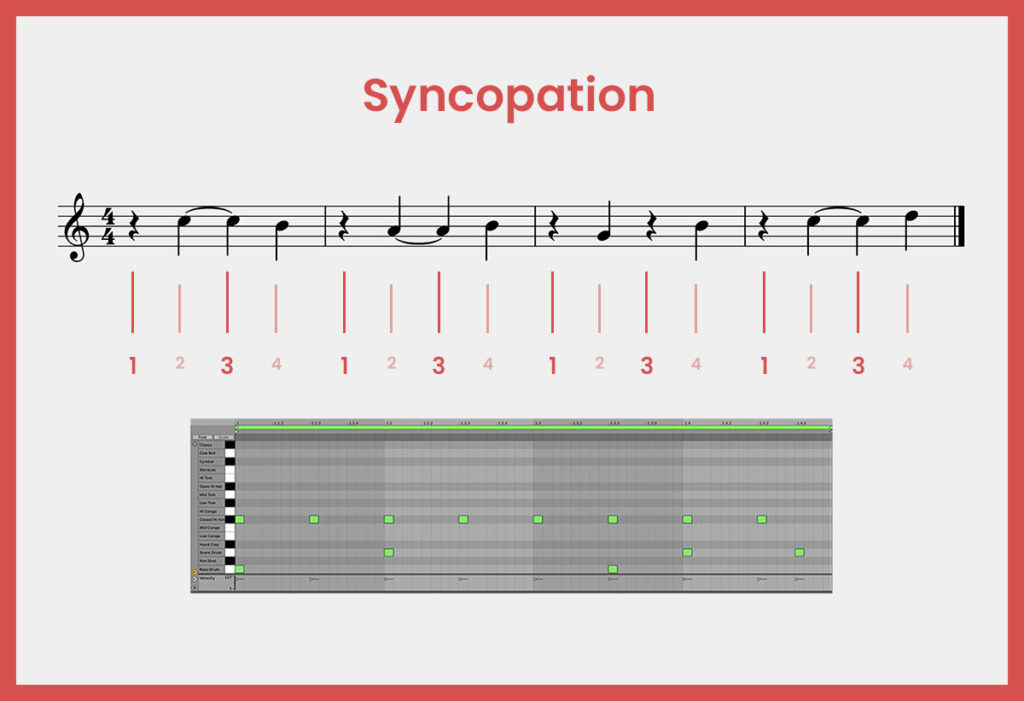
The Mechanism: Displacement and Expectation Violation
Your background in physics and mathematics will appreciate that we can formalize this concept beyond simple description. From a cognitive science perspective, syncopation functions by violating metrical expectations. The meter sets up a predictable pattern of strong and weak pulses. Our brains anticipate events on the strong pulses. Syncopation creates surprise and interest by either withholding an expected event on a strong pulse or placing an event on a weak pulse just before it.
A rigorous way to model this is through the concept of displacement. We can think of a syncopated note as an event that has been shifted, or displaced, from a strong metrical position to an adjacent, weaker one.
The following academic paper, while quite dense, provides a formal model for this idea. You don't need to read it in its entirety, but understanding its core premise will give you a powerful mental model.
[PDF] Transforming musical rhythms: meter and syncopation
This paper by Sioros and Guedes presents a formalized, algorithmic model of syncopation based on event displacement.
Focus on these key ideas: In Section 2, read the paragraph defining syncopation. It introduces the crucial concept: "an event in a weak metrical position is bound to an event in the following strong metrical position and when the expected strong note does not occur the weak one is left hanging." Next, skim Section 4, "Displacing Event Onsets," particularly the first paragraph and Figure 3. The key idea here is that you can think of syncopation as being generated by shifting an event. Conversely, you can "de-syncopate" a rhythm by shifting it back onto the strong beat. Finally, look at the first paragraph under "Syncopation" in subsection 4.1. It formalizes the idea of a shift, defining the "type" of syncopation by the metrical distance the note is moved. This provides a quantifiable, algorithmic way to think about creating and analyzing syncopated patterns.
This "displacement" model is incredibly useful for programming. When you want to create a syncopated feel, you can literally take a note that would have landed on a downbeat and nudge it one 16th note earlier.
Programming Simple Syncopation
Let's put this into practice. The goal is to take a basic, "on-the-grid" pattern and introduce syncopation by strategically placing or moving notes to weak 16th-note positions.
The following video gives excellent, concrete examples of doing exactly this in a DAW environment.
The video "Swing & Syncopation EXPLAINED" by EDMProd provides a very clear, step-by-step guide to programming syncopation.
Watch the section from the explanation. The presenter demonstrates the effect of placing a snare on different parts of the grid: On the strong quarter notes (layering the kick). On the weaker eighth-note offbeats. Crucially, on the weakest 16th-note positions (the 'e' and 'a'), where true syncopation emerges. Pay close attention to how he builds a groove by accenting specific weak beats, and how the same principle applies not just to drums, but to melodic elements like chords.
Practical Exercise:
Now it's your turn. Open your DAW and create a simple one-bar loop.
- Build a Foundation: Program a standard four-on-the-floor beat:
- Kicks on beats 1, 2, 3, 4.
- Snares on beats 2, 4.
- Closed hi-hats on every 8th note (1, &, 2, &, 3, &, 4, &).
- Introduce Syncopation: Now, add one more snare hit, but place it on a weak 16th note.
- Try placing it on the 'a' of beat 3 (the last 16th note before the snare on beat 4). Listen to how it creates a "galloping" feel and pulls you into the next beat.
- Delete that snare and try placing it on the 'e' of beat 2 (the second 16th note of the beat). This creates a classic funky feel, often called the "Funky Drummer" placement.
- Experiment by adding synth stabs or other percussive sounds on these weak sixteenths. Notice how they gain prominence and create rhythmic tension.
This act of placing a single event off the main grid is the fundamental technique of programming syncopated rhythms.
A Note on Generative Syncopation
Given your computational background, you might find it interesting that certain algorithms naturally produce syncopated rhythms. Euclidean algorithms, for example, which distribute a set number of pulses as evenly as possible over a set number of steps, often generate highly syncopated and musically compelling patterns. This happens because "maximal evenness" for two numbers that are relatively prime (e.g., 5 hits in 16 steps) requires interleaving two different step lengths, which is a form of syncopation. The paper "Euclidean Rhythms" by Godfried Toussaint explores this fascinating link between a classical geometric algorithm and world music rhythms. While a deep dive is beyond today's scope, it's a powerful example of how mathematical principles can generate complex musical structures.
Conclusion
Today we have defined and explored syncopation, moving beyond a simple grid to understand the hierarchy of rhythmic strength within a measure. We've seen that syncopation is a tool for creating tension and interest by intentionally accenting the weakest parts of the beat.
Key Takeaways:
- Beat Hierarchy: In 4/4 time, downbeats (1,2,3,4) are strongest, upbeats (&) are strong, and 16th-note subdivisions ('e', 'a') are weakest.
- Definition: Syncopation is the accentuation of weak beats or weak parts of a beat.
- Mechanism: It can be modeled as the displacement of a musical event from a strong metrical position to an adjacent, weaker one, creating a violation of rhythmic expectation.
- Application: In a DAW, syncopation is programmed by placing notes (drum hits, synth stabs) on the 'e' and 'a' subdivisions of the 16th-note grid.
You now have the core principle for breaking out of robotic, on-the-grid patterns. In our next lesson, we will examine quantization, the DAW function that snaps our performances to this grid. We will see how perfect quantization helps create surgically precise syncopated rhythms, and how imperfect quantization or deliberately shifting notes off the grid can introduce a more human "feel."