In our previous lesson, we explored modal interchange, a technique for adding harmonic color by "borrowing" chords from parallel modes. You learned how to substitute, for example, a somber F minor chord (iv) from C minor into a C major progression to create a moment of poignant reflection. This was about changing the mood or color of the harmony.
Today, we shift our focus from color to drive. We will investigate secondary dominants, a powerful technique for introducing non-diatonic chords that, instead of just adding color, create a powerful sense of gravitational pull towards other chords within the key. Where modal interchange borrows a mode's static character, secondary dominants import the dynamic, goal-oriented function of tonal harmony to create temporary points of arrival on chords other than the tonic. By the end of this lesson, you will be able to identify, construct, and use secondary dominant chords to energize your progressions and guide the listener's ear with precision.
The Physics of Dominant Function
Before we can create secondary dominants, we must first have a solid grasp of the primary dominant's function. In any key, the dominant seventh chord (V7) has a unique quality of instability that strongly desires resolution to the tonic (I). In C major, this is the G7 chord resolving to C major.
This instability isn't arbitrary; it arises from the specific intervals within the chord. Your background in physics provides a useful analogy: think of it as a system in a high-energy, unstable state that naturally seeks to resolve to a more stable, lower-energy state. The harmonic tension of the V7 chord is the high-energy state, and the resolution to the I chord is the release to a stable ground state.
The primary source of this tension is the tritone—an interval of six semitones—that exists between the 3rd and the 7th of the dominant seventh chord. In G7, this is the interval between B and F. This interval is highly dissonant and "pulls" towards resolution.
The following video provides an excellent explanation of this inherent tension and its resolution.
A Complete Guide To Secondary Dominants - Go BEYOND Basic Chord Progressions
The video "A Complete Guide To Secondary Dominants" by Pur Pasteur begins by dissecting the unique quality of the dominant chord.
Please watch the section from this point. The crucial takeaway is how the tritone between the 3rd and 7th creates an unstable interval that resolves smoothly by contrary motion to the root and third of the tonic chord.
Tonicization: Creating Temporary Tonics
The core idea of secondary dominants is to take this powerful V7-I relationship and apply it to other diatonic chords in the key. In essence, for a brief moment, you treat a non-tonic chord (like the ii, V, or vi chord) as if it were the tonic. This process is called tonicization.
A secondary dominant is the V7 chord "borrowed" from the key of the chord you want to tonicize. It is always a major triad or a dominant 7th chord (a major triad with a minor 7th), and it almost always contains at least one chromatic note (a note from outside the home key).
Let's watch a short, formal definition of this concept.
Music Theory: Secondary Dominants.
The video "Music Theory: Secondary Dominants" by David E. Farrell provides a clear, academic definition of secondary dominants and the concept of tonicization.
Watch the segment from the beginning of this section. Focus on the two key characteristics: the chord quality (major or major-minor 7th) and the concept of "borrowing" a dominant from another key to create a brief "tonicization."
Constructing and Identifying Secondary Dominants
The process for finding a secondary dominant is algorithmic and can be broken down into simple steps:
- Choose your target: Select a diatonic major or minor chord you wish to tonicize. Let's use the ii chord in C major, which is D minor.
- Find its dominant: Go up a perfect fifth from the root of your target chord. The root of Dm is D, and a perfect fifth above D is A.
- Build the dominant 7th chord: Build a dominant 7th chord on that new root. A dominant 7th chord on A is A7 (A–C♯–E–G).
- Label it: This A7 chord is the secondary dominant of Dm. In Roman numeral analysis, we write this as V7/ii (read as "five-seven of two").
The C♯ is the crucial chromatic note. It acts as a temporary leading tone, pulling strongly up by a half step to D, the root of the target ii chord. This chromatic motion is what gives the secondary dominant its compelling directional force.
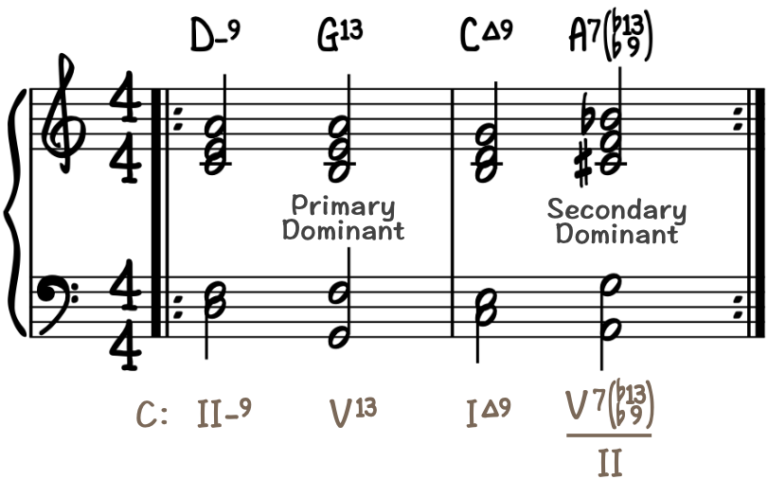
To identify a secondary dominant when analyzing a piece, you can reverse the process using the question: "Five of what?"
Music Theory: Secondary Dominants.
Let's return to David Farrell's video for a practical demonstration of this identification process.
Watch the detailed example from this section. The instructor analyzes a chromatic chord in the key of D major. Follow his three questions: Is the chord chromatic? (Yes, it has a G♯) Is it a major triad or dominant 7th? (Yes, it's an E7) "Five of what?" (E is the dominant of A. A is the V chord in D major. Therefore, E7 is the V7/V).
The System of Secondary Dominants
Not all diatonic chords can be effectively tonicized. The V7 chord resolves most naturally to a major or minor chord. Because of this, we typically do not use secondary dominants to tonicize diminished chords. The diatonic vii° chord in a major key and the ii° chord in a minor key are therefore not valid targets.
This gives us a clear system of available secondary dominants.

For a more formal and comprehensive reference, the following charts from a harmony textbook are invaluable. They systematically lay out the available secondary dominants in both major and minor keys.
Secondary Dominants – Harmony and Musicianship with Solfège
This resource from a textbook on Harmony and Musicianship provides clear, systematic charts of the available secondary dominants.
Focus on the sections "I. secondary dominants in MAJOR" and "II. secondary dominants in MINOR". Study the two charts for major keys and the two charts for minor keys. Observe which scale degrees can be tonicized (ii, iii, IV, V, vi in major) and which cannot (vii°). Notice the more limited options in minor keys, due to the diminished quality of the ii° chord.
Application in Composition
Knowing how to build these chords is one thing; using them effectively is another. Secondary dominants are a cornerstone of creating compelling harmonic journeys, even within the looping structures of electronic music. They can be used to build tension leading into a new section or to create a "turnaround" at the end of a four- or eight-bar phrase that propels the listener back to the beginning of the loop.
Let's explore some common applications, including alternative resolutions and chaining them together to create unstoppable forward momentum.
A Complete Guide To Secondary Dominants - Go BEYOND Basic Chord Progressions
Now let's explore how these chords are used to create specific musical effects and drive longer progressions. The video "A Complete Guide To Secondary Dominants" by Pur Pasteur offers fantastic examples.
Watch these three segments: The V of V: This section discusses the most common secondary dominant, the V/V. Notice the explanation of how adding a sharp increases the "energy" of the system, a concept that connects back to the circle of fifths. Challenging Expectations: This part explores alternative resolutions, like V/V moving to IV instead of V. This is a key technique for subverting predictable classical cadences, something often done in modern electronic music. Chaining Dominants: This final segment shows how you can chain secondary dominants together (e.g., V/vi -> V/ii -> V/V -> V -> I). This technique creates a powerful, cascading forward momentum that is extremely useful for builds and transitions.
Conclusion
Today we've added a crucial tool for creating dynamic, functional harmony to your toolkit. You've learned that secondary dominants are more than just random chromatic chords; they are purposeful, functional devices that import the powerful physics of dominant-tonic resolution to temporarily highlight any major or minor chord in a key. This allows you to create intricate harmonic paths and a sense of propulsive energy that is fundamental to Western music and highly applicable to the tension-and-release structures of electronic music.
Key Takeaways:
- Secondary Dominants are dominant 7th chords that resolve to a diatonic chord other than the tonic.
- The process of using a secondary dominant to make a non-tonic chord sound like a temporary tonic is called tonicization.
- The driving force behind their function is the resolution of the unstable tritone interval.
- The notation V/x means "the dominant of chord x".
- The construction is algorithmic: identify your target, find the note a perfect fifth above its root, and build a dominant 7th chord.
- In practice, they can be used to create turnarounds, build tension, or be chained together for long, chromatic progressions.
As a practical exercise, try programming a simple ii-V-I progression in your DAW (e.g., Dm7-G7-Cmaj7). Now, insert the V7/ii (A7) before the Dm7. Listen to how the A7 energizes the arrival of the Dm7. Then, try inserting the V7/V (D7) before the G7. Notice how this creates a chain of dominants, adding even more momentum to the progression.
In our next lesson, we will explore an even more sophisticated technique related to dominant function: tritone substitution. This will give you a way to replace a dominant chord with another, seemingly unrelated dominant chord, opening up new avenues for smooth, chromatic voice leading and harmonic surprise.