Introduction
In our last lesson, we established the system of harmonic functions—Tonic, Subdominant, and Dominant—and mapped the narrative arc of tension and release that governs tonal music. We saw that the most common harmonic "sentence" is a journey from the stability of the Tonic, through the preparatory Subdominant, to the peak tension of the Dominant, before finally returning home.
This lesson focuses on that critical moment of return: the resolution from the dominant seventh chord (V7) to the tonic (I). This progression, known as the authentic cadence, is arguably the single most important harmonic device in the Western tonal tradition. We will dissect the V7 chord to understand the source of its immense power, explore the precise mechanics of its resolution, and even question the very nature of that resolution—is it a law of physics or a deeply ingrained cultural agreement? For you, this can be likened to analyzing the collapse of a system from a high-energy, unstable state to its stable ground state, examining the forces that drive the transition.
The Anatomy of Dominant Tension
The power of the V7 chord lies in its unique construction. It contains the two most "unstable" notes of the major scale, which act as tendency tones—notes that possess a strong melodic pull toward resolution.
Let's begin by seeing how these tendencies are established from the psychoacoustic properties of the scale itself.
The video "Functional Tonal Harmony 1" by Greg Dalessio provides an excellent foundation, connecting the physical properties of sound to our perception of harmonic function.
Watch the introduction from the beginning to understand the psychoacoustic basis of consonance and dissonance in terms of frequency ratios. This relates directly to our discussions in Module 1. Next, see how this applies to individual scale degrees from the discussion on note stability. Pay close attention to which notes feel stable and which feel unstable. Finally, watch the crucial section from the definition of harmonic functions, which explains how the V7 chord harnesses the two most unstable scale degrees to generate the strongest possible resolution.
As the video explains, the V7 chord is a major triad built on the dominant (scale degree 5) with an added minor seventh. In the key of C major, the G major chord (G-B-D) becomes G7 (G-B-D-F). Let's map its components to their scale degrees:
- Root: G (Scale degree 5, the Dominant)
- Third: B (Scale degree 7, the Leading Tone)
- Fifth: D (Scale degree 2, the Supertonic)
- Seventh: F (Scale degree 4, the Subdominant)
The two critical ingredients here are the tendency tones:
- The Leading Tone (scale degree 7): As we've seen, this note is only a half-step below the tonic and has a powerful melodic inclination to resolve upwards to it.
- The Chordal Seventh (scale degree 4): This note lies a half-step above the third of the tonic chord (in C major, F is a half-step above E) and has a strong tendency to resolve downwards.

Crucially, these two tendency tones—the 7th and 4th scale degrees—combine within the V7 chord to form the interval of a tritone. In G7, this is the interval between B and F. As we learned in Module 2, the tritone's complex frequency ratio makes it one of the most dissonant and unstable intervals, creating a powerful acoustic and psychological need for it to resolve to a more consonant sonority.
The Mechanics of Resolution: Voice Leading the V7-I Cadence
The "rules" of voice leading for the V7-I progression are simply a description of the most efficient path for this release of tension. Each note in the V7 chord has a preferred destination in the I chord.
The following video provides an exceptionally clear and systematic guide to this process.
Professor Seth Monahan's "Lesson 15: Resolving V7 to I" is a masterclass in the practical mechanics of this fundamental progression.
Start with the introduction to solidify your understanding of the V7 chord itself. Pay close attention to the section on tendency tones. Monahan clearly explains the jobs of scale degrees 4 and 7 and how they form the crucial tritone. Next, study the three voice-leading options in detail. This is the core of the lesson, presenting practical solutions to common voice-leading "problems." Finally, watch the summary to review the key principles.
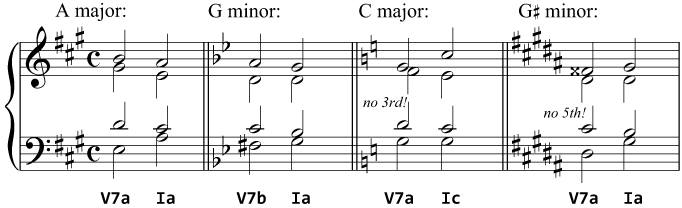
Let's summarize the voice-leading principles and the three main resolution options discussed in the video. The core idea is that the tendency tones must resolve correctly:
- Scale degree 7 resolves up by step to scale degree 1.
- Scale degree 4 resolves down by step to scale degree 3.
This leads to three common scenarios for a four-voice texture:
-
Complete V7 → Incomplete I: If you use a V7 chord with all four notes present and resolve the tendency tones correctly, the remaining voices (scale degrees 2 and 5) will typically move to the root of the tonic. This results in a stable but incomplete tonic chord, usually with a tripled root and a third, but no fifth. This is a very common and perfectly valid resolution.
-
Incomplete V7 → Complete I: To ensure a complete tonic chord, you can start with an incomplete V7 chord. The fifth (scale degree 2) is omitted, and the root (scale degree 5) is doubled. Since scale degree 5 is also the fifth of the tonic chord (a common tone), one of these notes can simply be held over, while the other voices resolve as normal. This easily produces a complete tonic chord.
-
Complete V7 → Complete I (with "sprung" leading tone): There is a third option that allows both chords to be complete. If the leading tone (scale degree 7) is in an inner voice (not the highest or lowest note), it is permitted to "frustrate" its tendency and leap down by a third to the fifth of the tonic chord. Usually, another voice will move to the tonic note that the leading tone "abandoned," creating a sonic illusion of resolution.
A Law of Physics or a Cultural Contract?
So far, we've discussed the V7-I resolution as if it were a physical inevitability, driven by the mathematics of frequency ratios and the neurology of psychoacoustics. This is the standard textbook explanation, and it holds significant truth. The move from a complex, dissonant waveform (V7) to a simple, consonant one (I) represents a decrease in what could be analogized to "information entropy" for the brain's auditory processing centers.
However, this is not the whole story. Your interest in experimental genres like noise and industrial—genres that often deliberately avoid such clean resolutions—points to a deeper question. Is this "need" for resolution a law of nature or a learned behavior?
Why V7–I Is an Agreement, Not a Law - Max Schwartz Music
This essay by Max Schwartz offers a fascinating and sophisticated perspective, challenging the purely physical explanation of resolution. It's a perfect read for someone with your background, bridging physics, physiology, and cultural theory.
Begin with the section "The Physics Story (and Why It’s Only Half True)". This directly critiques the simple, deterministic view of resolution. Next, read the discussion of physiological response. This part reframes "hearing" as a physiological event where your body registers a change in energy state. Continue with "A Contract You Didn’t Sign", which argues that our interpretation of this energy change as "resolution" is a culturally inherited contract. Finally, read the section "The Political Ending". This powerfully connects the choice to resolve or not to artistic and even political expression, using Fela Kuti's music as a prime example.
The V7-I cadence is powerful not just because of acoustics, but because centuries of Western music have trained our ears to expect it. It has become a deeply ingrained convention. When a V7 chord sounds, our brains, conditioned by countless nursery rhymes, symphonies, and pop songs, anticipate the arrival of the tonic. The satisfaction comes from the fulfillment of this expectation.
This perspective is liberating for a creator of electronic music. It means you are in control of this "contract."
- You can honor it to provide a sense of stability, closure, and satisfaction.
- You can delay it to build suspense.
- You can subvert it with a deceptive cadence (V7-vi) to create surprise.
- Or, as is common in noise and industrial music, you can refuse it entirely, forcing the listener to dwell in a state of unresolved tension. This refusal is not a "mistake"; it is a deliberate aesthetic and expressive choice.
Conclusion
The V7-I resolution is the gravitational center of the tonal system. Its propulsive force is generated by the acoustic instability of the tritone, formed by the two primary tendency tones of the scale (the leading tone 7 and the subdominant 4). The resolution itself is governed by clear voice-leading principles that guide these dissonances to their nearest points of rest.
Key Takeaways:
- The V7 chord is the engine of dominant function, containing scale degrees 4 and 7.
- These two notes form a tritone, a highly dissonant interval that demands resolution.
- The leading tone (7) pulls up to the tonic (1), and the chordal seventh (4) pushes down to the mediant (3).
- Standard voice leading provides three main options for resolving V7 to I, balancing the integrity of the chords with the smooth movement of voices.
- While rooted in psychoacoustics, the powerful feeling of V7-I resolution is also a deeply embedded cultural convention—an agreement between composer and listener that can be honored, subverted, or broken for expressive effect.
In our next lesson, we will broaden our view of musical punctuation by examining the full range of cadential patterns. Having mastered the "full stop" of the authentic cadence, we will explore the "comma" (half cadence), the "question mark" (deceptive cadence), and the "amen" (plagal cadence). This will give you a complete toolkit for controlling the flow and structure of your harmonic phrases.