Introduction
In our last lesson, we conducted a deep dive into the V7-I authentic cadence, framing it as the fundamental unit of resolution in tonal harmony. We analyzed its power, stemming from the acoustic instability of the tritone, and explored the idea that its satisfying "release" is as much a cultural convention as a physical inevitability. You can think of it as a system relaxing from a high-energy, unstable state to its stable ground state.
This lesson expands on that concept by mapping out the other common ways a musical phrase can conclude. The authentic cadence is the definitive "full stop," but music, like language, requires a full suite of punctuation. We will explore the four principal cadential patterns: authentic, plagal, half, and deceptive. Each one manages the listener's expectations differently, providing a distinct flavor of closure, suspense, or surprise. This will equip you with a complete toolkit for controlling the narrative energy and flow of your harmonic progressions.
What is a Cadence?
At its core, a cadence is a melodic or harmonic formula that occurs at the end of a phrase, section, or piece of music. It provides a sense of resolution or pause. In tonal harmony, we typically identify them by the final two chords of the phrase. Think of them as the energetic transitions between states of harmonic tension and stability.
The following video provides an excellent overview of the concept and introduces the main types we will be discussing.
Dr. B Music Theory Lesson 22 (Cadences)
The video "Dr. B Music Theory Lesson 22" offers a systematic breakdown of cadences, using the analogy of punctuation in language.
Please watch from the introduction for a clear definition of cadences and how to identify them at the end of musical phrases.
1. The Authentic Cadence (V-I): Conclusive Resolution
We are already familiar with the authentic cadence from our previous lesson. It is the progression from the dominant (V) to the tonic (I) and provides the strongest sense of finality. However, there are important distinctions within this category that determine the degree of finality.
Perfect Authentic Cadence (PAC): This is the most conclusive cadence in music. For a V-I cadence to be considered "perfect," it must satisfy three conditions:
- Both the V and I chords are in root position.
- The highest note of the final tonic chord (the soprano voice) is the root of the chord (scale degree 1).
- The leading tone resolves to the tonic.
This configuration leaves no room for ambiguity; the musical statement is unequivocally finished. It is the system reaching its global energy minimum with maximum stability.
Imperfect Authentic Cadence (IAC): Any authentic cadence (V-I) that fails to meet one or more of the PAC criteria is an imperfect authentic cadence. This could be because:
- One or both chords are inverted (e.g., V⁶-I or V-I⁶).
- The leading tone chord (vii°) substitutes for the V chord (e.g., vii°⁶-I).
- The final tonic chord has the 3rd or 5th in the soprano.
An IAC still feels like a resolution, but it's softer and less final than a PAC. It’s more like a period at the end of a sentence within a paragraph, rather than the final period at the end of a chapter.
Every type of Cadence EXPLAINED
The video "Every type of Cadence EXPLAINED" by David Bennett gives a very clear explanation of the distinction between Perfect and Imperfect Authentic Cadences, which is standard in US music theory terminology.
Watch the section from US Terminology for a detailed breakdown of PACs and the three types of IACs.
2. The Plagal Cadence (IV-I): The "Amen" Cadence
The plagal cadence is the progression from the subdominant (IV) to the tonic (I). It also provides a sense of resolution, but it is far less dynamic than the authentic cadence. Because it lacks the powerful pull of the leading tone, the plagal cadence has a gentler, more passive quality.
It is often called the "Amen" cadence due to its frequent use to set that word in Christian hymns. Its emotional quality is one of peaceful closure or affirmation.
Tonal Map of Chord Sequences: Harmonic Analysis and Practical ...
This article provides fascinating emotional descriptors for chord movements. It will help connect the technical definition of a cadence to its perceived effect.
Read the bullets for Authentic and Plagal resolution. The author describes the V-I as a "Bright resolution" and the IV-I as a "Soft return," which is a perfect summary of their differing emotional characters.
3. The Half Cadence (...-V): Unresolved Tension
Unlike the previous two, the half cadence is a cadence of irresolution. It is any cadence that ends on the dominant (V) chord. The phrase pauses, but on a moment of maximum tension, leaving the listener hanging and anticipating a resolution that has not yet arrived. It functions like a comma or a question mark, creating suspense and a powerful need for continuation.
This subjective feeling of increased tension is not just an artistic metaphor; it has been observed empirically.
[PDF] The influence of different structural features on felt musical tension in ...
This scientific paper analyzes how different musical structures affect perceived tension. It provides an empirical basis for the theoretical concepts we are discussing.
Focus on the qualitative analysis of the Mozart piece. Read the paragraph starting from "The tension profile...". Note the observation that the half cadence marks a point of tension, and that deceptive cadences (which we'll discuss next) yield a "sudden increase in experienced tension." This validates our model of cadences as modulators of a tension-release system.
A particularly dramatic form of the half cadence, found exclusively in minor keys, is the Phrygian Half Cadence. This is the specific progression iv⁶-V. The name comes from the half-step descent in the bass from the subdominant to the dominant (e.g., in A minor, from F to E), which mimics the characteristic half-step above the tonic in the Phrygian mode.
4. The Deceptive Cadence (V-vi): The Plot Twist
The deceptive cadence occurs when the dominant (V) chord, which creates a powerful expectation of resolving to the tonic (I), instead progresses to the submediant (vi) chord. In a major key, this means resolving to the relative minor.
The effect is one of surprise. The tension of the V chord is resolved, but not in the expected way. The bass movement (from scale degree 5 up to 6) is smooth, but the harmonic destination is unexpected, often adding a touch of melancholy or poignancy. As the study above noted, this subversion of expectation causes a spike in perceived tension before it settles into the new, unexpected chord.
Every type of Cadence EXPLAINED
David Bennett's video provides an excellent demonstration of the deceptive cadence in a pop context.
Watch his explanation of the interrupted/deceptive cadence. The example from Queen's "I Want to Break Free" is particularly effective, as it repeats the V-vi deception twice before finally granting the V-I resolution, clearly illustrating the buildup and release of expectation.
The "Tonal Map" resource describes this V-vi move as a "Sad resolution, acceptance," capturing the complex emotion of a resolution that feels like a poignant, rather than triumphant, conclusion.
Summary and Application
Here is a concise summary of the four cadence types, visually represented in the key of C Major.
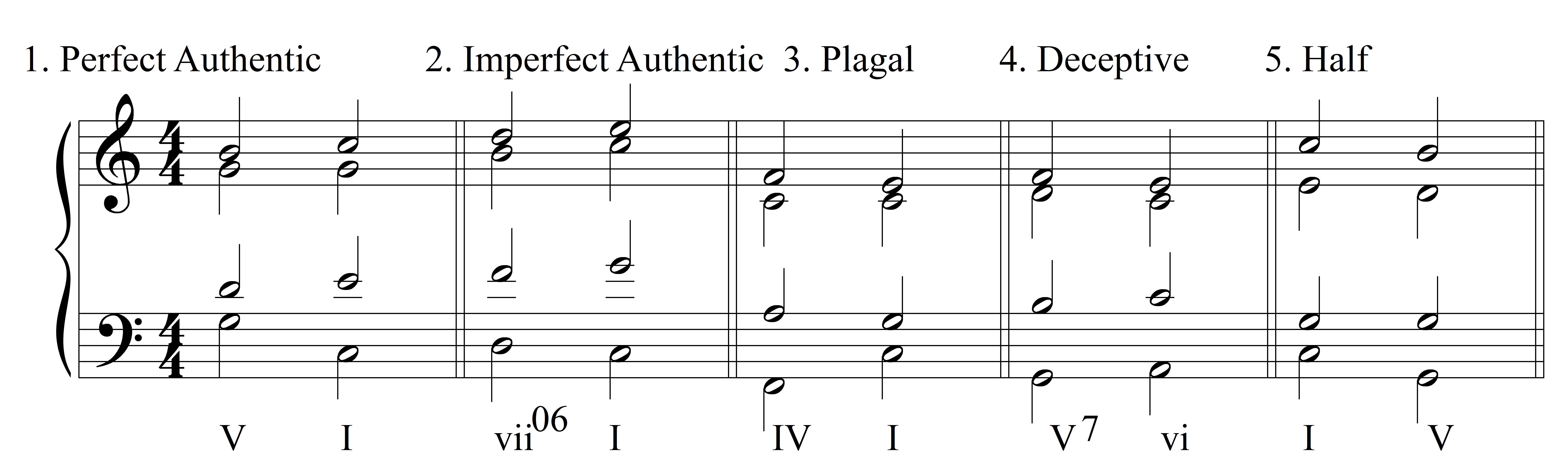
Now, let's consider this in your DAW environment. While traditional scores are useful, seeing these patterns on a piano roll is essential for production.

Understanding these traditional cadential patterns is the key to controlling harmonic energy. In your music, you can:
- Use a PAC for a definitive track ending.
- Use a plagal cadence for a softer, more reflective ending to a section.
- End a pre-drop phrase on a half cadence to maximize tension and suspense.
- Use a deceptive cadence to introduce a new melodic idea or shift the mood of a track unexpectedly.
- Or, as in the piano roll example, deliberately avoid strong cadences to create hypnotic, unending loops.
Conclusion
We have now categorized the primary harmonic "punctuation marks" that structure tonal music. Each cadence manipulates the core principles of tension and release in a unique way, providing you with a palette of tools for guiding the listener's emotional and structural journey.
Key Takeaways:
- Cadences are two-chord formulas that conclude musical phrases.
- Authentic Cadence (V-I): The strongest resolution. It can be Perfect (PAC) for maximum finality or Imperfect (IAC) for a softer closure.
- Plagal Cadence (IV-I): A gentle, non-dynamic resolution often called the "Amen" cadence.
- Half Cadence (...-V): An unresolved cadence that ends on a point of high tension, creating suspense.
- Deceptive Cadence (V-vi): A surprising resolution that subverts expectation by moving to the relative minor instead of the tonic.
In our next lesson, we will apply this knowledge directly to the genres you're interested in. We will analyze how techno and house utilize, adapt, or even consciously reject these functional harmonic patterns within their characteristic loop-based structures.