Introduction
In our last lesson, we completed our journey into sound design by learning to deconstruct synth patches, moving from the sonic whole back to its constituent parts: oscillators, filters, and envelopes. This analytical process, much like reverse-engineering a physical system from its observable outputs, gave you the tools to understand sounds at a micro level.
Today, we begin our final module by dramatically "zooming out." We will shift our focus from the fine details of individual sounds to the macro-scale architecture that governs how these sounds are organized over time to form a complete piece of music. This lesson addresses the foundational concepts of musical arrangement in electronic music, allowing you to identify the common structural sections—intro, build, drop, breakdown, and outro—that define the narrative and energetic flow of a track. Understanding these building blocks is the first step toward constructing compelling, full-length compositions.
The Functional Anatomy of an Electronic Track
In contrast to the verse-chorus structure common in traditional pop and rock, electronic dance music is often built around a more cyclical and functional organization of energy. The sections are defined less by lyrical narrative and more by their role in modulating tension and creating a dynamic experience for the listener, particularly on a dancefloor.
A helpful way to frame this, given your background, is through the concept of "sonic function," an idea explored in music theory that parallels the setup-buildup-peak model. Each section serves a specific purpose in this energy transaction. The primary resources for this lesson provide excellent overviews of these sections from both a practical producer's perspective and a formal academic one.
First, let's establish a clear vocabulary for these sections.
The video "How to arrange any song" by Alice Efe provides excellent, concise definitions of the core structural elements of a dance track.
Watch the segment from the start of the definitions. The presenter explains the function of the chorus (often analogous to the drop), bridge, break, drop, verse, intro, and outro. Pay close attention to the distinctions she makes, particularly between a short bridge and a longer, more impactful break.
Let's synthesize and formalize these definitions:
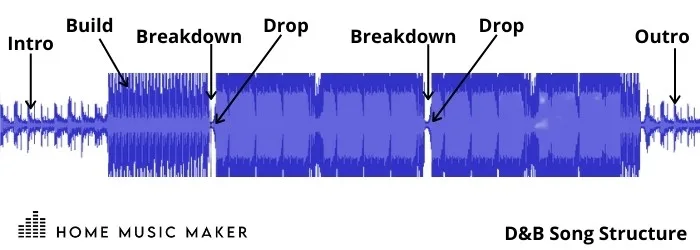
- Intro: The beginning of the track. Its primary function is to be DJ-friendly, providing a percussive, low-energy section that can be mixed smoothly with the preceding track. It also establishes the track's core groove and mood.
- Breakdown (or Break): A section characterized by a significant reduction in energy. Typically, the kick drum and bassline are removed, leaving melodic and atmospheric elements. Its function is to release tension, create anticipation, and provide emotional or dynamic contrast. The term "break" often implies a longer, more ambient section, while "breakdown" can be a more general term for any substantial removal of elements.
- Build (or Buildup): A section of steadily increasing tension that leads into a drop. This is the "buildup" phase of our functional model. It uses a specific sonic vocabulary to signal an impending climax.
- Drop: The section of maximum energy and impact, or the "peak." This is where the kick and bass return with full force, accompanied by the main melodic or rhythmic hook. In pop-structured electronic music, the drop often serves the same function as a chorus.
- Outro: The end of the track. Like the intro, it is designed for DJ mixing, gradually stripping away elements to provide a smooth transition into the next track.
This structure can be visually represented in at least two ways: by its energy profile over time, and by the layering of its instrumental components.

The Physics of the Build: Quantifying Tension
The "build" section is not arbitrary; it relies on a well-established set of techniques designed to create a quantifiable increase in sonic energy and psychological tension. The following article details these elements.
The Advanced Guide to Tension and Energy in Electronic ...
This article from EDMProd, "The Advanced Guide to Tension and Energy," provides a producer-focused breakdown of what constitutes a buildup.
Please read the sections on macro-tension and the build-ups section. Note the typical elements listed under macro-tension: Risers: Synthesized tones that sweep upwards in pitch or brightness. Snare Rolls: A pattern of snare hits that increases in speed (e.g., from quarter notes to 8ths, 16ths, and 32nds). Automated Filtering: Often a high-pass filter that sweeps upwards, removing low frequencies and creating a sense of "thinning out" before the bass-heavy drop. These elements create a clear statistical trend—rising pitch, increasing rhythmic density, decreasing low-frequency energy—that our brains interpret as a direct precursor to a significant event.
From Formal Functions to Arrangement Strategy
Understanding the identity and function of these blocks is the first step. The next is assembling them into a coherent whole. There are two primary methodologies for this, which we can frame as different problem-solving strategies.
The same video, "How to arrange any song," now introduces two fundamental arrangement workflows: top-down and bottom-up.
Watch the section explaining the single top-down approach. This is a subtractive method where you start with the most complex section (the drop) and carve away elements to create the other sections. Then, watch the section covering the bottom-up approach. This is an additive method where you build the track chronologically from the intro. Notice the strong recommendation to use a reference track to guide this process.
-
Top-Down (Subtractive) Arrangement: You begin by creating your main 8 or 16-bar loop with all elements playing—this is your drop. You then copy this loop across the timeline and create the other sections by deleting or deactivating elements. For the intro, you might keep only the kick and some percussion. For the breakdown, you remove the kick and bass. This method is highly efficient and ensures a cohesive set of sounds throughout your track.
-
Bottom-Up (Additive) Arrangement: You begin with a blank timeline and build the track from the intro forward, adding elements and sections as you go. This can feel more organic but is often more challenging for maintaining focus and cohesion. Using a reference track as a structural guide is an extremely effective way to manage this process.
Plotting the Narrative: The Energy Map
A powerful tool for planning your arrangement, regardless of the method you choose, is the Energy Map. This is a simple plot of perceived energy versus time. Creating one forces you to think consciously about the dynamic journey you want the listener to take. This concept should be intuitive from your experience plotting physical phenomena.
The Advanced Guide to Tension and Energy in Electronic ...
The EDMProd article introduces the concept of an Energy Map and a method for creating one.
Read the section titled Energy Dynamics. Pay particular attention to the visual representation of an energy map and the "1-9 method" for analyzing a reference track's energy levels. This provides a systematic way to deconstruct and plan the large-scale dynamics of a composition.
By using a reference track you admire, you can create an energy map that serves as a template. You are not copying the music, but rather the underlying structural dynamics, which you can then fill with your own musical ideas.
A Deeper Dive: Formal Music Theory and EDM
While these structural conventions are born from the practical needs of the dancefloor, they can also be analyzed with the same rigor as classical forms. A formal analysis can provide a deeper understanding of how these sections relate and function.
Formal Functions and Rotations in Top-40 EDM - Music Theory
The academic paper "Formal Functions and Rotations in Top-40 EDM" by Osborn applies musicological concepts to modern electronic music.
First, read Section 1, focusing on the descriptions under Figure 1 (Formal Functions). Note the distinction between a "syntactical climax" (a memorable pop chorus) and a "statistical climax" (the maximal volume and texture of an EDM drop). This provides a precise language for what we intuitively feel. Next, read Section 3 (Compound AAA Form). This introduces the idea that many EDM tracks follow a "compound AAA" structure, essentially rotations of the same core sections, rather than the AABA form with a contrasting bridge found in much pop music. Finally, read Section 5 (Cumulative Functions). This describes a common technique where the final section combines elements from previously distinct sections (like the vocals from a breakdown and the beat from a drop) into a final, cumulative climax.
This perspective helps formalize what we observe: electronic music arrangement is often about the creative repetition, variation, and recombination of a core set of functional blocks within a rotational, non-linear structure.
Conclusion
In this lesson, we have established a framework for understanding the macro-architecture of electronic music. You have learned to identify the primary structural sections and, more importantly, to understand their function in the management of energy and tension.
Key Takeaways:
- Core Structural Blocks: Electronic music is typically built from functional sections: Intro, Build, Drop, Breakdown, and Outro.
- Energy and Function: Each section's purpose is defined by its role in the track's energy flow—setting the mood, building tension, providing a climax, or offering release.
- Arrangement Strategies: You can construct a track using a top-down (subtractive) method, starting from the drop and removing elements, or a bottom-up (additive) method, building from the intro with the guidance of a reference.
- The Energy Map: This is a powerful analytical and planning tool that allows you to visually plot the intended dynamic journey of your track.
- Formal Structure: From a music theory perspective, many electronic tracks can be seen as "compound AAA" forms, using rotations of core sections rather than traditional contrasting structures.
You now have the conceptual tools to listen to a piece of electronic music and map out its architectural blueprint. In our next lesson, we will begin exploring the production tools that breathe life into this blueprint. We will start with reverb and delay, two essential effects used to create a sense of acoustic space, add depth, and generate rhythmic complexity within your arrangement.