Introduction
In our last lesson, we established the architectural blueprint of an electronic music track, identifying the functional sections that guide a listener's journey. We saw how arrangement is about managing energy on a macro scale. Now, we turn our attention to the tools that give this architecture dimension, depth, and life. This lesson focuses on two of the most fundamental effects in audio production: reverb and delay.
For you, with your background in physics, these effects can be understood as the practical application of wave phenomena. Reverberation is the result of sound waves reflecting, absorbing, and superimposing within a space. Delay is its elemental component—a discrete echo. We will explore how these physical principles are modeled mathematically and implemented in digital systems, and then apply them to create a sense of acoustic space, add perceptual depth, and generate rhythmic complexity in your music.
The Physics of Reverberation
Before we can digitally create a sense of space, we must first understand how it's formed in the natural world. When a sound is produced in an environment, it doesn't just travel in a straight line to the listener. It propagates outwards, reflecting off every surface it encounters.
What Digital Reverb Actually Does - iZotope
This article from iZotope begins by explaining the physics of natural reverberation. It provides the foundational concepts we need to build upon.
Read the introductory section and the part titled How natural reverb is created. As you read, focus on the three key components of the sound a listener perceives: Direct Signal: The sound that travels directly from the source to the listener without any reflections. Early Reflections: The first few reflections that reach the listener after bouncing off only one or two surfaces. These are crucial for our brain to determine the size and shape of the space. Late Reflections (Reverberant Tail): The dense web of subsequent reflections that have bounced off multiple surfaces. They are so close together in time that we perceive them as a continuous, decaying wash of sound.
This entire process—direct signal, early reflections, and the reverberant tail—can be characterized by a room's impulse response. In physics and engineering terms, the impulse response of a system is its output when presented with a brief input signal, a Dirac delta function . In acoustics, this is approximated by a very short, sharp sound like a starter pistol shot or a balloon pop. The recording of how that sound decays in a room is the impulse response of that room.

The most common quantitative measure for reverberation is the RT60, which is the time it takes for the reverberant sound pressure level to decrease by 60 decibels after the source has stopped. This corresponds to a decay to one-millionth of its initial amplitude.
Simulating Space: Digital Reverb
Creating these complex reflections digitally requires sophisticated modeling. There are two primary approaches: algorithmic reverb and convolution reverb.
Everything about REVERB explained very FAST - Sound Design Theory
The video "Everything about REVERB explained very FAST" provides a concise and practical overview of different methods for creating reverb, both mechanical and digital.
Watch the segment from the beginning of the types section, which covers mechanical reverbs (chamber, plate, spring) before explaining the two main digital types: algorithmic and convolution.
Algorithmic Reverb
Algorithmic reverbs use mathematical algorithms to simulate the process of reflection and decay. They don't model a specific real space but rather generate a plausible one based on a set of parameters. The core building blocks are networks of digital filters, primarily delay lines.
What Digital Reverb Actually Does - iZotope
The iZotope article explains how algorithmic reverbs use delay lines and feedback to generate early and late reflections.
Read the section on algorithmic digital reverb. Note how it describes the process: a few simple delays create the early reflections, and then feedback loops feed these signals back into the algorithm to generate the dense, decaying tail of late reflections.
These networks often consist of comb filters (a delay line with feedback, creating a series of resonant peaks and troughs like a comb) and all-pass filters (which alter the phase relationship of frequencies without changing their amplitude, smearing the signal in time to increase diffusion). By combining these elements in complex structures, such as a Feedback Delay Network (FDN), developers can simulate the sound of reverberation.
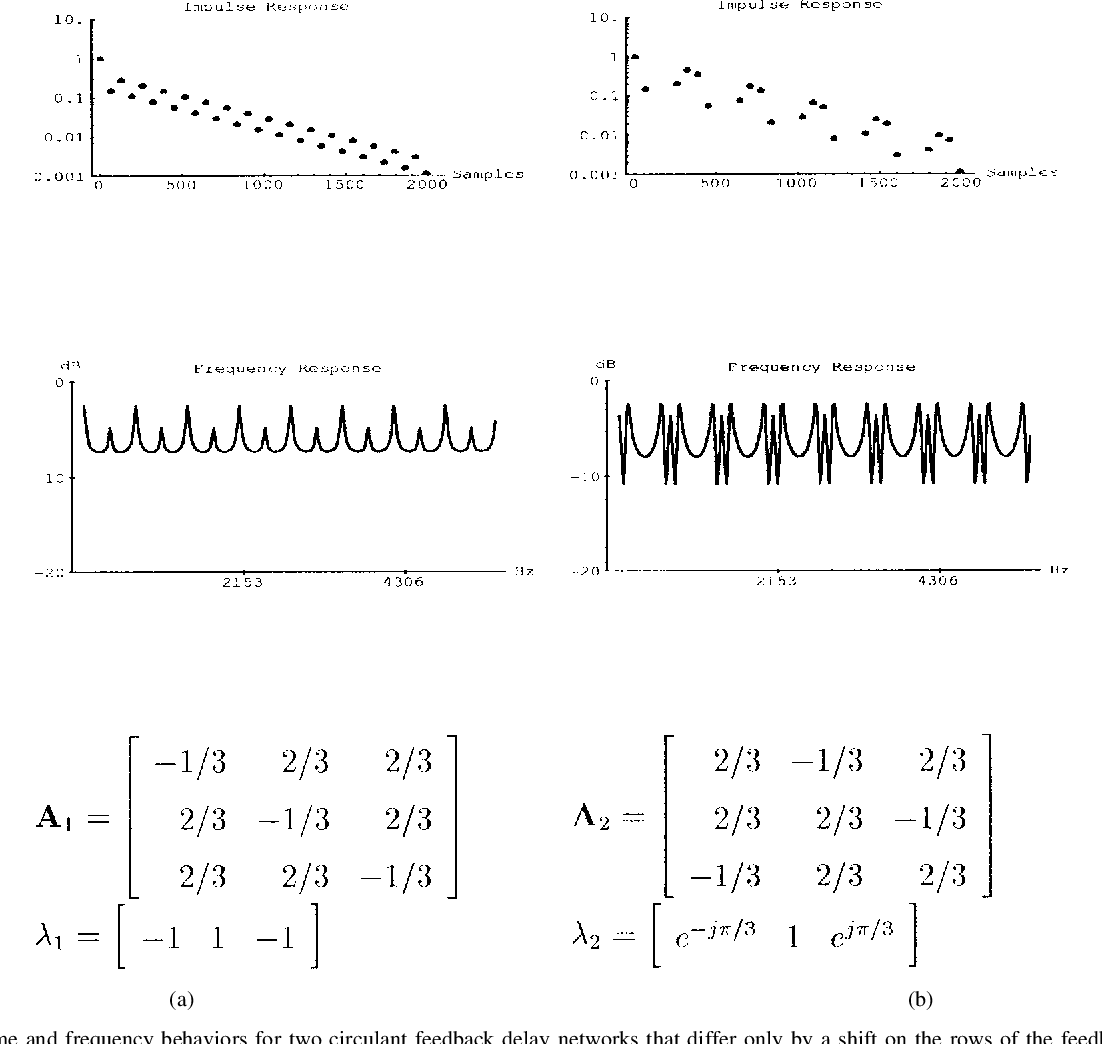
Convolution Reverb
Convolution reverb takes a different approach. Instead of simulating a space with an algorithm, it uses the pre-recorded impulse response (IR) of a real space. The dry audio signal is then mathematically convolved with this IR to place the sound within that captured acoustic environment.
For a dry signal and an impulse response , the resulting wet signal is given by the convolution integral:
This operation, in essence, "stamps" the acoustic signature of the IR onto the dry signal.
What Digital Reverb Actually Does - iZotope
This final reading from the iZotope article details the process of creating and using impulse responses for convolution reverb.
Read the section on convolution digital reverb. This will solidify your understanding of how IRs are captured and applied.
Convolution reverbs are prized for their realism, allowing you to place a vocal in a specific, famous concert hall, for example. Algorithmic reverbs, while potentially less "realistic," offer greater creative flexibility and are often less demanding on a computer's CPU.
Delay: The Fundamental Building Block
At the heart of all these reverberation models is the simple concept of delay: a single, discrete repetition of a sound. Understanding delay is key not only to understanding reverb, but also to unlocking a vast range of rhythmic and spatial effects crucial to electronic music.
Creating & Using Custom Delay Effects - Sound On Sound
This article from Sound On Sound introduces the core concepts of delay and its practical setup in a mix.
Read the introductory section (first few paragraphs) and the section under "Vocal Treatments" that explains the basic setup and tempo calculation.
The two fundamental parameters of any delay are:
- Delay Time: The time between the original sound and its echo.
- Feedback: The amount of the delayed signal that is fed back into the delay's input, creating further echoes. A feedback value of 0% results in a single echo, while higher values create a series of decaying echoes. A value of 100% or more can lead to self-oscillation, where the echoes grow in volume, a technique often exploited in noise and experimental music.
Applying Reverb and Delay in Production
Knowing the theory is one thing; applying it effectively is another. Let's explore the key parameters and techniques for using these effects to achieve your goals.
Creating Space and Depth
The primary use of reverb and delay is to move sounds from a dry, "in your face" context into a simulated three-dimensional space.
Everything about REVERB explained very FAST - Sound Design Theory
The Woochia video now breaks down the common parameters you'll find on a reverb plugin.
Watch the segment from the parameters section. Pay attention to the explanations of: Dry/Wet: The balance between the original (dry) and processed (wet) signal. When using reverb on a return track (a common practice), this should be set to 100% wet. Decay Time (or RT60): The length of the reverb tail. Size: Simulates the dimensions of the virtual room. Pre-delay: A short delay before the reverb begins. This is crucial for maintaining clarity. It separates the transient of the dry sound from the wash of the reverb, allowing the sound to be perceived as closer to the listener while still being in a large space. Early Reflections vs. Diffusion: The balance between the distinct early echoes and the smooth, diffuse late-reverb tail.
A common and powerful technique is to use EQ to shape your reverb. By placing an EQ on the reverb return track, you can filter out frequencies that might clash with other elements. A very common practice is to use a high-pass filter to remove low-frequency mud and a low-pass filter to remove high-frequency sizzle, helping the reverb sit "behind" the main elements in the mix.
Generating Rhythmic Complexity
In electronic music, delay is often used not just for space, but as a rhythmic element in its own right. To do this effectively, the delay time is synchronized to the project's tempo.
The formula is simple:
From there, you can derive other note values: divide by 2 for an eighth note, by 4 for a sixteenth note, multiply by 2 for a half note, and so on.
The Reverb Technique Every Producer Should Know
The video "The Reverb Technique Every Producer Should Know" focuses specifically on syncing reverb decay time to the tempo of your track.
This video demonstrates how to apply the tempo-syncing formula not just to delay, but to the decay time of a reverb. Watch the following segments: The basic calculation. Adjusting for pre-delay. Applying to longer durations. A crucial reminder to use your ears, not just the math.
Some classic rhythmic delay techniques include:
- Ping-Pong Delay: The echoes alternate between the left and right stereo channels, creating a wide, dynamic sense of movement.
- Slapback Delay: A single, very short delay (typically 60-180ms) with no feedback. It's used to add thickness and a subtle sense of space without a noticeable reverb tail.
- Ducked Delay: A compressor is placed on the delay return track and is sidechained to the dry signal. This means the delay echoes are "ducked" (reduced in volume) whenever the dry signal is present, and swell up in the gaps. This creates a clean, professional sound where the delays don't clutter the main performance.
Creating & Using Custom Delay Effects - Sound On Sound
The Sound On Sound article provides excellent descriptions of these creative delay techniques.
Read the sections on Ducked Delay, Ping-pong Delay, and Slap Happy to understand these core rhythmic and spatial tricks.
Conclusion
In this lesson, we have connected the physical phenomenon of sound waves in a space to their digital simulation through reverb and delay. You now have a framework for understanding these effects not just as abstract plugins, but as tools for manipulating the spatio-temporal properties of your audio.
Key Takeaways:
- Reverb Components: A reverberant signal consists of the direct signal, early reflections (defining space), and a reverberant tail (defining decay).
- Digital Implementations: Algorithmic reverb simulates space using networks of delay lines and filters, offering creative flexibility. Convolution reverb uses a recorded impulse response (IR) for hyper-realistic spatial emulation.
- Delay as a Foundation: Simple delay (with parameters for Time and Feedback) is the building block for reverb and a powerful rhythmic tool.
- Tempo Synchronization: You can mathematically sync delay times and reverb decays to your track's BPM to create rhythmic coherence, a cornerstone of electronic music production.
- Creative Application: Techniques like pre-delay, EQing the wet signal, ducking, and ping-pong delays are essential for creating professional-sounding depth, space, and rhythmic interest.
You now have the tools to begin sculpting the three-dimensional world your music inhabits. In our next lesson, we will shift focus from space to texture. We'll explore distortion and saturation, effects that shape a sound's timbre and add harmonic richness—techniques that are absolutely central to the aggressive, powerful soundscapes of industrial and techno music.