Hello! Let's continue our exploration of the many-body theory of excitons.
Introduction
In our last lesson, we established that the complex, many-body Bethe-Salpeter Equation (BSE) can be recast into a more familiar form: an eigenvalue problem for an effective two-particle Hamiltonian, . The eigenvalues of this Hamiltonian give the energies of the interacting electron-hole system, and the eigenvectors describe the exciton wavefunctions as a superposition of non-interacting electron-hole pairs.
The full BSE formalism is powerful and general, but it can seem quite abstract. A natural and important question is: how does this rigorous many-body framework connect to the simple, intuitive hydrogen-atom model of a Wannier-Mott exciton that we discussed earlier in the course?
Today's lesson will answer exactly that. Our learning outcome is to show how the BSE reduces to the Wannier equation for excitons under the effective mass approximation. We will start with the BSE eigenvalue equation and, by applying a series of physically justified approximations valid for many semiconductors, derive the well-known Wannier equation. This process is crucial because it validates both the sophisticated BSE theory by showing it contains the correct physical limit, and it provides a rigorous foundation for the simpler Wannier model, clarifying its assumptions and domain of validity.
The Starting Point: The BSE Eigenvalue Problem
Let's recall the final equation from our previous lesson. After transforming to a basis of non-interacting electron-hole pairs, the BSE becomes a matrix eigenvalue equation:
The Hamiltonian has two main parts:
- Diagonal Elements: These are the energies of the non-interacting pairs, , representing the kinetic energy.
- Off-Diagonal Elements: These arise from the interaction kernel and couple different electron-hole pairs. They consist of the repulsive exchange interaction (from the bare Coulomb potential ) and the attractive direct interaction (from the screened Coulomb potential ).
The Pathway of Approximations
To simplify this general equation into the Wannier form, we will make a few key approximations. These approximations are precisely what define the regime where the Wannier-Mott model is applicable.
-
Two-Band Model: For many direct-gap semiconductors, optical properties near the fundamental absorption edge are dominated by transitions between the highest valence band (v) and the lowest conduction band (c). We can therefore restrict our basis to electron-hole pairs created from just these two bands. This eliminates the sums over .
-
Effective Mass Approximation: Near the band extrema (let's assume at ), we can approximate the band structure as parabolic:
- Conduction band:
- Valence band:
The diagonal part of the Hamiltonian, which represents the kinetic energy of the pair, becomes:
where is the reduced effective mass of the electron-hole pair.
-
Approximation of the Interaction Kernel:
- Exchange Interaction: The electron-hole exchange interaction is a short-range effect. For Wannier-Mott excitons, where the electron and hole are typically separated by many lattice constants, this term is much weaker than the direct Coulomb attraction. For our derivation of the Wannier equation, we will neglect it. We will revisit its important effects (like fine-structure splitting) in a later lesson.
- Direct Interaction: The attractive direct interaction is given by the screened potential . In a semiconductor, the static dielectric constant effectively screens the bare Coulomb interaction. For the relatively large electron-hole separations and slow dynamics characteristic of Wannier excitons, we can approximate the dynamically screened potential by the statically screened potential: .
With these approximations, our BSE eigenvalue equation in momentum space simplifies significantly.
From the BSE to the Wannier Equation
The following resource provides a concise walkthrough of the final steps of the derivation. We will follow its logic to make the final connection.
TDDFT for extended systems II: Excitons
These presentation slides from Carsten Ullrich's lecture on TDDFT and excitons contain a clear, step-by-step derivation that shows how the many-body equations reduce to the Wannier equation.
Please study slides 32 through 39 (within the PDF viewer), under the heading 'Derivation of Wannier equation'. The key steps are: Applying the two-band and effective mass approximations to the general eigenvalue equation (slide 35). Examining the matrix elements of the BSE interaction kernel and replacing it with the screened Coulomb potential (slides 37-38). Performing a Fourier transform to convert the resulting momentum-space equation into a real-space differential equation, which is the Wannier equation (slide 39).
Let's consolidate the key steps from the resource. After applying our approximations, the BSE eigenvalue problem for the exciton amplitudes takes the form of an integral equation in momentum space:
The matrix element of the screened interaction, , after several steps of simplification (including averaging over the fast-oscillating periodic parts of the Bloch functions), becomes approximately , where is the Fourier transform of the screened potential . The equation becomes:
This is still in momentum space. To obtain the familiar Schrödinger-like form, we define the exciton envelope function as the Fourier transform of the amplitudes :
This envelope function describes the shape of the exciton's relative-motion wavefunction, averaged over a unit cell.
As you know from your courses on mathematical methods and quantum mechanics, Fourier transforms have the following properties:
- Multiplication by in momentum space corresponds to applying the operator in real space.
- A convolution in momentum space becomes a simple product in real space.
Applying these rules to our equation transforms it into a real-space differential equation:
Substituting and rearranging, we get:
This is precisely the Wannier equation. It is a Schrödinger equation for a particle with the reduced effective mass moving in a screened Coulomb potential. The eigenvalue, , is the exciton energy relative to the band gap, which is the negative of the exciton binding energy, .
The Physical Result: A Hydrogen-like Spectrum
The Wannier equation is mathematically identical to the equation for the hydrogen atom. Its solutions are therefore a series of bound states with quantized energies.
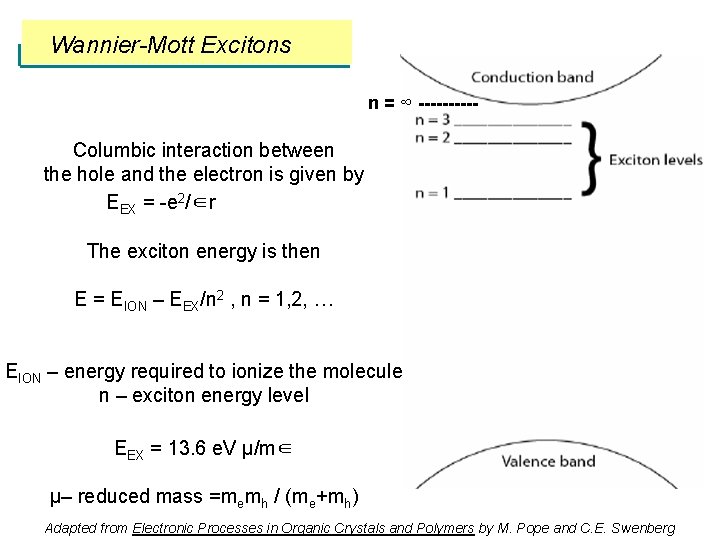
The binding energies are given by the exciton Rydberg series:
where is the exciton Rydberg energy:
Here eV is the hydrogen Rydberg constant. This shows that the exciton binding energy is significantly smaller than that of a hydrogen atom due to the typically small reduced mass () and large dielectric constant ().
This hydrogen-like series of absorption peaks converging to the band edge is the classic experimental signature of Wannier-Mott excitons. Your research interest in Cu₂O is particularly relevant here, as it is the textbook example of a material exhibiting a beautiful Rydberg series of excitons.
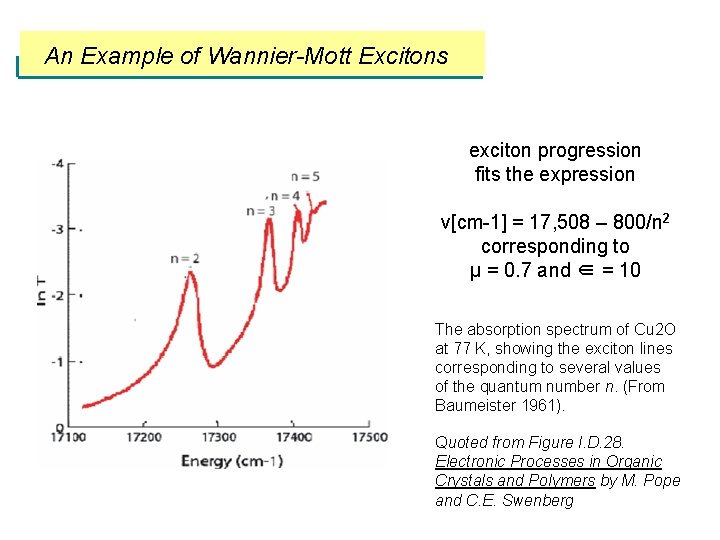
This spectrum is a direct experimental confirmation of the theoretical model we have just derived from the fundamental Bethe-Salpeter Equation.
Test your understanding!
The derivation of the Wannier equation from the BSE involved several key approximations. Which of these approximations would be the first to break down if we were to consider a tightly bound Frenkel exciton in an organic crystal, where the electron and hole are localized on the same molecule?
Show answer
Almost all of them would break down, but the most critical ones are:
- Neglecting the Exchange Interaction: For a Frenkel exciton, the electron and hole wavefunctions have significant overlap, making the short-range exchange interaction comparable in strength to the direct Coulomb term. It cannot be neglected.
- Using a Statically Screened Coulomb Potential: In a tightly bound system, the simple model of a uniform dielectric medium screening a point charge fails. The local environment and molecular structure become dominant.
- The Effective Mass Approximation: This approximation is based on delocalized Bloch waves near a band minimum. For a localized exciton, this picture is no longer valid.
Conclusion
In this lesson, we have successfully bridged the gap between the abstract many-body formalism and a simple, powerful physical model.
Key Takeaways:
- The Bethe-Salpeter Equation, when subjected to a series of physical approximations (two-band model, effective mass, static screening, and neglect of exchange), correctly reduces to the Wannier equation.
- The Wannier equation is a Schrödinger equation for an electron-hole pair with a reduced effective mass and a screened Coulomb interaction .
- This reduction provides a rigorous theoretical foundation for the hydrogenic model of Wannier-Mott excitons and clearly defines its assumptions.
- The solutions to the Wannier equation predict a Rydberg series of bound states with energies , which is a hallmark signature observed in the optical spectra of many semiconductors like Cu₂O.
Preview of the Next Lesson
To arrive at the simple Wannier equation, we made a crucial simplification: we neglected the electron-hole exchange interaction. While this is often a reasonable starting point for calculating the main binding energy, the exchange term has profound consequences for the exciton fine structure. In our next lesson, we will re-introduce this term and formally analyze the effect of the electron-hole exchange interaction on exciton energies. This will lead us to the crucial concept of singlet and triplet excitons and their different optical properties.