Hello! Let's continue our journey into the many-body physics of excitons.
Introduction
In our last lesson, we successfully derived the Wannier equation, a cornerstone for understanding weakly-bound excitons. We achieved this by starting with the complex Bethe-Salpeter Equation (BSE) and applying a series of simplifying approximations. The most critical simplification was neglecting the electron-hole exchange interaction. While this allowed us to recover the familiar hydrogenic model, it glossed over some crucial physics.
Today, we will reintroduce this term and fulfill this lesson's learning outcome: to analyze the effect of the electron-hole exchange interaction on exciton energies at a formal level. This interaction, which has no classical counterpart, is responsible for the fine structure of exciton energy levels. We will explore its quantum mechanical origins, see how it arises naturally within the BSE formalism, and understand its most important consequence: the energy splitting between singlet and triplet exciton states.
A Conceptual Refresher: The Exchange Interaction
Before diving into the solid-state formalism, let's refresh our understanding of the exchange interaction from fundamental quantum mechanics. The classic example is the helium atom, which involves two interacting electrons.
The following short video provides an excellent qualitative and quantitative review of how the Pauli exclusion principle leads to an energy difference between spin-parallel and spin-antiparallel states, even without any direct magnetic interaction.
This video from the Nicola Spaldin group at ETH Zurich clearly explains the origin of the exchange interaction using the first excited state of a Helium atom. It's a great refresher on the concepts of spatial wavefunction symmetry, the Coulomb integral (K), and the exchange integral (J).
Please watch the entire video (about 10 minutes, as the calculation is spread across sections). Pay close attention to how the total wavefunction's antisymmetry requirement forces the spatial part to be either symmetric or antisymmetric, depending on the spin configuration. Note how this leads to two different energy expectation values, with the difference being the exchange integral, J.
To summarize the key points from the video:
- The total wavefunction of a multi-electron system must be antisymmetric under the exchange of any two electrons.
- For a two-electron system, this means if the spin part is symmetric (spins parallel, total spin , a triplet), the spatial part must be antisymmetric.
- If the spin part is antisymmetric (spins antiparallel, total spin , a singlet), the spatial part must be symmetric.
- Calculating the energy expectation value with these two different spatial wavefunctions results in an energy difference. For the two-electron case, the total energy is .
- The Coulomb integral, K, represents the classical electrostatic repulsion between the charge clouds of the two electrons.
- The Exchange integral, J, is a purely quantum mechanical term with no classical analog. It arises from the interference terms in the wavefunction.
For the helium atom, the triplet (parallel spin) state has energy , while the singlet (antiparallel spin) state has energy . Since is positive for this configuration, the triplet state is lower in energy. This energy difference, , is the exchange splitting.
The Exchange Interaction in the Bethe-Salpeter Equation
Now, let's apply this concept to our electron-hole system in a semiconductor, using the rigorous BSE formalism. In the previous lesson, we saw that the BSE can be written as an eigenvalue problem for an effective two-particle Hamiltonian, . The interaction part of this Hamiltonian, the kernel , is where the physics of exchange lies.
To understand this formally, let's consult the paper by Lucia Reining, which we've used before. It provides the precise structure of the interaction kernel.
Linear Response and More: the Bethe-Salpeter Equation
In this resource, we'll focus on the section that transforms the BSE into an effective two-particle Hamiltonian. This will allow us to clearly identify the direct and exchange interaction terms.
Please read Section 6, 'A two-body Schrödinger equation' (pages 10.17-10.19). Focus on Equations (53), (54), and (55) and the accompanying text. This section explicitly defines the two-particle Hamiltonian and its interaction kernel Ξ in terms of the direct interaction (W) and the exchange interaction (v_c). Also, pay attention to Equation (49) and the discussion on singlet-triplet splitting.
Let's break down the key equations from the text. The effective two-particle Hamiltonian acts on electron-hole pair states and mixes them. Its interaction kernel (within the Tamm-Dancoff approximation and for optical transitions) is given by:
Here, denote the initial valence and conduction band states, and denote the final states.
-
Direct Term (): This is the attractive, screened Coulomb interaction. An electron in state is attracted to the hole left behind in state . This term is responsible for the binding of the exciton and is what we kept when deriving the Wannier equation. Diagrammatically, it's often called a "ladder" diagram, representing the sustained interaction between the electron and the hole as they propagate.
-
Exchange Term (): This is the repulsive electron-hole exchange interaction, arising from the bare Coulomb potential . Its structure is different: an electron in state can annihilate the hole in state , while a new pair is created with an electron promoted from to . This process only works if the initial and final pairs have the same total momentum. It is a purely quantum-mechanical process involving the annihilation of one pair and the creation of another.
Singlet-Triplet Splitting
The most profound consequence of the exchange interaction is the splitting of exciton states based on their total spin. An exciton is formed from an electron (spin-1/2) and a hole (which acts like a spin-1/2 particle). Their spins can combine to form:
- A total spin state (singlet), where the spins are antiparallel.
- A total spin state (triplet), where the spins are parallel.
As shown in Equation (49) of the Reining paper, the exchange interaction affects these two types of states differently:
- Triplet states (): The exchange term is zero. The interaction is purely the attractive direct term, .
- Singlet states (): The exchange term is non-zero and repulsive. The interaction is .
This means the exchange interaction raises the energy of the singlet exciton relative to the triplet exciton. The energy difference is the exchange splitting, .
Test your understanding!
In the helium atom example, the triplet state (parallel spins) was lower in energy. For the exciton, the triplet state is also lower in energy than the singlet. Is the underlying physics the same?
Show answer
The outcome is similar (triplet is lower in energy), but the nature of the interaction is different.
- For the two-electron system (Helium), the exchange interaction between the two identical fermions is fundamentally attractive. It lowers the energy of the spatially antisymmetric (spin-parallel) state.
- For the electron-hole system, the exchange interaction involves an electron from the conduction band annihilating a hole in the valence band. This process corresponds to a repulsive term in the effective exciton Hamiltonian. It raises the energy of the state it affects (the spin-singlet).
So, in both cases the triplet is lower in energy, but for electrons it's due to an attractive exchange force, while for excitons it's due to a repulsive exchange force that only acts on the singlet state.
Manifestation of the Exchange Interaction
The exchange interaction is short-ranged, as it requires the electron and hole wavefunctions to overlap. Its magnitude, , is proportional to , where is the exciton envelope function. This has several important consequences:
- It primarily affects s-like excitons (1s, 2s, ...), which have non-zero probability at .
- Its strength decreases rapidly with the principal quantum number (as in 3D) because the wavefunction becomes more spread out.
- In some materials, it can be strongly dependent on the exciton's center-of-mass momentum .
A prominent modern example is found in monolayer transition metal dichalcogenides (TMDs), which you might encounter in your research. In these materials, electrons and holes exist in distinct momentum valleys (K and K'). The exchange interaction can couple excitons in these different valleys.
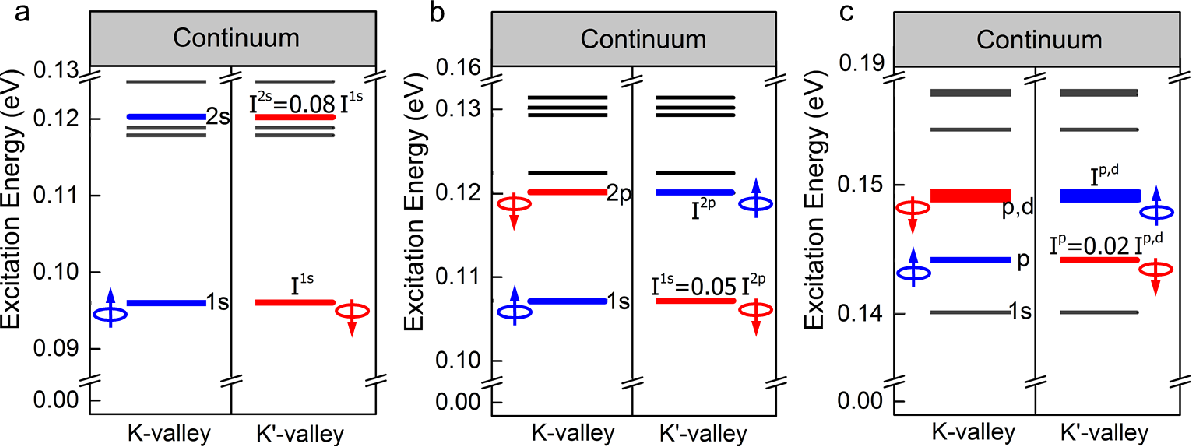
The following resource provides a formal treatment of this intervalley exchange.
Impact of Coulomb exchange interaction on exciton ...
This master's thesis by Marne Verjans provides a clear derivation of a Hamiltonian describing the momentum-dependent intervalley exchange interaction in TMDs. It's a great example of how the abstract concept of exchange manifests in a real material system.
Please skim Chapter 4, 'Coulomb Exchange Interaction' (pages 13-15). You don't need to follow the full derivation in the appendix (sections A.1 and A.2), but focus on the structure of the Hamiltonian in Eq. (4.5) and the resulting eigenenergies shown just below Eq. (4.7). This shows how the exchange term J_Q creates a momentum-dependent splitting of the exciton bands.
As shown in the resource, the exchange interaction adds an off-diagonal coupling term to the Hamiltonian that mixes the K and K' valley excitons:
Diagonalizing this Hamiltonian leads to new eigenstates that are symmetric and antisymmetric combinations of the original valley excitons, with energies split by an amount proportional to . This momentum-dependent splitting is a direct and measurable consequence of the electron-hole exchange interaction.
Conclusion
Today, we have formally incorporated the electron-hole exchange interaction into our model of excitons. This purely quantum mechanical effect, which we had previously neglected, is crucial for understanding the fine details of exciton physics.
Key Takeaways:
- The exchange interaction arises from the Pauli principle and the required antisymmetry of the total many-electron wavefunction.
- In the BSE formalism, it appears as a repulsive term () in the interaction kernel, originating from the possibility of electron-hole annihilation and re-creation.
- Its most important physical effect is the singlet-triplet splitting: it raises the energy of spin-singlet excitons but does not affect spin-triplet excitons, making the triplets the lower-energy states.
- The exchange interaction is short-ranged, depending on the electron-hole wavefunction overlap. Its magnitude thus depends on the exciton state (e.g., principal quantum number ) and can also depend on the exciton's momentum .
Preview of the Next Lesson
We have now built a fairly sophisticated picture of a single exciton, including its binding energy and fine structure. But what happens when we create not just one, but many excitons? At high densities, excitons cease to be isolated quasiparticles. They begin to overlap, their Coulomb interactions get screened by the surrounding charges, and eventually, the very concept of a bound exciton breaks down. At a critical density, the system undergoes a phase transition from an insulating gas of excitons to a conducting electron-hole plasma. This is the density-driven Mott transition, which will be the focus of our next lesson.