Hello! Welcome to the first lesson in our second module, "The Wannier-Mott Exciton Model".
Introduction
In our previous module, we built the foundation for understanding how light interacts with semiconductors. We concluded by deriving the k-selection rule, which dictates that photons primarily induce "vertical" transitions on an E-k diagram, creating an electron in the conduction band and a hole in the valence band with nearly the same crystal momentum ().
So far, however, we've ignored the mutual attraction between the newly created electron (charge ) and hole (charge ). This Coulomb force can bind them into a hydrogen-like, neutral quasiparticle: the exciton. This lesson is the first step in describing this bound state.
Today, our learning goal is to separate the center-of-mass and relative coordinates for a two-particle system to formulate the exciton problem. This is a powerful and elegant technique, which you've likely encountered in classical mechanics and in solving the hydrogen atom in your quantum mechanics courses. By applying it here, we will transform the seemingly complex problem of two interacting particles into two much simpler, independent problems:
- The motion of the exciton as a single entity moving through the crystal.
- The internal motion of the electron and hole relative to each other.
This separation is the crucial step that will allow us, in the next lesson, to solve for the energy levels and properties of the exciton itself.
1. The Electron-Hole Hamiltonian
Let's consider an electron at position with effective mass and a hole at position with effective mass . The total energy of this pair is the sum of their individual kinetic energies and their mutual potential energy.
Within the effective mass approximation, the kinetic energy operators are:
- Electron:
- Hole:
The electron and hole attract each other via the Coulomb potential. Inside a material, this interaction is "screened" by the polarization of the lattice, which is accounted for by the material's static dielectric constant, . The potential energy is:
The Hamiltonian for the two-particle system is therefore:
The corresponding time-independent Schrödinger equation, , is a partial differential equation in six spatial variables ( and ), making it very difficult to solve directly.
2. Transformation to Center-of-Mass and Relative Coordinates
To simplify the problem, we introduce a new set of coordinates. Instead of tracking the electron and hole individually, we track the motion of their center of mass and their separation.
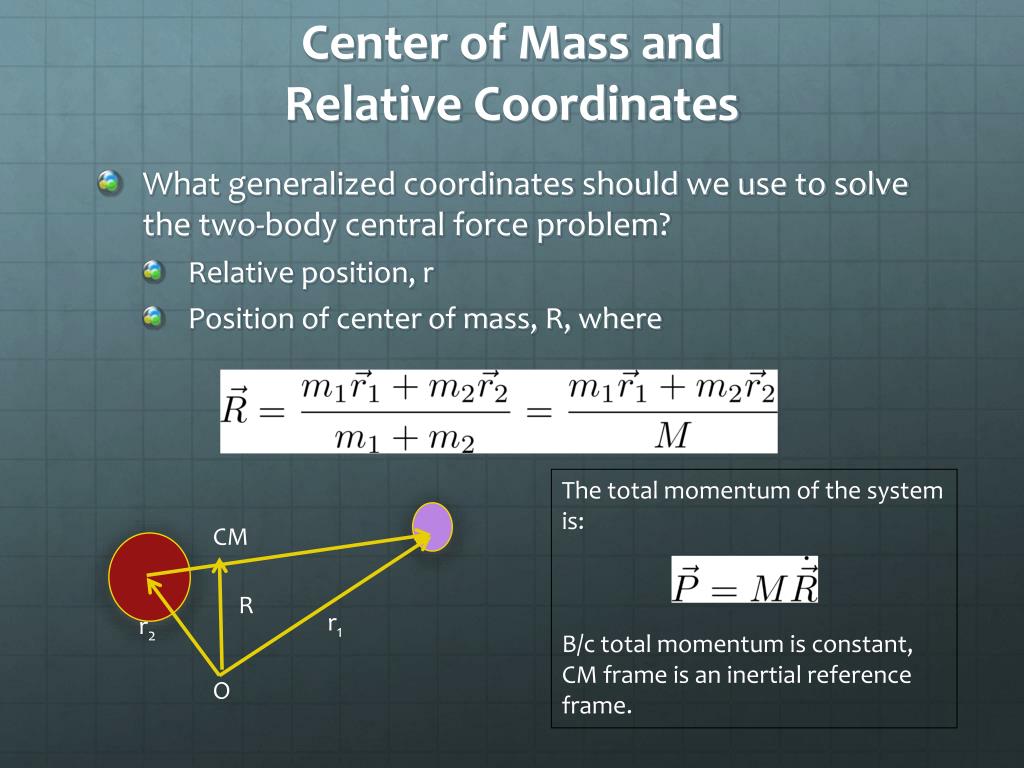
We define the relative position vector and the center-of-mass (COM) position vector as:
Our goal is to rewrite the Hamiltonian in terms of these new coordinates. This involves transforming the kinetic energy operators and \nabla_h^2) into derivatives with respect to and . The result of this mathematical procedure is remarkably simple and elegant.
Ground state of an exciton in a three-dimensional parabolic quantum dot
The following paper, though it discusses excitons in quantum dots, provides a perfectly clear and standard derivation of the coordinate separation for the general exciton Hamiltonian. It concisely presents the exact result we need.
Please read the text at the beginning of Section 2, from the sentence introducing the center-of-mass coordinates up to Equation (6). Focus on how the definitions of the center-of-mass (\mathbf{R}) and relative (\mathbf{r}) coordinates in Eq. (2) are used to rewrite the initial Hamiltonian into a sum of two independent Hamiltonians, H_{COM} and H_{relative}, as shown in Eqs. (3)-(5). Note the definitions of the total mass (M) and reduced mass (m) in Eq. (6). (You can ignore the parabolic potential terms, rac{1}{2}m\omega^2r^2, as we are considering a bulk semiconductor for now).
As the paper shows, the coordinate transformation neatly separates the Hamiltonian. By defining the total mass and the reduced mass ,
the Hamiltonian becomes a sum of two independent terms:
where
Here, and are the Laplacian operators with respect to the and coordinates, respectively, and . Notice that depends only on and depends only on . This separation is the key to solving the problem.
Test your understanding!
For Gallium Arsenide (GaAs), a common semiconductor used in research, the effective masses are approximately and for the electron and heavy-hole, respectively, where is the free electron mass. Calculate the reduced mass for a heavy-hole exciton in GaAs (in units of ). What do you notice about its value compared to and ?
Show answer
The reduced mass is calculated as:
Notice that the reduced mass () is slightly smaller than the smaller of the two masses, the electron effective mass (). This is a general property: the reduced mass of a two-body system is always dominated by the lighter particle.
3. Separation of the Schrödinger Equation
Because the Hamiltonian is now a sum of two independent operators acting on different variables, we can solve the Schrödinger equation using the separation of variables method. We propose a product-form solution for the total wavefunction:
where is the COM wavefunction and is the relative motion wavefunction.
Substituting this into the Schrödinger equation, we get:
Since only acts on and only acts on , this becomes:
The logic from here is a standard argument in quantum mechanics.
Center of mass and relative motion wavefunctions
The following video from an MIT OpenCourseWare quantum mechanics course demonstrates exactly how the separability of the Hamiltonian leads to a separation of the total wavefunction and two independent Schrödinger equations. The example used is the hydrogen atom, which is perfectly analogous to our exciton problem.
Please watch from 04:47 to 11:30. This part of the lecture shows how a product wavefunction is substituted into the Schrödinger equation, and how the equation is separated into two independent equations—one for the center-of-mass motion and one for the relative motion. The logic is identical to our case.
By following the procedure in the video (dividing the entire equation by ), we arrive at two separate, simpler Schrödinger equations:
- Center-of-Mass Equation:
- Relative Motion Equation:
The total energy of the exciton is simply the sum of the energies from these two parts: .
4. Physical Interpretation
This mathematical separation has a clear and powerful physical meaning:
-
Center-of-Mass Motion: The first equation is the Schrödinger equation for a free particle of mass . Its solutions are plane waves of the form , where is the wavevector of the exciton's center of mass and is the crystal volume. The corresponding energy is the kinetic energy of the exciton as a whole:
This describes the exciton propagating through the crystal as a single, neutral quasiparticle. -
Relative Motion: The second equation describes the internal structure of the exciton. This equation is formally identical to the Schrödinger equation for a hydrogen atom. However, there are two critical modifications:
- The mass is the reduced mass of the electron-hole pair.
- The Coulomb potential is weakened, or screened, by the dielectric constant of the semiconductor.
We have successfully reduced the complex, 6D two-body problem into two familiar, solvable problems: a free particle and a hydrogen atom.
Conclusion
In this lesson, we have taken a crucial step in formalizing the concept of the exciton. By recognizing the electron-hole pair as a two-body system, we were able to simplify the problem dramatically.
Key Takeaways:
- The exciton is modeled as an interacting electron-hole pair, described by a two-particle Hamiltonian that includes their kinetic energies (with effective masses) and their screened Coulomb attraction.
- By transforming to center-of-mass () and relative () coordinates, the Hamiltonian separates into two independent parts: .
- describes a free particle with total mass , representing the motion of the exciton as a whole through the crystal.
- describes a hydrogen-like problem for a fictitious particle with a reduced mass and a screened Coulomb potential.
- This separation allows the total wavefunction to be written as a product, , turning one difficult 6D differential equation into two solvable 3D equations.
Preview of the Next Lesson
We have successfully isolated the equation governing the exciton's internal structure. In our next lesson, we will solve this "excitonic hydrogen atom" problem. By doing so, we will derive the two most important properties of a Wannier-Mott exciton: its discrete series of quantized binding energies (the exciton Rydberg series) and its characteristic size (the exciton Bohr radius).