Hello! Welcome to your next lesson on the Wannier-Mott exciton model.
Introduction
In our last lesson, we performed a crucial mathematical step: by transforming to center-of-mass and relative coordinates, we separated the complex two-body problem of an electron and a hole into two much simpler, independent problems. We found that the exciton behaves as:
- A free particle of total mass , describing its motion through the crystal.
- A hydrogen-like bound system with a reduced mass and a screened Coulomb potential, describing its internal structure.
We left off with the Schrödinger equation for the relative motion:
Today, our goal is to solve this equation. Since you have a strong background in quantum mechanics, you'll immediately recognize its form. We will leverage the known solution of the hydrogen atom problem to derive the two most fundamental properties of a Wannier-Mott exciton: its discrete series of binding energies, known as the exciton Rydberg series, and its characteristic size, the exciton Bohr radius. These results form the bedrock for understanding the spectroscopy of semiconductors like GaAs and Cu₂O.
1. The "Excitonic Hydrogen Atom"
The equation for the relative motion is mathematically identical to the Schrödinger equation for the hydrogen atom. The only differences are in the physical constants used. Let's make a direct comparison:
| System | Particle Mass | Coulomb Interaction Term |
|---|---|---|
| Hydrogen Atom | Electron mass, | |
| Wannier Exciton | Reduced mass, |
This allows us to obtain the solution for the exciton by simply taking the well-known results for hydrogen and making the following substitutions:
- Replace the electron mass with the reduced mass:
- Replace the vacuum permittivity with the material's effective permittivity:
Let's recall the standard results for the hydrogen atom's ground state:
- Bohr Radius: Å
- Rydberg Energy: eV
The energy levels of hydrogen are given by the famous formula , where is the principal quantum number.
2. Deriving Exciton Properties
By applying our substitutions, we can now define an effective Bohr radius () and an effective Rydberg energy () for the exciton.
Exciton Bohr Radius
Substituting and into the formula for , we get the exciton Bohr radius:
It's insightful to express this in terms of the hydrogen Bohr radius:
This shows that the exciton's "size" is increased by two factors: the dielectric screening () and the fact that the reduced mass is typically much smaller than the free electron mass . In most semiconductors, is many times the lattice constant, justifying our use of the effective mass and macroscopic dielectric constant.
Exciton Rydberg Energy and Binding Energies
Similarly, substituting into the formula for , we find the effective Rydberg energy for the exciton, which represents its binding energy in the ground state ():
Again, expressing this in terms of the hydrogen Rydberg energy:
The binding energy is significantly reduced compared to hydrogen. Note the powerful effect of the dielectric constant, which enters as . This is why exciton binding energies are typically in the meV range, whereas atomic binding energies are in the eV range.
The full series of bound-state energies for the exciton's relative motion is a Rydberg series:
These energies are negative, indicating they are bound states. They are measured relative to the continuum of free electron-hole pairs, which begins at the semiconductor's band gap energy, .
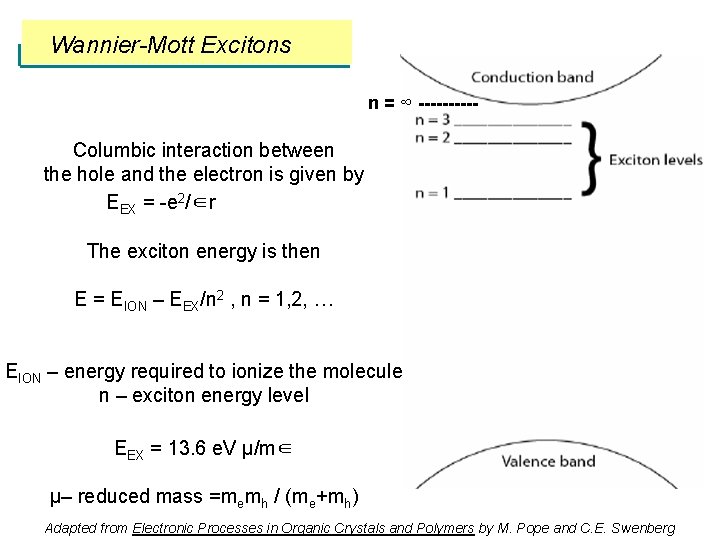
Therefore, the total energy of an exciton with center-of-mass wavevector and principal quantum number is:
For optical transitions where , we create excitons with discrete energies located at . This is what you see as sharp absorption peaks below the main band-edge absorption in experiments.
Rydberg excitons in external fields
The following text from the dissertation 'Rydberg excitons in external fields' provides an excellent and compact summary of the model we have just discussed. It connects the initial two-particle Schrödinger equation to the final exciton energy spectrum.
Please read Section 2.2.3, titled 'Excitons'. Pay close attention to the transition from the full Schrödinger equation (2.56) to the separated equations for center-of-mass (2.57) and relative motion (2.58). Confirm how our definitions of the effective Rydberg (Eq. 2.60) and the total energy (Eq. 2.61) match what we have just derived.
3. A Concrete Example: Gallium Arsenide (GaAs)
Your research has involved photoluminescence of GaAs, so let's apply our theory to it.
The relevant parameters for GaAs are:
- Electron effective mass:
- Heavy-hole effective mass:
- Static dielectric constant:
1. Calculate the reduced mass :
2. Calculate the exciton Bohr radius :
The lattice constant of GaAs is about 5.65 Å. The exciton radius is about 20 times larger than the lattice spacing, confirming that our continuum model (using ) and effective mass approximation are well-justified.
3. Calculate the exciton binding energy :
This small binding energy is easily overcome by thermal energy at room temperature ( meV), which is why clear excitonic features in GaAs are typically observed at cryogenic temperatures, like the 4K you use in your experiments ( meV).
Test your understanding!
You mentioned an interest in the yellow-series excitons in Cuprous Oxide (), which are famous for forming Rydberg states. For this series, the relevant parameters are , , and .
Calculate the ground state () binding energy () and the exciton Bohr radius () for these excitons in . How do they compare to GaAs?
Show answer
First, we calculate the reduced mass for :
Now, we calculate the Bohr radius:
And the binding energy:
Comparison:
- Binding Energy: The exciton binding energy ( meV) is much larger than in GaAs ( meV). This is primarily because the dielectric constant is smaller and its effect is squared. This larger binding energy makes the exciton more stable against thermal dissociation and is a key reason why high-n Rydberg states (up to n > 20) are observable in .
- Bohr Radius: The exciton is much smaller ( Å) than the GaAs exciton ( Å), mainly due to its larger reduced mass.
Microscopic modelling of exciton-exciton interactions in ...
The following video, though focused on 2D materials, gives an excellent conceptual overview of the Wannier equation and the resulting hydrogen-like properties of excitons. It visually reinforces the concepts we've just derived mathematically.
Watch the segment from 10:15 to 13:10 in the video from Chalmers University of Technology. This corresponds to Section 2.3, 'The emergence of excitons'. Focus on how the narrator describes the transformation to the Wannier equation (Eq. 2.22) and its analogy to the hydrogen atom, leading to a Rydberg series of states (Fig. 2.1b). The discussion about screening (Fig. 2.2b) also provides a nice lead-in to our next topic.
Conclusion
In this lesson, we have solved the fundamental problem of the Wannier-Mott exciton. By building on your existing knowledge of the hydrogen atom, we've derived the key parameters that govern exciton physics in bulk semiconductors.
Key Takeaways:
- The relative motion of an electron-hole pair is described by a Schrödinger equation analogous to the hydrogen atom, but with a reduced mass and a screened Coulomb potential characterized by .
- Solving this equation yields a Rydberg series of bound states with energies , where is the effective Rydberg energy or exciton binding energy. These energy levels lie within the semiconductor band gap.
- The exciton binding energy () and characteristic size () are given by:
- The properties of real materials (effective masses and dielectric constant) determine whether excitons are large and weakly bound (like in GaAs) or smaller and more tightly bound (like in Cu₂O).
Preview of the Next Lesson
We have seen the critical role of the static dielectric constant in determining exciton properties. In the next lesson, we will look more closely at this phenomenon. We will analyze the role of dielectric screening on exciton binding energies in different material classes, and we will derive the criterion that distinguishes these large, weakly-bound Wannier-Mott excitons from their tightly-bound counterparts, Frenkel excitons, which are typically found in molecular crystals and insulators.