Hello! Welcome to the first lesson in our new module on excitonic complexes.
In the previous modules, we developed a comprehensive picture of the single exciton—a two-body system of an electron and a hole. We explored its hydrogenic nature, its interaction with light, and its complex behavior in magnetic fields, culminating in our discussion of quantum chaos and state mixing. We are now ready to add more particles to the mix and explore the rich physics of many-body excitonic states.
This lesson addresses the learning outcome: Describe the formation and binding of trions (charged excitons) in doped or gated semiconductors. We will investigate what happens when an exciton captures an additional charge carrier, forming a three-body quantum mechanical system known as a trion. This is a fundamental step toward understanding the optical properties of real-world semiconductors, which almost always contain some density of free carriers.
1. The Concept of a Trion
A trion is a quasiparticle consisting of three charge carriers. It is, in essence, a charged exciton. We distinguish between two types:
- Negative trion (): Formed when an exciton (one electron + one hole) binds with an additional electron. It consists of two electrons and one hole.
- Positive trion (): Formed when an exciton binds with an additional hole. It consists of one electron and two holes.
These complexes are prevalent in n-doped or p-doped semiconductors, respectively, where a background population of free carriers is available to be captured by photo-excited excitons. They can also be formed in gated semiconductor structures where a carrier gas can be electrically induced.
To start, let's get a formal definition and a visual picture of trion formation.
Trion-phonon interaction in atomically thin semiconductors
This excerpt from the introduction of a paper by Perea-Causin et al. provides a concise definition of trions and their importance in doped semiconductors.
Please read the 'Introduction' section. Focus on the first few paragraphs that define positive and negative trions and explain the context in which they form (doped materials).
The image below, from the same paper, provides a helpful visualization of the concepts. Panel (b) shows the band structure context for forming a negative trion, while panels (c) and (d) illustrate the resulting bound state.

2. The Trion Hamiltonian: A Three-Body Problem
Unlike the exciton, which can be mapped to the analytically solvable two-body hydrogen atom problem, the trion is an intrinsically three-body problem and lacks a closed-form solution.
Let's consider the Hamiltonian for a negative trion (), which consists of two electrons (at positions with effective mass ) and one hole (at position with effective mass ). In the effective mass approximation, the Hamiltonian is:
Here, is the dielectric permittivity of the material. A stable, bound trion exists only if the total ground state energy of this Hamiltonian, , is lower than the energy of a free exciton and a free electron, . The trion binding energy, , is defined as this energy difference:
This binding energy is typically small, often just a few meV, which is a fraction of the exciton binding energy itself. This makes trions fragile and observable mainly at low temperatures.
The image below gives a nice conceptual picture of how photo-excited excitons interact with a background of carriers (a Fermi sea) to form trions.
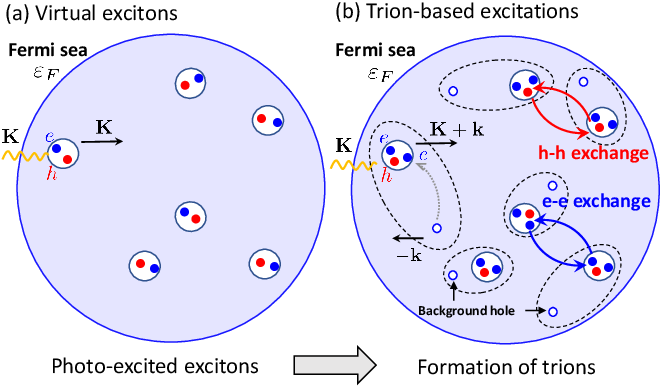
3. A More Rigorous Model: The Trion Schrödinger Equation
Given your background, we can go beyond the simple Hamiltonian and look at how this problem is tackled in modern condensed matter theory. The approach involves transforming the basis from individual electrons and holes to an exciton-electron basis. This is physically intuitive: we view the trion not as three independent particles, but as an exciton interacting with a third carrier.
This transformation leads to a Schrödinger equation for the relative motion between the exciton and the extra electron. This is a very powerful formulation that provides deep insight into the trion's internal structure.
Trion-phonon interaction in atomically thin semiconductors
The following reading from Perea-Causin et al. outlines the derivation of the trion Hamiltonian and the resulting Schrödinger equation. This is mathematically dense, but it formalizes the intuitive picture of an 'exciton interacting with an electron'.
Please read Section II ('microscopic model') and the more detailed Appendix A ('Trion Hamiltonian'). In Section II, focus on the conceptual steps: starting with the electron-hole system, transforming to the exciton-electron picture, and arriving at the trion Schrödinger equation (Eq. 3). In Appendix A, trace the derivation from the electron-hole Hamiltonian (A1) to the exciton-electron Hamiltonian (A8) and finally the trion Schrödinger equation (A11). Don't get bogged down in every operator, but focus on understanding the transformation of basis and the meaning of the final equation.
The key result from that reading is the trion Schrödinger equation in the exciton-electron basis (Eq. A11 in the paper):
Let's break this down:
- is the trion wavefunction. It depends on the exciton state () and the relative momentum between the exciton and the third electron ().
- The first term is the kinetic energy, containing the exciton's internal energy () and the kinetic energy of the exciton-electron relative motion (with reduced mass ).
- The second term is the crucial interaction potential . It describes the Coulomb interaction between the third electron and the electron/hole within the exciton. Notice it connects different exciton states (). This term is responsible for the binding. It causes a polarization of the exciton by the field of the third charge, creating an induced dipole that leads to a net attraction.
Solving this equation numerically yields the trion eigenenergies and wavefunctions.
4. Key Factors Influencing Trion Binding
The solution to the three-body problem is sensitive to several physical parameters.
Mass Ratio
The binding energy is strongly dependent on the electron-to-hole effective mass ratio, .
- In the limit , a negative trion resembles a hydrogen anion (H⁻), where two light electrons orbit a heavy nucleus.
- In the limit , a positive trion resembles a hydrogen molecular ion (H₂⁺), where one light electron orbits two heavy nuclei.
As you know from atomic physics, H⁻ is very weakly bound. In semiconductors, trion binding is often maximized for mass ratios that are not extremely small or large, making the "three-body" nature of the problem fully apparent, as none of the particles can be considered stationary.
Dimensionality
Confinement has a dramatic effect on binding energy.
- 3D (Bulk): Trion binding energies are extremely small, often unobservable.
- 2D (Quantum Wells): Confining the carriers to a plane significantly enhances the Coulomb interaction by preventing them from moving far apart in the third dimension. This increases the binding energy, making trions readily observable in quantum well structures. This effect is analogous to how the 2D hydrogen atom's binding energy is four times that of the 3D case.
The following reading provides excellent context on trion observation and the effects of mass ratio and dimensionality.
Trion Based Optical Processes in Semiconductor Quantum...
This chapter from a PhD thesis provides a very clear conceptual introduction to trions, touching upon their history, the three-body problem, and the importance of dimensional confinement.
Please read Section 1.1 'Trions' and Section 2.3 'Excitons and Trions', including subsection 2.3.2 'Effects of dimensional confinement'. Pay attention to the comparison with H⁻ and H₂⁺ and the discussion on why trions are more easily observed in quantum wells.
5. Trion Spin States: Singlet and Triplet
For a negative trion (), the two electrons are identical fermions. The Pauli exclusion principle dictates that their total wavefunction must be antisymmetric upon exchange. The total wavefunction is a product of a spatial part and a spin part. This leads to two distinct configurations:
- Singlet Trion: The two electrons form a spin-singlet state (, antisymmetric spin wavefunction). To maintain overall antisymmetry, the spatial wavefunction must be symmetric. This allows the electrons to occupy the same lowest-energy spatial orbital, but at the cost of being closer together, increasing Coulomb repulsion.
- Triplet Trion: The two electrons form a spin-triplet state (, symmetric spin wavefunction). The spatial wavefunction must therefore be antisymmetric. An antisymmetric spatial wavefunction must have a node where the two electrons are at the same position ( implies ). This keeps the electrons further apart, reducing their Coulomb repulsion.
At zero magnetic field, the energetic cost of forcing the electrons into a higher-energy, spatially antisymmetric state is typically greater than the energy gained from reduced repulsion. Consequently, only the singlet trion is usually bound at B=0. The triplet state is generally unbound. However, as we saw in previous lessons, a magnetic field can change everything. By quantizing the orbital motion into degenerate Landau levels, a magnetic field can make it energetically favorable for electrons to occupy different orbitals with parallel spins, potentially leading to the formation of a bound triplet trion.
The resource from the University of Oregon provides a good explanation of this.
Trion Based Optical Processes in Semiconductor Quantum...
Let's return to the PhD thesis to explore the distinction between singlet and triplet trion states.
Please read Section 4.2 'Fine Structure of Excitons and Trions' and Section 4.3 'Triplet State of the Trion'. Focus on the reasoning based on exchange symmetry for why the singlet is the ground state at zero field and how a magnetic field can enable the formation of a bound triplet state.
6. Formation in Doped and Gated Structures
Finally, let's explicitly connect trion formation to the environments mentioned in the learning outcome. To form trions efficiently, a reservoir of charge carriers is needed.
-
Doped Semiconductors: This is the most straightforward method.
- n-doping introduces donor impurities, which provide a gas of free electrons in the conduction band, enabling the formation of negative trions ().
- p-doping introduces acceptor impurities, providing free holes in the valence band for the formation of positive trions ().
-
Gated Semiconductors: Field-effect structures offer dynamic control. By applying a voltage to a gate, one can attract and accumulate either electrons or holes at the interface of a quantum well, forming a two-dimensional electron gas (2DEG) or hole gas (2DHG). The density of this gas, and thus the rate of trion formation, can be tuned by simply changing the gate voltage. A specific technique called modulation doping, where dopants are placed in the barrier layers adjacent to a quantum well, creates a high-mobility 2DEG by spatially separating the carriers from the ionized impurity scattering centers.
The same thesis resource has a great section explaining these techniques. Please review section 2.5 ("Two-dimensional Carrier Gases"), especially the descriptions of modulation doping and optical doping in Figure 2.7.
Test your understanding!
Consider two different 2D quantum well systems:
- System A: A GaAs/AlGaAs quantum well. The effective mass ratio is .
- System B: A monolayer of MoS₂. The effective mass ratio is .
Assume both are n-doped to the same electron density and kept at the same low temperature. A photoluminescence experiment is performed on both. How would you expect the trion binding energy () and the intensity of the trion luminescence peak relative to the exciton peak to compare between the two systems? Justify your answer based on the concepts discussed.
Show answer
Based on theoretical calculations of the three-body problem, the trion binding energy is highly dependent on the mass ratio . The binding energy is generally larger for mass ratios closer to 1.
-
Binding Energy (): System B (MoS₂, ) has a mass ratio much closer to 1 than System A (GaAs, ). Therefore, we would expect the trion binding energy to be significantly larger in MoS₂ than in GaAs. A more tightly bound trion is more stable.
-
Relative Intensity: The relative intensity of the trion peak depends on the formation probability. Since the trion in System B is more stable (more tightly bound), it is more likely to form and remain stable until it recombines radiatively. Therefore, we would expect the intensity of the trion photoluminescence peak, relative to the neutral exciton peak, to be stronger in System B compared to System A, all other conditions being equal.
Conclusion
In this lesson, we have taken our first step into many-body exciton physics by introducing the trion. We have established that this three-body quasiparticle is a cornerstone for understanding the optical properties of doped semiconductors.
Key Takeaways:
- Trions are charged excitons ( or ) formed when an exciton binds to an extra electron or hole from a carrier reservoir.
- Their formation and binding are described by a three-body Schrödinger equation that lacks an exact analytical solution but can be solved numerically.
- Trion binding energy is highly sensitive to the electron-hole mass ratio and dimensionality, with 2D confinement in quantum wells being crucial for creating strongly bound trions.
- Due to Pauli exclusion for the two identical fermions, trions can exist in singlet or triplet spin states. At zero field, only the singlet state is typically bound.
Preview of the Next Lesson
We have tackled the three-body problem. The logical next step is the four-body problem. In our next lesson, we will investigate the biexciton, an excitonic molecule formed from two excitons. We will formulate its Hamiltonian, explore variational methods for estimating its binding energy, and discuss its unique optical signatures.