Hello! Let's dive into our next lesson.
In our last session, we developed a powerful quantitative tool—level spacing statistics—to identify the onset of quantum chaos in the magneto-exciton spectrum. We saw that in the intermediate field regime, the system's energy levels exhibit GUE statistics, a clear signature of non-integrable dynamics and broken time-reversal symmetry. This statistical analysis, while rigorous, might feel a bit abstract. What are the tangible, physical consequences of this chaos?
Today, we will answer that question by connecting the abstract concept of state mixing to a direct, measurable phenomenon. This lesson is designed to help you evaluate the field-induced mixing of ortho- and para-exciton states and the resulting relaxation of optical selection rules. We'll see how the very same chaotic interactions that cause level repulsion also blur the lines between previously distinct exciton states, making "dark" excitons visible and changing the optical fingerprint of the material.
A Quick Review: Ortho- and Para-excitons in Cu₂O
As you know from your background, an exciton is a bound state of an electron (spin ) and a hole (which has an effective spin ). Their spins can combine to form two types of excitons:
- Para-excitons: Total spin (antiparallel spins, singlet state).
- Ortho-excitons: Total spin (parallel spins, triplet state).
At zero magnetic field, the electron-hole exchange interaction splits these states in energy. In many materials, dipole selection rules mean that only singlet excitons can be created by a single photon, as the crystal ground state is also a singlet.
However, cuprous oxide (Cu₂O) is a fascinating and more complex case. Due to the specific symmetries of its crystal lattice and band structure, the optical selection rules are quite different. As we'll review in the following reading, the lowest energy transitions are parity-forbidden for electric dipole coupling. For the higher-lying "yellow" exciton series (), which are formed from -like envelope functions, transitions are weakly allowed via electric quadrupole coupling. Crucially, due to the symmetries of the bands involved, these rules lead to a situation where the para-exciton is optically forbidden, while the ortho-exciton is the one that is weakly "bright".
Magneto-absorption spectra of hydrogen-like yellow exciton series in Cu₂O
To formalize our understanding of the unique properties of excitons in Cu₂O, let's study a research paper that delves into this topic. It's directly relevant to your own research interests and will provide the foundation for today's lesson.
Please read the following sections from the paper by Slobodeniuk et al.: 'Symmetry of the yellow excitons': This section explains how the crystal structure and the symmetries of the electron (Γ_6^+) and hole (Γ_7^+) bands lead to the formation of ortho- and para-excitons. Don't worry about tracking every detail of the tight-binding model; focus on the final result regarding the formation of singlet and triplet states. 'Selection rules': This is the key part. Follow the argument for why the para-exciton is optically dark, while the ortho-exciton can be excited via a quadrupole transition. Pay close attention to the 'unusual selection rules' derived at the end of this section (before 'Motion of electron-hole pair').
So, at zero magnetic field, we expect to see absorption peaks corresponding to the ortho-exciton states, while the para-exciton state should be invisible. This clean separation, however, is about to be disrupted by the magnetic field.
The Mixing Mechanism: How a Magnetic Field Couples Spin States
Let's construct the mechanism for this disruption. The interaction of the exciton's spin with an external magnetic field is described by the Zeeman Hamiltonian:
where and are the g-factors for the conduction band electron and valence band hole, respectively, and is the Bohr magneton.
The crucial insight is that this Hamiltonian does not necessarily commute with the total spin squared operator, , where . The operator conserves total spin only in the special case where . If the g-factors are different, the magnetic field can induce transitions between states of different total spin—specifically, it can mix singlet and triplet states.
Let's prove this by examining the effect of on the states:
- Para-exciton (): |0,0\rangle = \frac{1}{\sqrt{2}}(|\uparrow\downarrow\rangle_e_h - |\downarrow\uparrow\rangle_e_h)
- Ortho-exciton (): |1,0\rangle = \frac{1}{\sqrt{2}}(|\uparrow\downarrow\rangle_e_h + |\downarrow\uparrow\rangle_e_h)
The Zeeman Hamiltonian has a non-zero off-diagonal matrix element between these two states:
After applying the spin operators and simplifying, we find:
This non-zero off-diagonal element is the key. It demonstrates that the magnetic field acts as a coupling term that directly mixes the and manifolds, as long as .
The Hamiltonian restricted to this two-level subspace can be written as a 2x2 matrix:
where and are the zero-field energies. Diagonalizing this matrix gives the new energy eigenvalues and eigenstates in the presence of the field. These new states are no longer pure ortho- or para-excitons, but superpositions of them.
The paper you are reading confirms this analysis perfectly.
Magneto-absorption spectra of hydrogen-like yellow exciton series in Cu₂O
Let's return to the paper by Slobodeniuk et al. to see this mixing described in the context of their experimental analysis.
Please read the subsection 'Fit to experimental data'. Focus on the text surrounding Eq. (16). It explicitly states that the interaction of spins with the magnetic field mixes the ortho- and para-exciton states and provides the resulting energy eigenvalues.
The Optical Signature: Relaxation of Selection Rules
Now we can connect the state mixing to its observable consequence. At , the para-exciton state is optically dark. The oscillator strength for a transition is proportional to the square of the transition matrix element, , where is the light-matter interaction operator. For the para-exciton, this is zero.
In the magnetic field, the new eigenstates are:
The mixing angle is determined by the field strength and the zero-field energy splitting.
Consider the transition to the state, which is predominantly para-like at small fields. Its transition matrix element is:
Since , this simplifies to:
The oscillator strength for this transition is now , where is the oscillator strength of the pure ortho-exciton.
The dark state has "borrowed" intensity from the bright state. As the magnetic field increases, the mixing angle grows, and the initially forbidden transition becomes progressively brighter. This phenomenon is what we call the relaxation of optical selection rules. It's a direct, spectroscopic signature of the state mixing induced by the field.
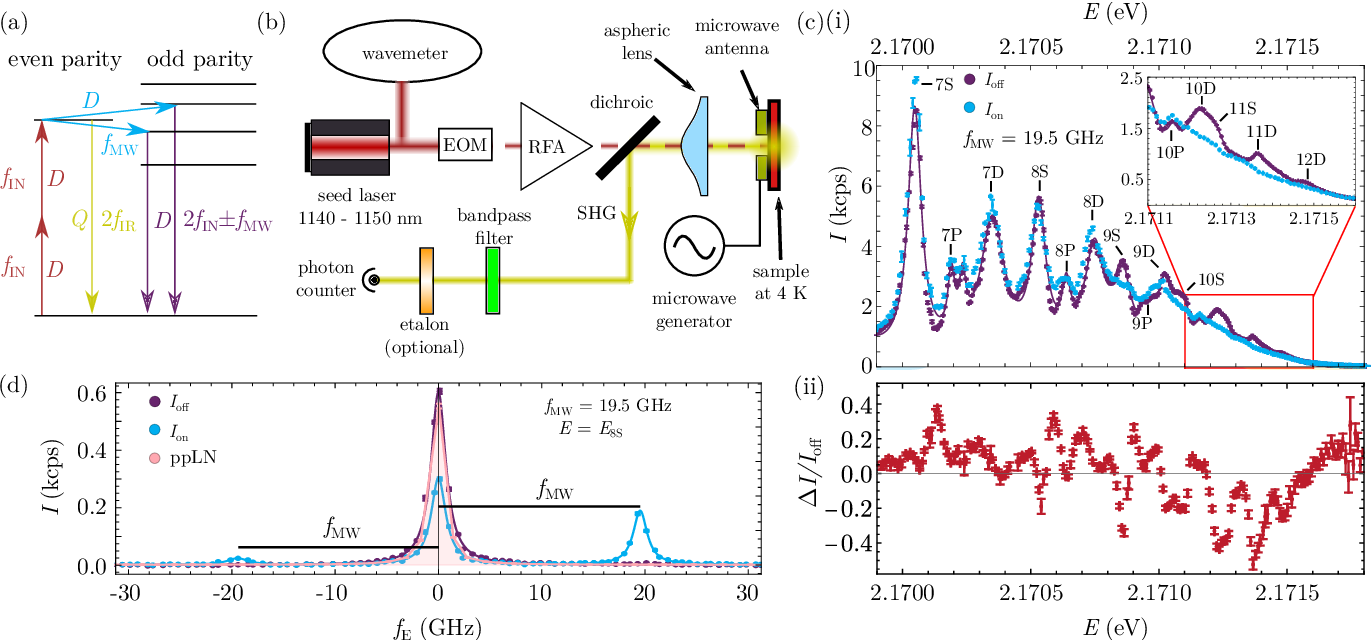
This principle of field-induced mixing is quite general. The image below shows an elegant experiment where a microwave field, instead of a static magnetic field, is used to mix Rydberg exciton states of different orbital parity (-states and -states) in Cu₂O. The mechanism is analogous: the external field provides the coupling that mixes states of different symmetries, making a dark state visible.
Test your understanding!
Imagine an exciton system where, at zero field, the ortho-exciton () is at energy with oscillator strength , and the para-exciton () is at a lower energy and is completely dark. The g-factors are and . You perform an absorption experiment as you sweep a magnetic field from zero upwards.
- What do you see in the spectrum at ?
- What happens to the spectrum as you apply a small but non-zero magnetic field? How many lines related to these two states do you see, and how do their intensities and energies change?
Show answer
-
At , you would see a single absorption line at energy , corresponding to the optically active ortho-exciton.
-
As you apply the magnetic field, because , the ortho- and para-states will mix. The single absorption line will split into two.
- Energies: The two new lines will repel each other. The upper line will shift to an energy slightly above , and the lower line will appear at an energy slightly above . The splitting between them will increase with .
- Intensities: The initially dark para-exciton state borrows intensity from the ortho-exciton. Therefore, the new lower-energy line will appear with a small but non-zero intensity that grows with for weak fields. Correspondingly, the intensity of the upper-energy line will decrease slightly from its initial value .
Conclusion
Today we have seen a direct physical manifestation of the Hamiltonian's non-integrability in a magnetic field. The same underlying interactions that lead to chaotic level statistics also cause a mixing of states with different symmetries. This has profound and measurable consequences for the optical properties of the system.
Key Takeaways:
- In materials like Cu₂O, zero-field selection rules can render certain exciton states, like the para-exciton, optically dark.
- An external magnetic field introduces a Zeeman term to the Hamiltonian. If the electron and hole g-factors differ (), this term does not conserve total spin and acts as a coupling between ortho- and para-exciton states.
- This field-induced mixing creates new eigenstates that are superpositions of the original "pure" spin states.
- This mixing leads to a relaxation of selection rules, where optically dark states "borrow" oscillator strength from bright states, causing formerly forbidden transitions to appear in absorption and photoluminescence spectra.
Preview of the Next Module
We have now completed our deep dive into the behavior of a single exciton, from its basic hydrogenic model to its complex dynamics in a magnetic field. We are now prepared to consider what happens when excitons are no longer isolated. In the next module, "Excitonic Complexes: Trions and Biexcitons," we will begin exploring the fascinating world of many-body exciton physics. Our first lesson will focus on describing the formation and binding of trions (charged excitons, or ) and biexcitons (excitonic molecules, ).