Hello! Welcome to the next lesson in our course on exciton physics.
In the previous lesson, we established a method to approximate the biexciton's ground state energy and wavefunction using the variational principle. We now have a theoretical handle on the static properties of a biexciton. Today, we shift our focus to its dynamics—specifically, how biexcitons are created and how they decay.
This lesson addresses the learning outcome: Derive the selection rules for biexciton creation via two-photon absorption and decay via radiative cascade. We will explore the quantum mechanical rules governing the interaction between light and biexcitonic states. Understanding these rules is essential, as they form the basis for the experimental techniques used to generate and identify biexcitons in materials like the quantum dots and cuprous oxide you are studying.
1. Biexciton Decay: The Radiative Cascade
The most prominent signature of a biexciton is its decay process, known as a radiative cascade. A biexciton cannot decay to the crystal ground state by emitting a single photon, as that would violate the constraint of annihilating only one electron-hole pair at a time. Instead, it decays in a two-step process:
- The biexciton () first decays into a single exciton () by emitting one photon ().
- The resulting exciton then decays to the ground state () by emitting a second photon ().
This sequence is .
To understand the selection rules for this cascade, we must consider the fine structure of the intermediate exciton state, which is governed by the electron-hole exchange interaction.
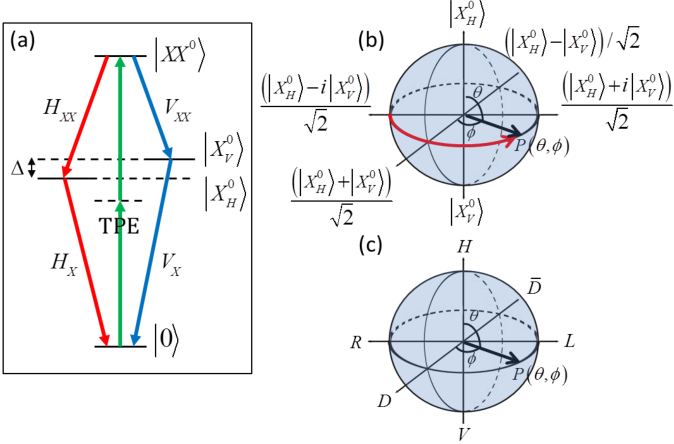
As shown in the diagram above, the biexciton ground state, , consists of two spin-paired electrons and two spin-paired holes, making it a state with total angular momentum . The intermediate bright exciton state, however, is split into two non-degenerate states, often labeled Horizontal () and Vertical () according to their linear polarization. This splitting, , is a direct result of the crystal's anisotropy, which makes the exchange interaction dependent on the orientation of the electron-hole pair.
The following reading explains the consequences of this structure for the biexciton decay.
Radiative Cascades in Semiconductor Quantum Dots
This section from 'Radiative Cascades in Semiconductor Quantum Dots' by D. Gershoni's group provides a clear explanation of neutral biexciton recombination and the resulting radiative cascade.
First, read subsection (b), 'Neutral biexciton recombination.' Note how the biexciton-to-exciton transition also exhibits a cross-linearly polarized doublet, but with an energy order opposite to that of the exciton-to-ground transition. Then, read the section 'The neutral biexciton cascade' to understand how the two-step decay proceeds through two distinct paths.
Let's consolidate the key takeaways from the reading:
- Energy Levels: The biexciton transition energy is . Because the exciton transition energy is , and the biexciton is typically bound (), the photon from the first decay step () has a lower energy than the photon from the second step (). This energy difference is precisely the biexciton binding energy, which we studied in the last lesson.
- Distinct Decay Paths: Since the intermediate exciton state is split into and , the cascade has two possible paths:
- Polarization Selection Rule: The initial state and the final state both have zero total angular momentum. The intermediate states and are eigenstates of linear polarization. Due to the conservation of angular momentum during the dipole transitions, the photon emitted in the first step must have the same linear polarization as the intermediate exciton state it leaves behind. The subsequent decay of that exciton will also produce a photon with the same linear polarization.
- The result is the primary selection rule for the cascade: the two emitted photons, and , are co-linearly polarized. An experiment measuring the joint probability of detecting photons from a biexciton decay will find a strong correlation for detecting two H-polarized or two V-polarized photons, and near-zero correlation for detecting an H-V pair from the same cascade. This provides an unambiguous experimental signature.
Test your understanding!
As noted in the reading, the biexciton emission spectrum shows a doublet (H and V lines) with the same energy splitting as the exciton emission spectrum, but the order of the lines is reversed. Why? For example, if the exciton decay spectrum shows the H-polarized line at a lower energy than the V-polarized line, why does the biexciton decay spectrum show the V-to-ground transition photon at a lower energy than the H-to-ground photon?
Show answer
The energy splitting originates in the exciton fine structure.
- For the exciton decay (), the initial states are and . The energy of the emitted photons directly reflects the energy of these initial states. So, if , the H-polarized line appears at a lower energy.
- For the biexciton decay (), the final states are and . The energy of the emitted photon is . If we assume , then the transition to the V-state () will result in a lower energy photon than the transition to the H-state (). Therefore, the polarization labels on the spectral lines are effectively reversed.
2. Biexciton Creation: Two-Photon Absorption (TPA)
Creating a biexciton population for study presents a challenge. Single-photon excitation powerful enough to create biexcitons would also create a vast, often overwhelming, population of single excitons. A more elegant solution is two-photon absorption (TPA), a nonlinear optical process.
In TPA, the material absorbs two photons simultaneously to drive a transition. For biexciton creation, two photons of energy are absorbed such that , where is the total energy of the biexciton.
The selection rules for TPA are fundamentally different from single-photon absorption. The transition rate for a process is proportional to , where is the interaction operator.
- Single-photon absorption: , the electric dipole operator. has odd parity. This means single-photon absorption can only connect states of opposite parity (e.g., gerade to ungerade).
- Two-photon absorption: This is a second-order process. The effective operator involves two applications of the dipole operator and can be schematically thought of as . This operator has even parity. Therefore, TPA connects states of the same parity.
The crystal ground state has even parity. The biexciton ground state , composed of four particles in s-like envelope functions, also has even parity. Consequently, the transition is:
- Forbidden for single-photon absorption.
- Allowed for two-photon absorption.
This parity selection rule makes TPA an ideal tool for creating biexcitons directly without populating single-exciton states (which have odd parity and are created via single-photon absorption).
Group Theory and Polarization Dependence in Cu₂O
To derive the specific polarization selection rules, we need to use group theory, which provides a powerful framework applicable to any crystal symmetry. Given your interest in Cu₂O, let's examine the rules for its cubic point group.
The following resource, a chapter from a PhD thesis, provides a detailed derivation using methods you should be familiar with from your advanced physics courses.
Selection Rules in Cu₂O (Chapter 3 from 'Excitons at high density in Cuprous Oxide...')
This document provides a detailed, group-theory-based derivation of optical selection rules in Cu₂O, which has the Oh symmetry group. We will focus on the section concerning two-photon excitation (TPE), which is synonymous with two-photon absorption (TPA).
Please read section 3.2.1, 'Without any external perturbation'. Follow the logic of how the selection rules for a dipole transition are derived. Pay close attention to the symmetries of the initial state, final state, intermediate states, and the dipole operator itself. The key result is Equation (3.3), which gives the polarization dependence.
Let's walk through the core argument for why the two-photon transition to a biexciton state is allowed and how its polarization dependence is found.
-
Symmetries of the States: In the group:
- The crystal ground state has full symmetry: .
- The biexciton ground state , being a composite of s-wave excitons with total spin zero, also transforms as the totally symmetric representation, .
- The electric dipole operator transforms as the vector representation, which is .
-
Symmetry of the TPA Operator: The TPA operator transforms as the direct product of two dipole operators: . Using character tables for the group, this product can be decomposed into irreducible representations:
-
The Selection Rule: For a transition from an initial state with symmetry to a final state with symmetry to be allowed, the decomposition of the operator's symmetry () must contain the representation given by the product .
- For our case, and . So, .
- Since the decomposition of the TPA operator does contain , the transition is allowed.
-
Polarization Dependence: The resource derives Equation (3.3) for the absorption intensity for an orthoexciton final state, but the principle is the same. The intensity depends on the direction cosines () of the light's polarization vector relative to the crystal axes. By controlling the input polarization, one can selectively excite (or not excite) the biexcitonic state, which is a powerful experimental knob. The exact form of the polarization dependence allows experimentalists to confirm the symmetry of the state they are creating.
Conclusion
In this lesson, we have derived the fundamental selection rules that govern how biexcitons interact with light, bridging our theoretical model with experimental reality.
Key Takeaways:
- Biexciton Decay: Occurs via a radiative cascade, emitting two photons. Due to the fine-structure splitting of the intermediate exciton state, the two photons are co-linearly polarized, providing a robust experimental signature.
- Biexciton Creation: Can be achieved cleanly using two-photon absorption (TPA). This is a parity-allowed process (), unlike the parity-forbidden single-photon transition.
- Symmetry and Polarization: Group theory provides the rigorous framework for determining detailed selection rules. For a biexciton in a cubic crystal (like Cu₂O), the TPA process is allowed, and its efficiency depends on the polarization of the incident light relative to the crystal axes.
Preview of the Next Lesson
We now understand the characteristic optical signatures of a biexciton. But in a real experiment with a dense gas of excitons, how do we confidently distinguish the biexciton emission from all other signals? In our next lesson, we will address the learning outcome: "Analyze power-dependent photoluminescence spectra to distinguish biexcitonic emission from single-exciton emission." We will explore how the intensity of exciton and biexciton luminescence scales with excitation power, providing a crucial tool for experimental identification.