Introduction
Welcome back. In our last lesson, you mastered the critical skill of synthesizing a patient's history and examination findings into a holistic Swasthya Profile. This profile serves as your clinical blueprint, identifying the patient's health strengths (Anukula Bhavas) and areas needing intervention (Pratikula Bhavas). However, this detailed diagnosis is for your clinical records; it is of little use if it cannot be translated into clear, actionable guidance that the patient can understand and follow.
This brings us to today's lesson, which is all about effective communication and empowerment. Our learning outcome is to create patient education materials for implementing Dinacharya practices tailored to different literacy levels and cultural contexts. We will move from the 'what' (the diagnosis) to the 'how' (the patient's daily practice), exploring the art and science of creating materials that inspire adherence and lead to tangible health outcomes. This skill is the bridge between a brilliant diagnosis and a successful treatment.
1. The Foundation: Health Literacy and Cultural Humility
Before we design any materials, we must first understand the person who will be using them. A one-size-fits-all approach is a primary cause of non-adherence. Two concepts are paramount here:
- Health Literacy: This is not just the ability to read, but the capacity to obtain, process, and understand basic health information and services to make appropriate health decisions. Low health literacy is a significant barrier to care.
- Cultural Humility: This involves recognizing that a patient's culture, beliefs, and socioeconomic realities profoundly impact their health choices. It's our responsibility to adapt our advice to fit their world, not the other way around.
A study on health literacy among diabetic patients in India provides a powerful insight into this challenge, directly relevant to our work in Swasthawritta.
Ayurpharmacoepidemiology Perspective: Health Literacy ...
The article 'Ayurpharmacoepidemiology Perspective: Health Literacy...' highlights a crucial gap between patients' knowledge and their actual self-care practices. It underscores the urgent need for physicians to provide education that is not only clear but also culturally sensitive and individualized.
Please read the 'Implications of the Findings' and the subsequent untitled paragraph (Sections 1 and 2). Focus on these key statements: The conclusion that educating older patients leads to better outcomes. The critical need for physicians to recommend diet and exercise plans that are 'culturally sensitive and individualized'. The statement that 'repeated health education/reinforcement and motivation are bound to bring about a positive change'. This will frame our entire approach to creating educational materials.
As the study shows, simply providing information is not enough. Our materials must be designed to overcome barriers in literacy and culture, actively motivating the patient to turn knowledge into beneficial practice.
2. Core Components of a Dinacharya Handout
Regardless of the target audience, all good educational materials share a logical structure. When creating a Dinacharya plan, your content should always be:
- Personalized: It must be derived directly from the Swasthya Profile you created for the individual.
- Prioritized: Introduce only 3-5 high-impact practices at first to avoid overwhelming the patient. You can add more later.
- Action-Oriented: Use clear, simple, active verbs.
Here is a basic template for explaining each practice, drawing from the classical list of activities in Dinacharya.
Ayurveda based diet & life Style Guidelines for Prevention ...
This document from the Central Council for Research in Ayurvedic Sciences provides a standard list of Dinacharya practices. We will use this as our content library.
Review the section 'Dinacharya (Daily regimen)'. This gives you a checklist of core practices: waking time, oral hygiene, oil massage (Abhyanga), exercise (Vyayama), bathing (Snana), etc. We will use these as the building blocks for our tailored materials.
For each recommended practice, structure your explanation as follows:
- The WHY (The Benefit): Start with the patient's goal. Use simple, benefit-oriented language.
- Instead of: "This pacifies Vata Dosha."
- Use: "This will help your joints feel less stiff and reduce dryness."
- The WHAT (The Practice): Clearly name the activity.
- Example: "Daily Self-Massage with warm oil (Abhyanga)"
- The HOW (The Instructions): Provide simple, step-by-step guidance.
- Example: "1. Before your bath, warm about 1/4 cup of the sesame oil I recommended. 2. Gently massage it over your whole body, spending extra time on your knees and back. 3. Let it soak in for 5-10 minutes. 4. Take a warm shower."
3. Tailoring the Format and Medium
This is where you adapt your delivery to the patient's literacy level and personal context.
For Low to Moderate Literacy / Visual Learners
Many patients respond best to visual cues rather than dense text. Infographics, images, and even short videos are invaluable tools. They convey complex routines in an instantly understandable format.
Let's analyze two excellent examples of visual Dinacharya guides.

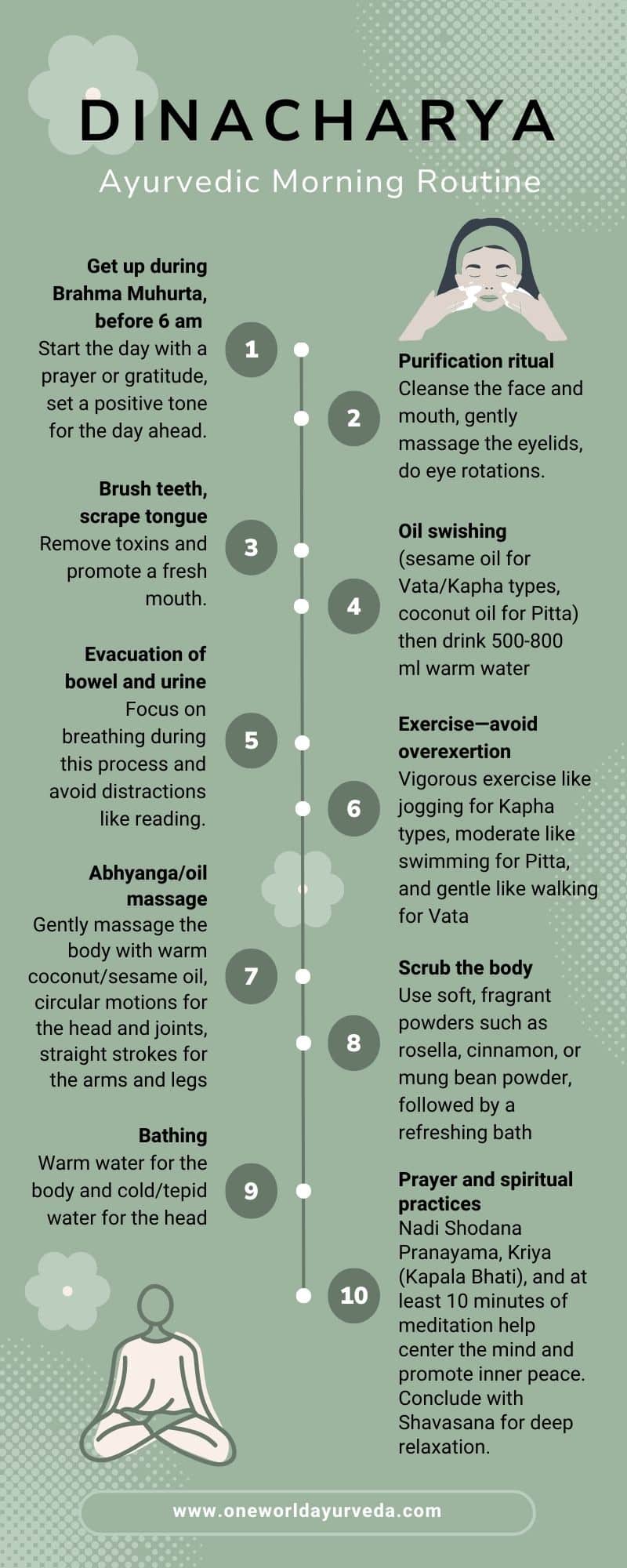
When designing for this audience:
- Use more pictures, fewer words.
- Choose a large, clear font.
- Break down tasks into very small steps.
- Consider a video or audio recording sent to their phone, where you explain the steps in their local language.
- Involve a family member who can help read and explain the instructions.
For High Literacy / Analytically-Minded Patients
An educated patient, such as an engineer or researcher, might find a simple pictorial guide insufficient or even patronizing. They often appreciate understanding the rationale behind the recommendations.
When designing for this audience:
- Use a structured, professional format (e.g., a typed document with clear headings).
- Include a brief, demystified explanation of the Ayurvedic principle. For example, "Gandusha with coconut oil has a cooling (
Sheeta Virya) and anti-inflammatory (Shothahara) effect, which helps soothe gum inflammation and balances thePittadosha that can contribute to it." - Frame practices in a modern context.
Abhyangacan be a "stress-reducing self-care ritual," and avoiding screens before bed is "optimizing your circadian rhythm." - Provide links to relevant articles or resources if they express interest.
Test your understanding!
You are advising a 19-year-old college student (Kapha-Pitta Prakriti) who is concerned about acne (Yauvana Pidika) and wants to start a healthy routine. How would you create an educational 'card' (digital or physical) explaining Kavala/Gandusha (oil pulling)? Mention the format, language, and the "Why, What, How."
Show answer
Format: A visually appealing digital graphic for their phone (like an Instagram story) or a small, laminated card. Use modern fonts and a clean design.
Language: Casual, encouraging, and relatable.
- The WHY (Benefit): "For a Brighter Smile & Clearer Skin! Oil pulling helps remove bacteria from your mouth that can be linked to inflammation and skin breakouts. It's a great detox to start your day."
- The WHAT (Practice): "Morning Oil Pulling"
- The HOW (Instructions):
- "First thing in the morning (before brushing), take 1 tablespoon of coconut oil."
- "Swish it around your mouth for 5-10 minutes. (You can do this while you pick out your clothes or check your messages!)"
- "Spit it out into the trash (not the sink, it can clog it!)."
- "Rinse with warm water and then brush your teeth as usual."
4. Application: Two Contrasting Case Scenarios
Let's apply these principles to two distinct patient profiles.
Scenario 1: Rural, Low Literacy
- Patient: A 65-year-old female farm worker with
Sandhigata Vata(osteoarthritis) in her knees. Her Swasthya Profile shows severeVataaggravation,Manda Agni, and a robust but physically strained body. She reads with difficulty. - Educational Material Goal: To get her to perform daily Abhyanga and consume a simple ginger appetizer.
Tailored Approach:
- Format: A pictorial handout with large photos: 1) A picture of a local sesame oil bottle. 2) A picture of someone massaging their knees. 3) A picture of fresh ginger.
- Language: Verbal instructions given clearly in her local dialect, recorded on her son's phone. Use a powerful local analogy: "Just as we oil the axle of the bullock cart so it runs smoothly, we must oil our own joints."
- Content (Prioritized):
- Knee Massage: "Every morning, before bathing, warm a little of this
tiloil and gently rub it on your knees for 5 minutes until the skin feels warm. This will help with the stiffness." - Ginger Appetizer: "Before you eat your lunch, chew a small slice of fresh ginger with a pinch of salt. This will help your food digest better and make you feel lighter."
- Knee Massage: "Every morning, before bathing, warm a little of this
- Delivery: Demonstrate the massage technique in person. Give the simple, two-step pictorial guide to her and her son.
Scenario 2: Urban, High Literacy
- Patient: A 38-year-old male marketing executive with work stress, acid reflux (
Amlapitta), and disturbed sleep (Nidranasha). His Swasthya Profile showsPitta-Vataaggravation,Tikshna Agnileading toAmlapitta, and depletedOjas. He is data-driven and wants to understand the science. - Educational Material Goal: To implement a calming morning and evening routine.
Tailored Approach:
- Format: A well-designed PDF emailed to him, titled "Your Personalized Performance & Recovery Protocol."
- Language: Professional, precise, and empowering. It links Ayurvedic principles to modern wellness concepts.
- Content (Excerpt):
- Morning Routine (6:30 AM): Cooling Oil Pulling (
Gandusha)- Benefit: Reduces oral bacteria and systemic inflammation (
Pitta), which can be a trigger for acidity. Calms the nervous system to start the day focused, not frantic. - Instructions: Swish 1 tbsp of coconut oil for 10 minutes while you prepare for your day.
- Benefit: Reduces oral bacteria and systemic inflammation (
- Evening Routine (9:30 PM): Digital Sunset & Foot Massage (
Padabhyanga)- Benefit: Signals to your brain to produce melatonin, initiating deep, restorative sleep. The foot massage grounds excess
Vataenergy (anxiety, racing thoughts) that accumulates during the day. This directly enhancesOjas(vitality). - Instructions: Put all screens away. Spend 5 minutes massaging your feet with the recommended Brahmi-infused sesame oil. Focus on the soles of the feet.
- Benefit: Signals to your brain to produce melatonin, initiating deep, restorative sleep. The foot massage grounds excess
- Morning Routine (6:30 AM): Cooling Oil Pulling (
Conclusion
Creating effective patient education materials is a core clinical skill that directly impacts patient outcomes. It is the practical application of your diagnostic acumen, requiring empathy, creativity, and an understanding of human behavior.
Key Takeaways:
- Start with the Patient: Your design must be guided by the patient's health literacy, cultural background, and personal context.
- Prioritize and Simplify: Introduce a few high-impact practices first. Use a clear "Why-What-How" structure for each recommendation.
- Match the Medium to the Person: Use visual aids like infographics for lower literacy and detailed, rationalized documents for higher literacy.
- Empower, Don't Prescribe: Your role is to provide the knowledge and tools in a way that motivates the patient to take ownership of their health.
Preview of the Next Lesson:
Now that you have learned how to create and deliver these initial instructions, the next logical step is to help the patient track their progress and stay motivated. In our next lesson, we will "Develop structured tools (e.g., diaries, checklists) to help patients assess their own compliance with prescribed regimens." This will equip you to support your patients throughout their journey to better health.