Introduction
Welcome back. In our previous lessons, you mastered the art of gathering information—first by taking a systematic patient history focused on their lifestyle (Dinacharya, Ritucharya, Sadvritta), and then by performing objective physical examinations (Ashtavidha and Dashavidha Pariksha) to assess their physiological state. You now have two distinct streams of data: the patient's subjective narrative and the objective clinical evidence.
Today's lesson is the crucial step where a clinician's true skill comes to life: synthesis. Our objective is to synthesize patient history and examination findings to formulate a holistic Swasthya Profile, identifying strengths and areas for intervention. This "Swasthya Profile" is more than just a summary of findings; it is an integrated diagnosis of a person's state of health (Swasthya), not just their state of disease (Vyadhi). It forms the essential blueprint upon which all effective, personalized Swasthawritta plans are built.
1. Defining the Swasthya Profile
A Swasthya Profile is a comprehensive, multi-dimensional assessment of an individual's health status. It weaves together constitutional factors, current physiological function, mental-emotional state, and lifestyle habits into a single, coherent picture.
While a Roga Samprapti report details the pathogenesis of a disease, a Swasthya Profile focuses on the factors maintaining or disturbing health. Its primary purposes are:
- To establish a clear baseline of the patient's health (
Swasthya). - To identify strengths (
Anukula Bhavas)—the positive factors and areas of resilience that should be preserved and enhanced. - To identify areas for intervention (
Pratikula Bhavas)—the imbalances, risk factors, and lifestyle errors that need to be addressed. - To provide the foundational logic for creating a personalized Swasthawritta protocol.
2. The Architecture of Synthesis: From Data to Diagnosis
Formulating a Swasthya Profile requires you to connect the dots between what the patient tells you (history) and what you observe (examination). The framework for this synthesis can be visualized using the classical components of Vikruthi Pareeksha.
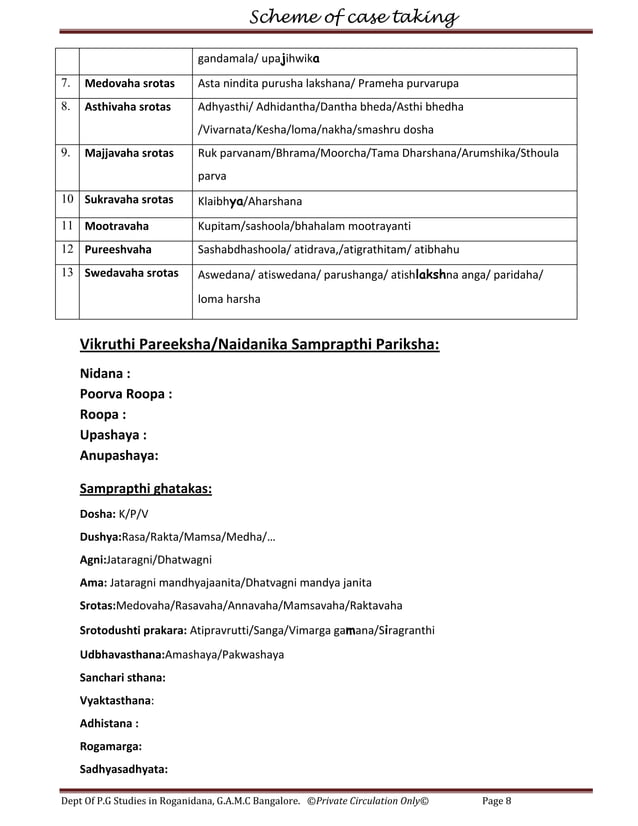
Let's break down how to build a profile using this structure:
| Component of Profile | Synthesizing History & Examination Findings |
|---|---|
| Constitutional Blueprint | Integrate Prakriti assessment (from history and exam) and Sara Pariksha (from exam) to define the patient's inherent constitution and tissue vitality. This is your baseline. |
| Agni & Koshta Status | Combine history of hunger, appetite, and digestion (Ahara Shakti) with objective Jihva Pariksha (tongue coating for Ama) and Nadi Pariksha to determine the state of Agni (Sama, Vishama, etc.) and Koshta. |
| Dosha Balance (Vikruti) | Link subjective symptoms (e.g., dryness, heat, lethargy) from the history with objective signs from Nadi, Sparsha (touch), and Druk (eyes) to pinpoint the current Dosha imbalances. |
| Dhatu & Mala Status | Synthesize reports of energy levels, strength, and elimination patterns (history) with your Sara assessment and Mala/Mutra Pariksha (examination) to evaluate the state of tissue nourishment and waste removal. |
| Manas & Sattva Status | Correlate the patient's description of their stress, sleep (Ratricharya), and emotional state (history) with your objective Sattva Pariksha and observation of their Akriti (demeanor, radiance) during the consultation. |
| Lifestyle Etiology (Nidana) | This is a direct summary from your detailed Dinacharya and Ritucharya history. It explains the why behind the imbalances found above. For example, Manda Agni is explained by the Nidana of Divaswapna (day sleep). |
3. Case Study: Synthesizing a Profile for Ati Sthoulya
Theory comes to life through practice. Let's analyze a published case study to see how a Swasthya Profile is expertly formulated. We will examine the case of a 40-year-old male with obesity (Ati Sthoulya).
Integrated Ayurveda and Yoga Therapy in the ...
This case report, 'Integrated Ayurveda and Yoga Therapy in the Management of Obesity', is an excellent practical demonstration of our lesson's objective. It clearly presents the patient's history, examination findings, and a synthesized Ayurvedic assessment.
Please read the following sections: 'Case History' (Section 0): Pay close attention to the patient's complaints and the identified 'nidanas' (e.g., 'snigdha ahara seela', 'adhyasana', 'avyayama', 'divaswapna'). This is the subjective history. 'Investigations' (Section 1): Note the objective physical measurements (BMI, waist circumference) and lab results. This is the examination data. 'Table 3- Ayurvedic parameters' (Section 2): This table is the final product—the synthesized Swasthya Profile. Study how the authors have translated the history and exam data into a structured Ayurvedic diagnosis.
Let's deconstruct their process:
-
History (Prashna):
- Complaints: Weight gain, polyphagia (
Kshut atimatram), polydipsia, fatigue, dyspnoea. - Nidanas:
Snigdha ahara(fried items),Adhyasana(eating before the previous meal is digested),Avyayama(lack of exercise),Divaswapna(day sleep), sedentary work, and a family history.
- Complaints: Weight gain, polyphagia (
-
Examination (Pariksha):
- Physical: Weight 80.3 kg, BMI 31.8, high waist-to-hip ratio (1.01).
- Lab: High total cholesterol (254 mg%), high LDL (153 mg%), high uric acid (7.2 mg%).
-
Synthesis (The Swasthya Profile - as seen in Table 3):
- Dosha:
Kapha pradhana, tridosha(The heavy, oilyNidanasled toKaphavitiation). - Dushya:
Medo vridhi(This is the primary tissue affected, directly seen in the high BMI and body fat). - Agni:
Vishamagni/Athyagni(The authors noteVishamagnilikely due to constipated bowel, and the cycle ofAthyagnidescribed inSthoulya Samprapticausing polyphagia). - Prakruti:
Kapha pitta(His constitution makes him more susceptible to this condition). - Srotas & Srotodushti:
Rasavaha,Medovaha... withSanga(Obstruction in the channels, leading to accumulation). - Bala:
Rogi bala - Madhyama(Patient strength is moderate, indicating good prognostic potential for intervention). - Sadyasadhyata:
KrichraSadhya(Difficult to cure, which is appropriate forAti Sthoulya).
- Dosha:
By looking at this profile, the strengths (moderate patient strength - Madhyama Rogi Bala) and areas for intervention (Kapha and Meda imbalance, Sanga in Srotas, improving Agni) become immediately clear. This profile directly guides the subsequent treatment plan of Udwarthana, diet modification, and Yoga.
4. A Modern, Structured Approach: The Swasthya Assessment Scale (SAS)
Your interest in research methodology and evidence-based practice is highly relevant here. While the classical approach provides a deep qualitative framework, modern research seeks to quantify health outcomes. The Swasthya Assessment Scale (SAS) is a validated tool designed for this very purpose. It essentially provides a structured questionnaire to build a quantifiable Swasthya Profile.
Swasthya Assessment Scale (SAS)-Ayurveda based health ...
The paper 'Swasthya Assessment Scale (SAS)-Ayurveda based health ...' details the development of a tool to systematically and quantitatively assess health from an Ayurvedic perspective. This bridges classical knowledge with modern research standards.
First, read the 'Materials and methods' (Section 2) to understand how the five key domains of health were identified. Then, look at the 'Final structure' and 'Interpretation of scores' (Section 3 and Table 2) to see how it quantifies health. Finally, and most importantly, review the questionnaire itself in the 'Supplementary material' (Sections 5-12). Notice how it systematically covers all the areas we've discussed: Digestion (Agni), Sleep (Nidra), Excretion (Malas), Physical Strength (Bala), and Mind (Sattva). This is a practical template for thorough history-taking.
The SAS demonstrates how the principles of a comprehensive Swasthya Profile can be operationalized. Using such a tool ensures that your history-taking is exhaustive and standardized. The domains covered in the SAS questionnaire—digestion, sleep, excretion, physical nourishment, and psychological well-being—are the very pillars of the Swasthya Profile. It serves as an excellent checklist to ensure you have gathered all necessary data before beginning your synthesis.
Test your understanding!
A 28-year-old software developer (Vata-Pitta Prakriti) comes to you for improving his health.
- History: He reports feeling anxious, has irregular meal times, often eating late at night. His sleep is disturbed and non-refreshing. He complains of dry skin, bloating, and constipation. He enjoys his work but finds it mentally draining.
- Examination:
Nadiis rapid and thready (Chala,Kshina).Jihvahas a thin, dry coating. Skin is dry and rough to touch (Ruksha Sparsha). HisAkritiis lean, but his eyes are dull and he appears restless.
Based on this, formulate a brief Swasthya Profile, identifying 2 strengths and 3 key areas for intervention.
Show answer
Swasthya Profile Summary:
This individual presents with a clear Vata aggravation superimposed on a Vata-Pitta constitution, driven by an irregular lifestyle (Vishamashana, Ratri Jagarana).
Strengths:
- Good
Sattva(potential): He is self-motivated to improve his health and seems to enjoy his work, suggesting a baseline ofSattvicinclination despite currentRajasicpressures. This is a key asset for adherence to advice. - No structural disease: The findings point towards functional imbalances (
Kriyakshaya) rather than deep-seated pathology, making the condition highly responsive to Swasthawritta (Sadhya).
Areas for Intervention:
Vishamagni&VatainKoshta: This is the top priority. The combination of bloating, constipation (history), and a dry-coated tongue (exam) points to disturbed digestive fire with dominantVata.Vata DoshaAggravation: The entire clinical picture—anxiety, disturbed sleep, dry skin, and aChala/Kshinapulse—confirms a systemicVataimbalance caused by his irregular routine (Nidana).OjasDepletion: The non-refreshing sleep, dull eyes, and mentally draining work are signs of depletingOjas. This is a direct consequence ofVataaggravation and needs immediate attention through properRatricharyaand Rasayana principles.
Conclusion
Today, you have learned the pivotal skill of clinical synthesis—transforming raw data from history and examination into a meaningful, holistic Swasthya Profile. This profile is not merely a list of problems but a balanced assessment of a person's health landscape, complete with their assets and liabilities.
Key Takeaways:
- A Swasthya Profile is a synthesized diagnosis of health that integrates
Prakriti,Vikruti,Agni,Dhatu,Mala, andManas. - The process involves systematically connecting subjective history (
Nidana, symptoms) with objective examination findings (Pariksha). - The goal is to clearly identify the patient's strengths (to leverage) and areas for intervention (to address).
- Structured tools like the Swasthya Assessment Scale (SAS) can help systematize data collection and provide a quantifiable measure of health, aligning classical principles with modern research needs.
Preview of the Next Lesson:
Having mastered the art of formulating a Swasthya Profile, you are now ready for the final step: action. In our next lesson, we will begin our module on Advanced Clinical Management. We will take a specific clinical condition, "design a comprehensive Swasthawritta-based lifestyle intervention plan for a case of Type 2 Diabetes (Madhumeha)." You will apply your ability to create a detailed profile to a complex metabolic disorder and learn to design a precise, multi-faceted intervention plan based on your findings.