Introduction
In our last lesson, we focused on identifying the psychological, social, and practical barriers that often prevent patients from following Swasthawritta advice. We concluded that understanding why a patient isn't adhering to a plan is the critical first step. Today, we build directly on that foundation to answer the next logical question: "What do we do about it?"
This lesson addresses the learning outcome: Apply motivational interviewing techniques to address patient ambivalence and enhance commitment to lifestyle changes.
We will move beyond the traditional role of a Vaidya as an expert who simply prescribes a regimen. Instead, we will explore a counseling style known as Motivational Interviewing (MI). This is a collaborative, goal-oriented method of communication that pays special attention to the language of change. Its primary purpose is to strengthen a person's own motivation for and commitment to a specific goal by eliciting and exploring their own reasons for change. In the context of Ayurveda, you can think of MI as a structured and evidence-based form of Satvavajaya Chikitsa (psychotherapy) that empowers patients to overcome Prajnaparadha (failure of intellect/will) and commit to their own Swasthya (health).
1. The Challenge of Ambivalence and the "Righting Reflex"
As we saw in the previous lesson, patients are often caught in a state of ambivalence. They simultaneously want to change for the better (e.g., improve their health, follow your advice) and want to stay the same (e.g., continue enjoyable but unhealthy habits).
When we, as practitioners, encounter this ambivalence, our natural instinct is to fix the problem. This is called the "righting reflex"—the desire to provide advice, give reasons, and persuade the patient to make the "right" choice. However, this often backfires. When you argue for change, an ambivalent patient will naturally argue for staying the same, a phenomenon known as "sustain talk."
Motivational Interviewing is designed to resist this reflex and instead guide the patient to resolve their own ambivalence. The first step in doing this is to understand where the patient is on their journey toward change.
2. The Stages of Change: Diagnosing Readiness
Before applying any technique, you must first assess the patient's readiness to change. The Transtheoretical Model of Change provides a useful framework for this.
To understand these stages, let's watch a brief overview.
Introduction to Stages of Change and Motivational Interviewing
The following video segment introduces the Stages of Change model, developed by Prochaska and DiClemente. As you watch, think about patients you have seen and try to place them within these stages.
Watch the segment from 01:48 to 02:48. Focus on understanding the five distinct stages: pre-contemplation, contemplation, preparation, action, and maintenance.
Here is a summary of the stages and the corresponding goal for the practitioner:
| Stage | Patient's Position | Practitioner's Goal |
|---|---|---|
| Pre-contemplation | "I don't have a problem." | Raise doubt; increase perception of risks. |
| Contemplation | "I have a problem, but I'm not sure what to do." | Tip the balance; explore ambivalence. |
| Preparation | "I'm ready to change. What's the plan?" | Help develop a concrete action plan. |
| Action | "I am actively making changes." | Support the patient in taking steps. |
| Maintenance | "I have changed and I'm sticking with it." | Help prevent relapse. |
| Relapse | "I slipped up and returned to my old habit." | Help the patient learn from the slip and renew the process. |
MI is most powerful in the pre-contemplation and contemplation stages, where ambivalence is the highest. Your approach must be tailored to the patient's stage. Trying to create an action plan (Preparation) with a patient who doesn't even see a problem (Pre-contemplation) is a recipe for frustration and resistance.
3. The Spirit of MI: The Foundational Mindset
MI is more than a set of techniques; it is a fundamental style of interacting with a patient. This "spirit" can be remembered with the acronym PACE or RULE.
- Partnership (Collaboration): You and the patient are partners. You are not an authority figure imposing your will. You respect the patient's expertise on their own life.
- Acceptance: You accept the patient for who they are without judgment. This includes accepting their autonomy to choose not to change.
- Compassion: You actively promote the patient's welfare and prioritize their needs.
- Evocation: You draw out the patient's own motivations and solutions. The answers lie within them, not you.
This article provides another helpful mnemonic, RULE:
Motivational interviewing techniques
This short document from McGill University gives a concise summary of the guiding principles of MI for practitioners. It introduces the RULE mnemonic, which is a very practical way to remember the MI mindset during a consultation.
Please read the section under the heading 'The guiding principles of motivational interviewing', focusing on the four principles represented by the acronym RULE: Resist the righting reflex, Understand your patient’s motivations, Listen with empathy, and Empower your patient.
4. The Core Skills: OARS
The "spirit" of MI is put into practice using four core skills, remembered by the acronym OARS.
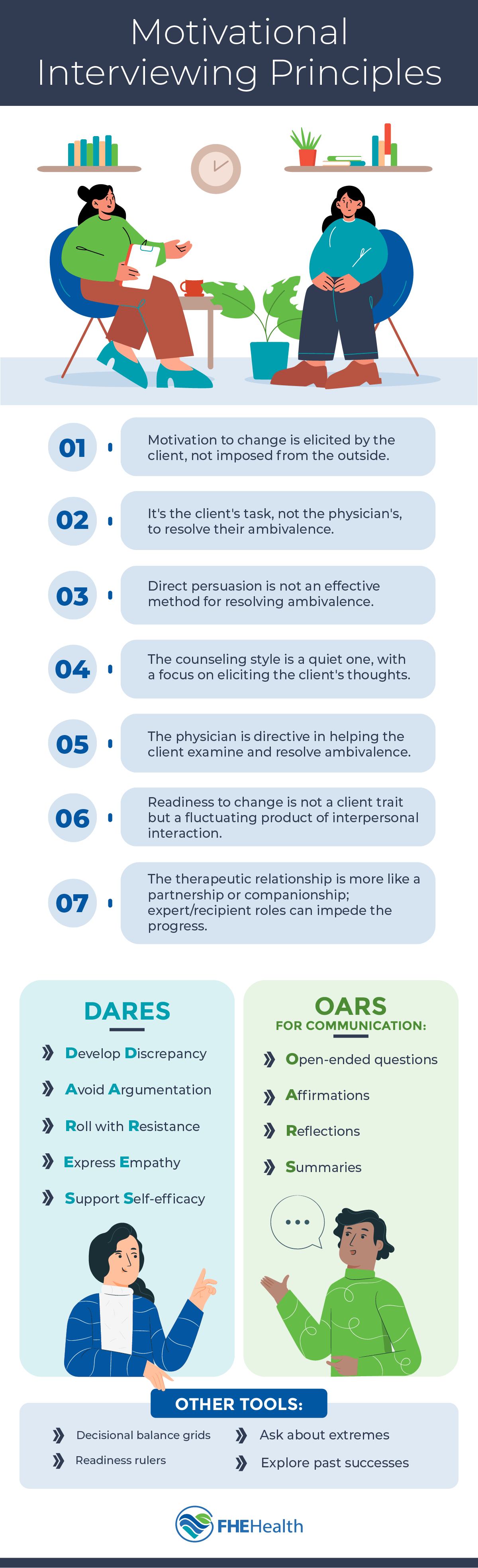
Let's break down each component.
How do you have patient-centered conversations? Motivational Interviewing Basics
The following video from YaleCourses offers a clear and concise introduction to the OARS framework. It will help you grasp the function of each of the four core skills.
Watch the video from 06:44 to 10:22. Pay attention to the definition and examples provided for Open-ended questions, Affirmations, Reflective listening, and Summaries.
O: Open-Ended Questions
These are questions that cannot be answered with a simple "yes" or "no." They invite the patient to tell their story.
- Instead of: "Are you worried about your diet?" (Closed)
- Ask: "What worries you about your diet?" (Open)
A: Affirmations
These are statements of recognition about the patient's strengths, efforts, and positive attributes. They build confidence and rapport. Affirmations must be genuine.
- "I appreciate you being so open with me about this."
- "It took courage to come in today to discuss this."
- "You've handled a lot of stress, and you're still determined to work on your health. That's impressive."
R: Reflective Listening
This is the most crucial and nuanced skill in MI. It involves stating what you think the patient is saying or feeling, which serves to check your understanding and deepen the conversation.
There are two main types:
- Simple Reflection: Repeats or slightly rephrases what the patient said.
- Patient: "I'm just so tired all the time, I can't even think about exercising."
- Reflection: "You're feeling too exhausted to consider adding exercise right now."
- Complex Reflection: Makes a guess about the underlying meaning or feeling. This is where you can start guiding the conversation.
- Patient: "I know I should follow the Dinacharya you gave me, but my mornings are so chaotic with the kids."
- Reflection: "It sounds like you feel caught between your desire to care for your health and your responsibilities as a parent."
This reflection names the core conflict (ambivalence) without judgment, inviting the patient to explore it further.
S: Summaries
Summaries are extended reflections that pull together several things the patient has said. They show you've been listening, allow for corrections, and can be used to transition the conversation. A good summary strategically highlights the patient's "change talk" (more on this next).
5. Eliciting Change Talk: The Goal of MI
The central task of MI is to guide the conversation so that the patient, not the practitioner, is the one making the arguments for change.
- Sustain Talk: Speech that favors the status quo ("I don't have time to cook," "My family won't eat healthy food").
- Change Talk: Speech that favors movement toward a goal.
We listen for and try to elicit change talk, which can be remembered with the acronym DARN-C:
- Desire: "I want to have more energy."
- Ability: "I could probably walk for 15 minutes a day."
- Reason: "I need to get my blood sugar down so I can avoid complications."
- Need: "I must do something about my sleep."
- Commitment: "I am going to start packing my lunch from tomorrow."
The DARN statements are preparatory talk, while Commitment language signals the patient is ready to plan. You use your OARS skills to reflect and affirm this language when you hear it.
One excellent technique for eliciting DARN talk is using a readiness ruler.
Practitioner: "On a scale of 0 to 10, where 0 is not at all important and 10 is the most important thing in your life, how important is it for you to change your eating habits right now?"
Patient: "I'd say about a 6."
Practitioner: "A 6, great. Why a 6 and not a 2 or 3?" (This question elicits Reasons for change).
Practitioner: "And what would it take to get from a 6 to an 8?" (This elicits ideas for overcoming barriers).
You can use the same ruler for confidence ("How confident are you that you could make this change?").
Test your understanding!
A patient says, "My wife keeps telling me I need to do something about my snoring, and the doctor said my weight is contributing. But I just don't see how I can give up my evening snacks. It's the only way I can relax after a long day."
Which of the following is the best MI-consistent response?
- "You have to give up the snacks. Your health is at risk, and it's affecting your marriage."
- "What if you tried eating carrots instead of chips? That's a healthier choice."
- "It sounds like, on the one hand, you're hearing concerns from your family and doctor about your health, but on the other hand, those evening snacks are a really important way for you to unwind."
- "Why don't you want to change?"
Show answer
The best response is 3. It is a complex, double-sided reflection that accurately captures the patient's ambivalence without judgment. It doesn't use the "righting reflex" (response 1), offer unsolicited advice (response 2), or ask a confrontational "why" question that invites defensiveness (response 4). It opens the door for the patient to explore their conflict further.
6. Case Study: MI in Action
Theory is one thing; seeing it in practice is another. The following reading provides a sample dialogue of a clinician using MI with a patient who has elevated liver enzymes due to alcohol consumption. As you read, notice how the clinician navigates the conversation.
Motivational Interviewing: An Evidence-Based Approach for ...
Let's analyze a clinical encounter. This article contains an excellent example of a dialogue demonstrating Motivational Interviewing. Your goal is to identify the MI techniques being used.
Read 'BOX 3. Example interview of motivational interviewing.' As you go through the dialogue, try to spot examples of: The Elicit-Provide-Elicit model for giving information. Reflective listening (simple and complex). Asking open-ended questions. Using a readiness ruler. Summarizing to reinforce change talk.
Deconstruction of the Case Dialogue:
Let's break down some key moments in that conversation:
-
Elicit-Provide-Elicit:
- The clinician provides the lab results and asks, "How does that sound to you?" (Elicit)
- The patient expresses disbelief. The clinician then asks permission: "Would you be interested in having a bit of information...?" (Elicit)
- After the patient agrees, the clinician gives neutral, factual information about low-risk alcohol consumption. (Provide)
- Finally, the clinician hands control back to the patient: "What does hearing that make you think?" (Elicit)
This is the core method for giving advice in MI. You get permission, provide information neutrally, and then ask the patient to interpret it.
-
Complex, Double-Sided Reflection:
- The patient says he found his consumption normal but is now worried.
- The clinician reflects: "On the one hand, you found your alcohol consumption quite normal, but on the other, you’re worried now…." This perfectly captures the patient's ambivalence and encourages him to resolve it.
-
Readiness Ruler:
- The clinician asks, "On a scale of 0–10, how important is it to you...?"
- The patient gives a "6 or 7." The crucial follow-up is, "Why did you choose a 6 or 7 and not a 3 or 4?" This skillfully avoids asking why it isn't higher and instead prompts the patient to voice his own reasons for change.
-
Strategic Summary:
- Near the end, the clinician provides a summary that is not just a random collection of facts. It strategically emphasizes all the change talk the patient has offered: "At the moment, you’re worried about your liver values, and you can imagine... giving up alcohol... That way, you would also prove to yourself that you don’t need that after-work beer..." This summary reinforces the patient's motivation and builds momentum toward a plan.
Conclusion
Motivational Interviewing is a profound shift from telling patients what to do to helping them discover what they want to do. It honors their autonomy and evokes their intrinsic capacity for change. For the Ayurvedic practitioner, it is a powerful, evidence-based tool that aligns perfectly with our holistic and patient-centered ethos. It operationalizes the concept of Satvavajaya for modern clinical practice.
Key Takeaways:
- Patient ambivalence is normal; your goal is to help them resolve it, not to argue against it.
- Resist the "righting reflex." Your role is to guide, not to direct.
- Tailor your approach to the patient's Stage of Change.
- Embody the spirit of MI: Partnership, Acceptance, Compassion, and Evocation.
- Practice the core skills of OARS: Open-ended questions, Affirmations, Reflective listening, and Summaries.
- Your primary goal is to listen for and elicit DARN-C (Desire, Ability, Reason, Need, Commitment) change talk.
- Always ask for permission before giving advice using the Elicit-Provide-Elicit model.
Preview of the Next Lesson:
Having explored how to identify barriers and foster motivation, we are now equipped to design truly personalized and practical lifestyle plans. In our next lesson, we will begin the "Advanced Clinical Management" module by applying these skills to a specific condition: "Design a comprehensive Swasthawritta-based lifestyle intervention plan for a case of Type 2 Diabetes (Madhumeha)." We will integrate our knowledge of disease pathology, Swasthawritta principles, and motivational counseling to create a plan that is not only clinically sound but also achievable for the patient.