Introduction
In our last lesson, we focused on evaluating the success of Swasthawritta interventions using a dual-paradigm approach, combining Ayurvedic parameters with modern objective measures. This evaluation is critical for understanding if a protocol is working. However, a common clinical challenge arises when a well-designed protocol yields poor results. More often than not, the root cause is not a flaw in the plan, but a breakdown in its execution.
This brings us to today's crucial topic, which addresses the learning outcome: Identify common psychological, social, and practical barriers to patient adherence in Swasthawritta.
Your success as a practitioner hinges not just on your ability to prescribe the correct regimen, but on your ability to help your patients integrate it into their complex lives. This requires shifting our perspective from viewing a patient as "non-compliant" to collaboratively identifying and troubleshooting the real-world obstacles they face. Understanding these barriers is the diagnostic step that precedes any effective counseling or motivational strategy.
1. A Framework for Understanding Barriers
Before we can address barriers, we must first learn to recognize and categorize them. Adherence is not a simple matter of willpower; it is a complex behavior influenced by a web of internal and external factors. The following conceptual model provides a clear framework for thinking about these influences.
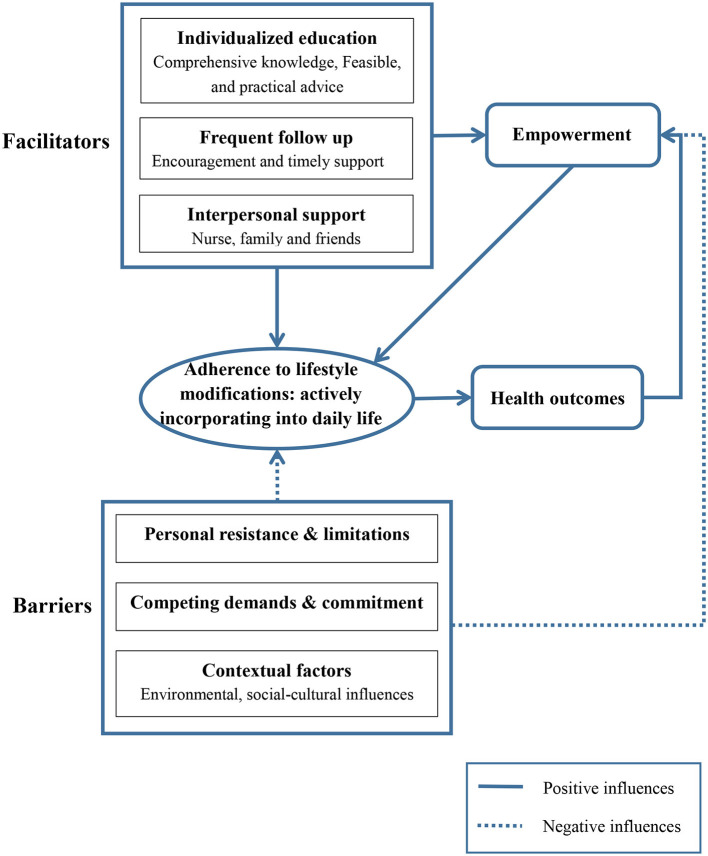
As the model shows, barriers are not monolithic. We can classify them into three main categories, which provides a structured way to investigate them during a clinical consultation:
- Psychological Barriers: These are internal obstacles related to a patient's beliefs, attitudes, motivation, and mental state. In Ayurvedic terms, this is the realm of Manas and often involves Prajnaparadha (intellectual error or failure of wisdom), where a person knowingly acts against their best interests.
- Social Barriers: These are external obstacles arising from a patient's relationships, family dynamics, workplace culture, and societal norms. The support system (or lack thereof) around a patient plays a huge role in their ability to sustain new habits.
- Practical Barriers: These are tangible, logistical obstacles such as time constraints, financial costs, geographical location, or lack of access to necessary resources (e.g., specific foods or facilities).
Let's explore each of these categories using specific examples from the classical and contemporary contexts.
2. Identifying Barriers in Clinical Practice
The following article provides an excellent analysis of the challenges patients face when trying to adopt an Ayurvedic lifestyle. We will use it to ground our understanding of these barriers.
Challenges faced in lifestyle modification - An Ayurvedic ...
Please read the introduction and the section on 'Challenges Faced' in the paper 'Challenges faced in lifestyle modification - An Ayurvedic perspective' by Lall et al. This will provide a broad overview of the types of difficulties that arise when implementing Swasthawritta principles.
Read the 'INTRODUCTION' and then jump to the 'Challenges Faced' section. Focus on the sub-section 'Physical aspects of life style- Dina charya'. Pay attention to the specific examples given for Pratimarsha Nasya, Vyayama, and Ritucharya. These are excellent illustrations of practical and environmental barriers.
As you read, you can see concrete examples of practical barriers:
- Environmental Factors: A patient living in a cold, overcast region (
Kapha Pradhana Desha) may find it challenging to startPratimarsha Nasyaas advised. Similarly, global climate change makes it difficult for a layperson to accurately identify theRitusand followRitucharya, creating a practical barrier rooted in environmental ambiguity. - Lack of Resources/Knowledge: A person may join a modern gym for
Vyayamabut be unaware of the Ayurvedic recommendation for a light massage (Mardana) post-exercise, a principle not typically incorporated in such establishments.
Now, let's examine the more subtle, yet powerful, psychological and social barriers.
Challenges faced in lifestyle modification - An Ayurvedic ...
Next, let's explore the internal and interpersonal challenges. This reading will focus on the mental, social, and cultural hurdles patients encounter.
Continue in the 'Challenges Faced' section, and read the parts titled 'Mental and social aspects', 'Dietetics', and 'Societal aspects'. As you read, identify and reflect on: Psychological Barriers: Note the mention of 'intellectual error' (Prajnaparadha) and the influence of contemporary beliefs and advertising that create doubt about classical advice (e.g., the myth about daily curd consumption). Social Barriers: Pay close attention to the examples of Rajaswala Charya and Ritumati Charya. How do modern advertising and work-life pressures create social and cultural conflicts for patients trying to follow these regimens?
This reading highlights several critical psychological and social barriers:
- Psychological Barrier (Belief System): The paper points out the conflict between the modern "health halo" around daily curd consumption and the classical guideline to avoid it (
Nitya Asevaniya Dravya). When a patient is bombarded with advertising that contradicts your advice, it creates a psychological barrier of doubt and confusion, making adherence difficult. - Psychological Barrier (Prajnaparadha): The authors connect non-adherence to the derangement of
Dhi(intellect),Dhriti(restraint), andSmriti(memory). This is the classical explanation for why a patient might understand the advice but fail to follow through. - Social Barrier (Cultural Norms): The discussion on
Rajaswala Charyais a prime example. Modern culture and marketing promote an image of women being unstoppable during menstruation, directly clashing with the Ayurvedic principle of rest andVatapacification. A working woman may face social or professional pressure that makes adherence to this regimen seem impossible. - Social Barrier (Life Demands): The trend of late marriages and career focus creates a social barrier to following preconception care (
Ritumati Charya), as lifestyle priorities shift.
Test your understanding!
A 30-year-old patient with Grahani (IBS) is advised to follow Ahara Vidhi Vidhana, including eating warm, freshly cooked meals at regular times and avoiding distractions. He returns after a month with no improvement. He states: "I work in a fast-paced startup, so I grab a salad at my desk. My team often orders pizza for late-night work sessions. Besides, I've read online that raw salads are healthier."
Categorize his barriers to adherence as psychological, social, or practical.
Show answer
- Psychological Barrier: His belief that "raw salads are healthier" directly contradicts the advice for warm, cooked food for his condition. This is a barrier rooted in conflicting health beliefs, likely influenced by popular diet trends.
- Social Barrier: His team ordering pizza for late-night sessions creates a social pressure to conform. Eating different food or at a different time could lead to feelings of isolation from his peer group.
- Practical Barrier: His fast-paced work environment and the habit of eating at his desk represent a significant practical barrier to having a mindful, undistracted meal. The long working hours make regular, timely meals challenging.
3. Case Study: Uncovering Barriers in a Complex Patient
Let's analyze a clinical case to see how these barriers manifest in a patient with a significant psychosomatic illness. This case of Major Depressive Disorder, understood as Kaphaja Unmada in Ayurveda, is rich with examples of the deep-seated barriers that can perpetuate a chronic condition.
Ayurveda management of Major Depressive Disorder: A case ...
We will now examine a case study of a patient with severe depression. Your task is to act like a clinical detective and identify the barriers described in her history that contributed to her illness over 33 years.
Please read section 2.2, 'Timeline', which details the patient's history. As you read, list the specific social and psychological barriers that fueled her condition for over three decades.
The patient's history reveals a devastating combination of barriers:
- Social Barriers:
- Marital Disharmony: The core of her suffering. Her husband was described as "suspicious," "dominating," and "harsh."
- Domestic Violence: She experienced physical abuse from her husband and mother-in-law.
- Social Isolation: She was "forced to stay alone and was confined to the house with restricted socialization."
- Psychological Barriers:
- Emotional Trauma: The long-term abuse and isolation are profound psychological wounds (
Manoabhighata). - Adjustment Issues: She "felt ignored in the family."
- These external factors culminated in the internal psychological states of worthlessness, helplessness, and sadness described in the case.
- Emotional Trauma: The long-term abuse and isolation are profound psychological wounds (
Now, let's look at a critical point during her treatment. Despite initial improvement, she had a significant setback.
Ayurveda management of Major Depressive Disorder: A case ...
Even with a good treatment plan, real life can intervene. Let's look at the section describing the patient's relapse. This is a powerful example of how practical and social factors can derail progress.
Read the second paragraph of section 4, 'Follow-up and outcomes'. Pay close attention to the reason given for the 'marked worsening of the clinical condition' on the 119th day. Identify the specific barrier responsible for this relapse.
The relapse was attributed to "environmental stress." Specifically: "This was a puerperal period of the patient's daughter-in-law and perinatal care of new born caused increased work pressure, and disturbed sleep due to attending the neonate at night."
This is a perfect example of a social obligation (caring for family) creating a practical barrier (increased workload and sleep deprivation). It wasn't a failure of her willpower or a rejection of the treatment. Life simply happened. As a clinician, identifying this specific barrier allows for a compassionate and targeted response—adjusting the treatment, providing counseling on stress management, and perhaps discussing delegation of tasks within the family—rather than simply noting a "relapse."
Conclusion
Today we have moved from the what of Swasthawritta to the why not. We've established a clear framework for identifying the psychological, social, and practical barriers that prevent patients from adhering to lifestyle advice. Recognizing these obstacles is the most critical step in helping patients succeed.
Key Takeaways:
- Patient non-adherence is rarely about defiance; it is usually the result of tangible barriers.
- Barriers can be categorized as Psychological (beliefs, Prajnaparadha), Social (family, work, culture), and Practical (time, cost, environment).
- A thorough patient history (
Prashna) is your primary tool for uncovering these barriers. Asking "What gets in the way?" is as important as asking "How are your symptoms?" - Understanding barriers allows you to co-create realistic, adaptable solutions with your patient, fostering a stronger therapeutic alliance and improving long-term outcomes.
Preview of the Next Lesson:
Identifying a barrier is step one. Step two is addressing it. What do you do when a patient is ambivalent, caught between their desire to change and the barriers holding them back? In our next lesson, we will learn the essential skill of how to "Apply motivational interviewing techniques to address patient ambivalence and enhance commitment to lifestyle changes." We will learn how to move beyond simply giving advice and instead help patients find their own motivation to overcome the very barriers we learned to identify today.