Introduction
Welcome to our next lesson. In our previous session, we established a clear understanding of Adana Kala and Visarga Kala, analyzing how these two halves of the year systematically impact Bala (strength), Agni (digestive fire), and create a predictable rhythm of Dosha accumulation (Sanchaya), aggravation (Prakopa), and pacification (Prashama).
Today, we transition from this diagnostic framework to a powerful therapeutic strategy. Your learning outcome is to analyze the rationale for seasonal Panchakarma (Ritu Shodhana), correlating it with the Dosha Sanchaya, Prakopa, and Prashama cycles. This principle lies at the heart of Ayurvedic prevention (Swasthasya Swasthya Rakshanam). We will explore why Ayurveda doesn't just manage seasonal imbalances but proactively eliminates their root cause, turning the predictable peak of a Dosha's aggravation into a strategic opportunity for purification and long-term health.
1. The Foundational Rationale of Ritu Shodhana
Ritu Shodhana is the process of performing specific Shodhana (purificatory) therapies, namely Panchakarma, in specific seasons to eliminate Doshas that have naturally become aggravated.
But why is this necessary? If a Dosha pacifies naturally in the following season (e.g., Kapha aggravating in Vasanta and pacifying in Grishma), why intervene?
The answer lies in the concept of Kriyakala (the stages of disease pathogenesis).
- Sanchaya (Accumulation): The Dosha begins to increase in its own site. This is a mild, subtle stage.
- Prakopa (Aggravation): The Dosha increases further and is ready to overflow from its site. This is the stage targeted by Ritu Shodhana.
- Prasara (Spread): The aggravated Dosha leaves its primary site and begins to travel throughout the body.
- Sthana Samshraya (Localization): The spreading Dosha finds a weak spot (Kha Vaigunya) in a Dhatu or Srotas and settles there, beginning the disease process.
- Vyakti (Manifestation): The signs and symptoms of the specific disease become clearly visible.
- Bheda (Differentiation): The disease becomes chronic and complications may arise.
Ritu Shodhana is a preemptive strike. By eliminating the Dosha during Prakopa (stage 2), we prevent its Prasara (stage 3) and subsequent disease formation. While the Dosha might naturally subside (Prashama), leaving it in the body after aggravation is like leaving embers in a forest after a fire; it creates a latent vulnerability that can easily flare up into a disorder later. Eliminating it entirely purifies the system and restores a true state of equilibrium.
2. The Seasonal Cycle of Dosha Aggravation and Shodhana
The selection of a specific Panchakarma procedure is not arbitrary; it is precisely matched to the Dosha that is in a state of Prakopa and its primary location (Ashaya) in the body.
Let's begin by studying a foundational text on this topic.
Ritu Shodhana - Way to Stay Healthy with special reference to Virechana
This research article, 'Ritu Shodhana - Way to Stay Healthy' by Dr. Manjusri et al., provides a clear and concise overview of the core concepts. It directly links seasonal Dosha variations to the appropriate Shodhana therapies.
Please read the section that begins with 'The attributes of season cause Doshas to undergo Sanchaya...' up to the end of 'Table 3: Unique preventive measure of Ayurveda - Ritu shodhana'. Pay close attention to Table 2 (Seasonal variation of Dosha) and Table 3 (Ritu shodhana). This will cement the correlation between the season, the aggravated Dosha, and the prescribed therapy.
The article you just read lays out the fundamental blueprint. Let's visualize this cycle and then break it down for each Dosha.
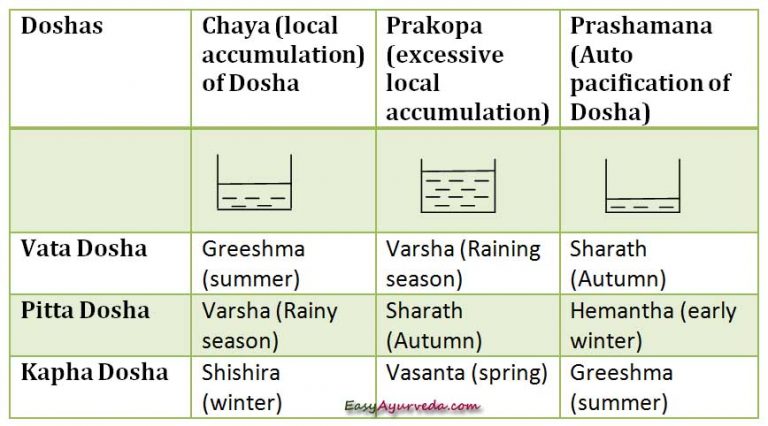
Now, let's analyze each phase in detail.
A. Kapha Shodhana in Vasanta Ritu (Spring)
- Sanchaya (Accumulation): During Shishira Ritu (late winter), the Sheeta (cold) and Guru (heavy) qualities of the environment cause Kapha Dosha to accumulate in a semi-solid state.
- Prakopa (Aggravation): In Vasanta Ritu (spring), the increasing warmth of the sun (Ushna Guna) liquefies this accumulated Kapha. This liquefied Kapha obstructs the Srotamsi (channels) and dampens Agni, leading to conditions like allergies, respiratory congestion, lethargy, and indigestion.
- Rationale for Shodhana: This peak of liquefied Kapha is the ideal moment for its elimination.
- Recommended Shodhana: Vamana Karma (therapeutic emesis).
- Why Vamana? The primary seat of Kapha is the Urdhwa Amashaya (stomach and upper GI tract). Vamana is the most direct and effective method to expel excess Kapha from its main site, resolving the issue at its source. Nasya (nasal medication) may also be used for Kapha accumulated in the head and sinuses.
B. Pitta Shodhana in Sharad Ritu (Autumn)
- Sanchaya (Accumulation): During Varsha Ritu (monsoon), the Amla Vipaka (acidic post-digestive effect) of the atmosphere and water, combined with weakened Agni, leads to the accumulation of Pitta Dosha.
- Prakopa (Aggravation): In Sharad Ritu (autumn), the clouds clear, and the sun's rays become intense once more. This sudden exposure to heat aggravates the Pitta that had accumulated during the monsoon. This leads to classic Pitta disorders like skin rashes, acidity, inflammation, and fever.
- Rationale for Shodhana: This is the classical season of Pitta Prakopa and the prime time for its removal.
- Recommended Shodhana: Virechana Karma (therapeutic purgation).
- Why Virechana? The primary seat of Pitta is the Adho Amashaya (lower stomach, duodenum, and small intestine). Virechana cleanses this entire area, effectively eliminating excess Pitta through the downward route (Adhomarga). As the resource LINK also mentions, Raktamokshana (bloodletting) is also indicated in Sharad, as Rakta Dhatu is closely linked to Pitta and is often vitiated alongside it.
C. Vata Shodhana in Varsha Ritu (Rainy Season)
- Sanchaya (Accumulation): During Grishma Ritu (summer), the intense heat and dryness (Ruksha Guna) of the environment cause Vata Dosha to accumulate.
- Prakopa (Aggravation): In Varsha Ritu (monsoon), the cold, wind, and atmospheric instability drastically aggravate the already accumulated Vata. This leads to joint pain, bloating, gas, stiffness, and neurological sensitivities.
- Rationale for Shodhana: While Varsha Ritu is a challenging season for therapies, managing the aggravated Vata is crucial.
- Recommended Shodhana: Basti Karma (medicated enema).
- Why Basti? The primary seat of Vata is the Pakwashaya (colon). Basti is considered the "gold standard" treatment for Vata Dosha because it delivers medicine directly to its root. Both oil-based enemas (Anuvasana Basti) and decoction-based enemas (Niruha/Asthapana Basti) are used to pacify, nourish, and regulate Vata's functions. Acharya Sushruta famously states that Basti is considered Ardha Chikitsa (half of all treatment) due to its profound effect on the master Dosha, Vata.
Test your understanding!
A 42-year-old female patient with a known history of gastritis and occasional skin rashes (Urticaria) consults you in late August for preventive care. She mentions her symptoms tend to worsen every year in the "hot season after the rains."
- Based on her history and the timing, which Dosha is undergoing Sanchaya and which is heading towards Prakopa?
- What Ritu Shodhana would be the most appropriate intervention for her, and in which upcoming Ritu should it be planned?
- Explain the clinical rationale for your choice, referencing the Dosha cycle.
Show answer
- Dosha State: In late August (Varsha Ritu), she is in the phase of Pitta Sanchaya. Her history of symptoms worsening "in the hot season after the rains" (Sharad Ritu) points directly to an impending Pitta Prakopa.
- Recommended Shodhana: The most appropriate intervention is Virechana Karma. It should be planned for the upcoming Sharad Ritu (Mid-September to Mid-November).
- Rationale: Her constitution and symptoms are clearly Pitta predominant. The Pitta that accumulates during the acidic, cloudy Varsha Ritu will be aggravated by the intense sun of Sharad. Performing Virechana during Sharad Ritu will eliminate this aggravated Pitta from its primary sites (stomach and small intestine) before it can manifest fully as severe gastritis or widespread skin rashes, thus preventing the annual flare-up.
3. The Importance of Kala and Desha: When Not to Purify
While Vasanta, Sharad, and Varsha are the classical seasons for Shodhana, this assumes a standard climate. The Acharyas also provided guidelines on adapting these procedures based on environmental conditions, emphasizing the use of Yukti (clinical reasoning).
Role of Climate in Practice of Panchakarma: A Critical Review
This article, 'Role of Climate in Practice of Panchakarma', explores the nuances of timing Shodhana. It introduces the critical concepts of Sadharana (moderate) and Asadharana (extreme) seasons, which is vital for safe and effective clinical practice.
Please read two key sections: Start from 'Hemanta (winter), Greeshma (summer) and Varsha (rainy), these are the three seasons...' and read about Asadharana Ritus and Sadharana Ritus. Then, read the section that starts with 'Shodhana is not recommended in Asadharana Ritus...'. Focus on understanding why extreme seasons are generally contraindicated for Shodhana and what exceptions are made.
As the article explains:
- Sadharana Ritus (Moderate Seasons): Vasanta, Sharad, and Pravrut/Varsha are considered moderate, without extreme heat or cold. The body is not under undue stress, making it the ideal time for the somewhat strenuous process of Panchakarma. The therapeutic effect is optimal and complications are minimal.
- Asadharana Ritus (Extreme Seasons): Greeshma (extreme heat) and Hemanta/Shishira (extreme cold) are generally avoided for elective Shodhana.
- In extreme cold, the Doshas become ‘stuck’ (Stambha) in the channels and are difficult to eliminate, leading to incomplete purification (Ayoga).
- In extreme heat, the body is already depleted, and the potency of purgative herbs can become excessively harsh (Tikshna), risking over-purification (Atiyoga) and dehydration.
This highlights a key clinical principle: Ritu Shodhana is ideally a planned, preventive measure performed in favorable conditions. However, in an emergency (Atyayika Avastha) where a disease is rapidly progressing, Shodhana can be performed in any season by creating an artificial environment (e.g., using heaters in winter, cooling rooms in summer) and modifying the potency of the medicines.
Conclusion
In this lesson, we have analyzed the profound logic that connects the cycles of nature with Ayurvedic therapeutic action. Ritu Shodhana is not merely a "detox"; it is a precise, evidence-based strategy for disease prevention rooted in a deep understanding of chronophysiology.
Key Takeaways:
- Proactive Prevention: Ritu Shodhana intervenes at the Prakopa (aggravation) stage of the Dosha cycle to eliminate the root cause of seasonal and chronic diseases.
- Specific Correlations:
- Vamana is performed in Vasanta to eliminate aggravated Kapha.
- Virechana is performed in Sharad to eliminate aggravated Pitta.
- Basti is performed in Varsha to manage aggravated Vata.
- Clinical Timing is Key: Shodhana is best performed in Sadharana Ritus (moderate seasons) to ensure safety and efficacy. Extreme seasons are generally avoided for elective procedures, demanding greater clinical skill and adaptation if purification becomes essential.
Preview of the Next Lesson:
We have now covered the major seasonal changes (Adana/Visarga Kala), the resulting Dosha dynamics, and the primary large-scale intervention (Ritu Shodhana). In the next lessons, we will zoom in on the specific day-to-day regimens. We will begin by exploring the detailed Ahara (diet) and Vihara (lifestyle) guidelines for Varsha, Sharad, and Hemanta Ritus (Visarga Kala), giving you the tools to advise patients on daily practices that support seasonal equilibrium.