Introduction
Welcome back. In our previous lesson, we established the foundational framework of Ritucharya by comparing the classical descriptions of the six Ritus across the Brihat Trayi. We introduced the year's primary division into Adana Kala (the period of absorption) and Visarga Kala (the period of release), noting their general effect on environmental moisture and human strength (Bala).
Today, we will dissect the mechanics behind these observations. Your learning outcome is to analyze the concepts of Adana Kala and Visarga Kala and their impact on Agni, Bala, and Dosha dynamics. We will move beyond simply identifying the seasons to understanding how and why they systematically alter our internal physiology. This knowledge is fundamental to moving from theoretical understanding to precise clinical application in preventive healthcare.
1. The Dynamics of Adana Kala: The Period of Depletion
As we discussed, Adana Kala is also known as Uttarayana, the northern solstice, comprising Shishira (late winter), Vasanta (spring), and Grishma (summer). Its nature is described as Agneya (fiery/solar). Let's explore how this translates into specific physiological changes.
To understand this directly from the source, we will turn to Acharya Charaka's explanation.
Charaka Samhita, in the 'Tasyashiteeya Adhyaya', provides a concise and powerful explanation of the chain of events that characterizes Adana Kala. Reading this will clarify the fundamental mechanism of depletion.
Please read the section titled 'Effect of adana kala' (Verse 6). Focus on how the qualities of the sun and wind influence the environment, the predominant Rasas (tastes), and the ultimate effect on human strength.
As the text explains, the intense sun and strong, dry winds progressively absorb the Snigdha Guna (unctuousness/moisture) from the world. This process has three key consequences:
Impact on Bala (Strength)
The environment is actively "taking" or "absorbing" energy and moisture. This external dehydrating force naturally leads to a gradual depletion of strength in living beings. The body must expend more energy to maintain homeostasis against this depleting environment. This results in a progressive decrease in Bala, reaching its nadir in Grishma Ritu.
Impact on Rasas (Tastes)
The increasing dryness (Raukshya) in the environment naturally gives prominence to tastes with similar qualities:
- Tikta (Bitter - Vayu + Akasha Mahabhuta)
- Kashaya (Astringent - Vayu + Prithvi Mahabhuta)
- Katu (Pungent - Vayu + Agni Mahabhuta)
These Rasas are themselves generally depleting (Langhana) and drying in nature, which further contributes to the reduction of Bala.
Impact on Agni and Doshas
The effect on Agni and Doshas is not linear but follows a precise sequence through the three Ritus of Adana Kala:
- Shishira (Late Winter):
- Agni: Remains strong. The intense external cold constricts the peripheral channels, trapping heat centrally and thus strengthening digestive power.
- Dosha: The prevailing cold and qualities of this season lead to the accumulation (Sanchaya) of Kapha Dosha.
- Vasanta (Spring):
- Agni: Begins to diminish.
- Dosha: The increasing warmth of the sun melts the accumulated Kapha from Shishira, causing its aggravation (Prakopa). This liquified Kapha can obstruct channels and dampen the digestive fire.
- Grishma (Summer):
- Agni: Is at its weakest. The intense external heat causes the body's heat to dissipate outwards to maintain temperature, weakening the central digestive fire.
- Dosha: The extreme heat pacifies (Prashama) Kapha Dosha but the intense dryness leads to the accumulation (Sanchaya) of Vata Dosha.
This progression shows a clear, predictable pattern of physiological shifts driven by the escalating fiery and dry nature of Adana Kala.
2. The Dynamics of Visarga Kala: The Period of Replenishment
In contrast, Visarga Kala is also known as Dakshinayana, the southern solstice, comprising Varsha (monsoon), Sharad (autumn), and Hemanta (early winter). Its nature is Saumya (lunar/cooling), a time of giving back or releasing nourishment.
Let's again turn to Charaka to understand the mechanism of this replenishment.
Continuing in the same chapter, Charaka explains the opposing qualities of Visarga Kala.
Now, please read the section 'Effect of visarga kala' (Verse 7). Pay attention to the role of the sun's position, clouds, rain, and the moon. Note the resulting predominant Rasas and the effect on body strength.
During this period, the sun's intensity is reduced, and the moon's cooling influence is dominant. The environment is replenished with moisture from rain. This nourishing process also has three key consequences:
Impact on Bala (Strength)
The cooling, moist, and stable environment is inherently supportive and anabolic (Brimhana). The body is no longer fighting a depleting force; instead, it is supported by nature's "release" of nourishment. This leads to a gradual and progressive increase in Bala, which reaches its peak in Hemanta Ritu.
Impact on Rasas (Tastes)
The hydrating environment naturally gives prominence to tastes that are nourishing and building:
- Amla (Sour - Prithvi + Agni Mahabhuta)
- Lavana (Salty - Jala + Agni Mahabhuta)
- Madhura (Sweet - Prithvi + Jala Mahabhuta)
The predominance of these anabolic tastes is a primary driver for the increase in bodily strength and tissue nourishment (Dhatu Pushti).
Impact on Agni and Doshas
The dynamics during Visarga Kala are equally precise and clinically vital:
- Varsha (Monsoon):
- Agni: Is significantly weakened (Mandagni). High humidity, environmental acidity (Amla Vipaka of water), and vitiated Doshas collectively suppress digestive power.
- Dosha: The cold and dampness cause aggravation (Prakopa) of Vata Dosha. The acidic nature of the environment also leads to the accumulation (Sanchaya) of Pitta Dosha.
- Sharad (Autumn):
- Agni: Begins to recover and strengthen.
- Dosha: The sudden return of intense sun after the cool monsoon season causes the accumulated Pitta to become aggravated (Prakopa). This is the classic season of Pitta Prakopa. The dry and clear weather helps in the pacification (Prashama) of Vata Dosha.
- Hemanta (Early Winter):
- Agni: Is at its maximum strength. As we saw in Shishira, the external cold forces the body's heat inward, leading to a powerful digestive fire capable of handling heavy foods.
- Dosha: The prevailing cold brings about the pacification (Prashama) of Pitta Dosha.
3. Synthesis: A Cyclical Model of Physiological Adaptation
These two Kalas create a complete, cyclical rhythm of depletion and replenishment that governs our physiology. The variation in strength is not random but a direct consequence of these environmental dynamics.
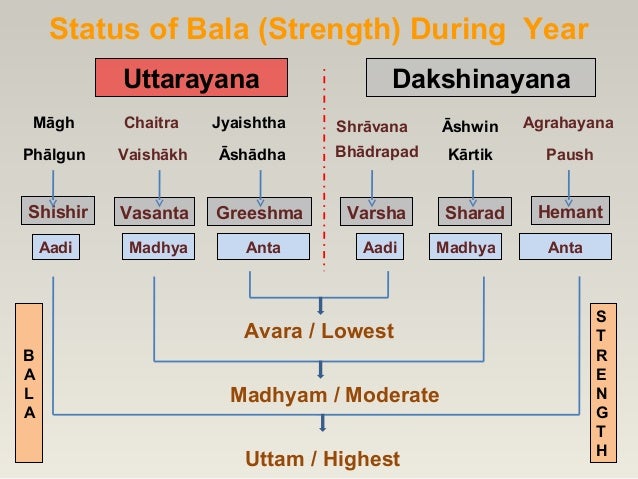
The following table summarizes the key dynamics we've analyzed:
| Kala | Ritu | Bala (Strength) | Agni (Digestive Fire) | Dominant Rasas | Key Dosha Activity |
|---|---|---|---|---|---|
| Adana | Shishira | Decreasing | Strong | Tikta, Kashaya, Katu | Kapha Sanchaya |
| (Depletion) | Vasanta | ↓ | Weakening | ↓ | Kapha Prakopa |
| Grishma | Minimum | Weak | ↓ | Vata Sanchaya | |
| Visarga | Varsha | Increasing | Weak | Amla, Lavana, Madhura | Vata Prakopa, Pitta Sanchaya |
| (Replenishment) | Sharad | ↑ | Strengthening | ↓ | Pitta Prakopa, Vata Prashama |
| Hemanta | Maximum | Strong | ↓ | Pitta Prashama |
Integrating a Modern Perspective
Your interest in evidence-based perspectives is crucial for contemporary practice. Modern science is beginning to validate these ancient observations.
Ritucharya: A Preventive and Promotive Ayurvedic ...
This research paper provides excellent modern interpretations that align with the classical Ayurvedic understanding of seasonal impact. It connects the concepts of Agni and Bala to measurable physiological parameters.
Scan through the 'Modern Interpretation' subsections for each of the six Ritus (starting from Shishira). You don't need to read every detail, but focus on the connections made between: Agni in Hemanta/Shishira and increased Basal Metabolic Rate (BMR) for thermoregulation. Agni in Varsha and reduced efficiency of gastrointestinal enzymes due to humidity. Bala in Hemanta and the season being ideal for anabolic activities (tissue building). The overall concept of Ritucharya and modern chronomedicine/chronobiology.
The article highlights key correlations:
- Strong Agni in Winter (Hemanta/Shishira) aligns with the modern understanding of an increased Basal Metabolic Rate (BMR) and non-shivering thermogenesis, where the body burns more calories to maintain core temperature. This is the physiological basis for the advice to eat heavier, nourishing foods.
- Weak Agni in Monsoon (Varsha) correlates with findings that high humidity can impair digestive enzyme efficiency and alter the gut microbiome, increasing the risk of indigestion and dysbiosis.
- Progressive Increase in Bala in Visarga Kala corresponds to a period of enhanced anabolic activity, where the body is primed for building and repair, supported by a nutrient-rich environment.
- Progressive Decrease in Bala in Adana Kala corresponds to a period of heightened catabolic activity and oxidative stress due to heat and dehydration.
This demonstrates that Adana and Visarga Kala are not just poetic descriptions but represent profound, predictable shifts in human metabolism and physiology.
Test your understanding!
A 35-year-old patient with a Vata-Pitta constitution comes to you for a preventive health consultation in mid-October in a region with a distinct monsoon and autumn. Based on the principles of Visarga Kala:
- What would be your assessment of their likely state of Bala and Agni?
- Which Dosha is most likely to be in a state of Prakopa?
- What is the underlying mechanism for this Dosha aggravation, as described by the classical texts?
Show answer
- Bala and Agni: Mid-October falls squarely in Sharad Ritu, the middle of Visarga Kala. Therefore, Bala would be recovering from its low point in Varsha and can be considered moderate (Madhyama Bala). Agni is also recovering from its weakest state and is now strengthening but not yet at its peak.
- Dosha Prakopa: Sharad Ritu is the classical season for Pitta Prakopa. Given the patient's Vata-Pitta constitution, they would be particularly susceptible.
- Mechanism: The mechanism, as explained by the Acharyas, is the sudden exposure to intense sun after the cooling period of the monsoon. The Pitta that accumulated (Sanchaya) in the acidic and humid environment of Varsha Ritu is now 'heated' and aggravated by the strong solar rays of Sharad, leading to its vitiation.
Conclusion
In this lesson, we have moved from a descriptive to an analytical understanding of the Ayurvedic calendar. We've dissected the causal chain through which the solar and lunar cycles create the two distinct periods of Adana and Visarga Kala.
Key Takeaways:
- Adana Kala (Agneya) is a depleting period characterized by dominant sun/wind, the prominence of drying tastes (Tikta, Katu, Kashaya), and a progressive decline in Bala.
- Visarga Kala (Saumya) is a replenishing period characterized by dominant moon/rain, the prominence of nourishing tastes (Madhura, Amla, Lavana), and a progressive increase in Bala.
- Agni strength is not static; it is weakest in Grishma and Varsha and strongest in Hemanta and Shishira, a principle directly linked to modern concepts like BMR.
- Dosha dynamics follow a predictable annual cycle of Sanchaya (accumulation), Prakopa (aggravation), and Prashama (pacification) that is directly tied to the qualities of the Ritus within each Kala.
Preview of the Next Lesson:
Understanding when and why the Doshas become aggravated is the diagnostic foundation. The next logical step is therapeutic action. In our upcoming lesson, we will analyze the rationale for seasonal Panchakarma (Ritu Shodhana), correlating it with the Dosha Sanchaya, Prakopa, and Prashama cycles that we have detailed today. We will see how Ayurveda uses these predictable peaks of Dosha aggravation as strategic opportunities for purification and disease prevention.