Introduction
In our last lesson, we established a critical clinical framework for deciding when to employ Swasthawritta versus when to escalate to Shamana or Shodhana therapies. You learned to assess a patient's Rogabala (disease strength) and Rogibala (patient strength) to determine the most appropriate starting point for treatment.
Now, we will delve deeper into a fundamental pillar of Swasthawritta: Vyayama (exercise). Today's lesson directly addresses the learning outcome: Compare the Ayurvedic Vyayama approach with modern physical activity recommendations for a patient with cardiovascular risk. This is a frequent and high-stakes scenario in clinical practice. We will move beyond generic advice and equip you with the knowledge to create a nuanced, safe, and effective exercise prescription that integrates the precision of Ayurveda with the evidence base of modern cardiology.
1. The Ayurvedic Framework: Vyayama as a Personalized Prescription
In Ayurveda, Vyayama is not simply 'physical activity'; it is a therapeutic intervention. Its definition, Sharirayasajananam Karma—an action that brings about exertion or fatigue in the body—is deceptively simple. The true art lies in its precise application.
To begin, let's establish the foundational principles of Vyayama as described in our classical texts.
Review Article ROLE OF VYAYAMA IN PREVENTION OF ...
The review article 'ROLE OF VYAYAMA IN PREVENTION OF LIFE STYLE DISODERS' provides an excellent summary of the core concepts of Vyayama, including its definition, types, and the crucial concept of appropriate dosage or 'Maatra'.
Please read the sections titled 'Review of Vyayama', 'Definition of Vyayama', 'Classification of Vyayama', and 'Maatra of Vyayama' to build a solid understanding of these foundational principles. Pay close attention to the signs of proper Vyayama and the concept of 'Balardha'.
The Cornerstone: Balaardha (Half-Strength)
The single most important principle governing Vyayama is exercising to half of one's capacity (Balaardha). This is a subjective, internally-referenced measure of intensity, which stands in contrast to modern external metrics like time or distance. Achieving Balaardha is indicated by a specific set of physiological signs:
Swedagama: Sweating, particularly on the forehead (lalaata), nose (naasa), and underarms (kaksha).Shvasavriddhi: Increased rate of respiration.Hridayoparodhachha: A feeling of lightness or slight strain around the heart region, indicating increased cardiac activity.Gatranam Laghavam: A feeling of lightness in the limbs.Mukhashosha: Dryness of the mouth.
Recognizing these signs allows for a dynamic adjustment of exercise intensity in real-time, preventing the adverse effects of over-exertion (Ativyayama).
Modulating Factors for Prescription
A Vyayama prescription is never generic. It must be tailored based on a holistic assessment of the individual and their environment. The second resource, "An Appraisal on Complex Relationship between Vyayama...", elaborates on these factors.
An Appraisal on Complex Relationship between Vyayama ...
The paper 'An Appraisal on Complex Relationship between Vyayama...' delves deeper into the factors that guide a personalized exercise prescription and compares Ayurvedic grading with modern concepts.
Please read the sections 'Grading of exercise according to Ayurveda' and 'Indications for Vyayama'. Notice how factors like season, body strength, and diet determine the recommended grade of exercise.
Based on these readings, the key modulating factors are:
Bala(Strength): A strong person can tolerate more intense exercise than a weak one.Prakruti(Constitution): AKaphapredominant individual has the most stamina, while aVatapredominant individual has the least.Ritu(Season): Exercise should be done toBalaardhacapacity inHemanta,Shishira, andVasantaRitus. It should be even milder (Alpa) inGrishmaandVarsha.Vaya(Age): Children (Bala) and the elderly (Vriddha) are contraindicated for strenuous exercise.Ahara(Diet): A person consuming unctuous, nourishing food (Snigdha ahara) can perform more exercise.
Failure to consider these factors, especially in a patient with cardiovascular risk, can lead to vitiation of Vata and Pitta, exacerbating the condition.
2. The Modern Framework: Physical Activity for Cardiovascular Health
Modern medicine has robustly established the benefits of physical activity for preventing and managing cardiovascular disease (CVD). The recommendations are typically structured around the FITT principle: Frequency, Intensity, Time, and Type.
Let's look at a visual summary of the modern perspective.
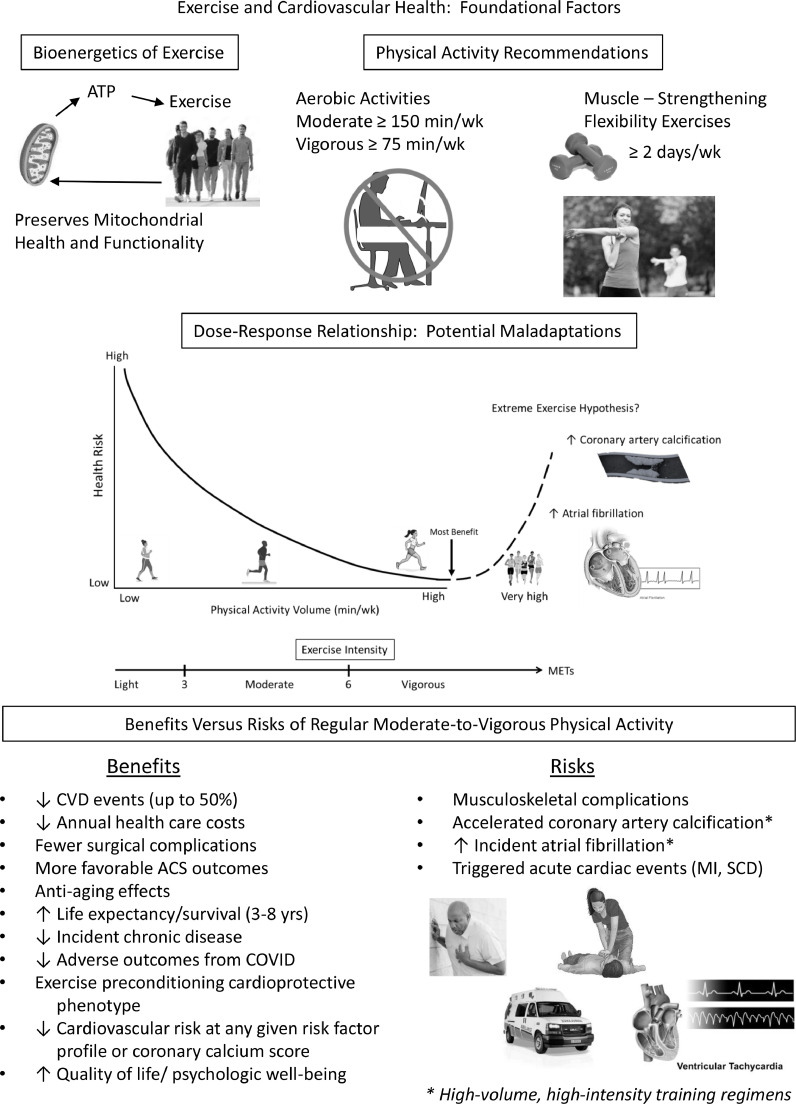
As shown in the image and supported by guidelines from organizations like the American Heart Association (AHA) and the American College of Sports Medicine (ACSM), a standard recommendation for an adult with cardiovascular risk factors is:
- Frequency & Time: At least 150 minutes of moderate-intensity aerobic activity or 75 minutes of vigorous-intensity aerobic activity per week, spread throughout the week.
- Intensity:
- Moderate: An activity you can talk, but not sing, during. This corresponds to 50-70% of maximum heart rate.
- Vigorous: An activity where you can only speak a few words at a time. This corresponds to 70-85% of maximum heart rate.
- Type:
- Aerobic: Brisk walking, cycling, swimming.
- Muscle-strengthening: Lifting weights, resistance bands, at least 2 days per week.
A key concept is the dose-response relationship. As the image illustrates, moving from inactivity to moderate activity yields the greatest health benefits. However, it also hints at a plateau and potential for increased risk (e.g., arrhythmias, musculoskeletal injury) with extreme, high-volume, high-intensity training. This modern finding directly validates the Ayurvedic warning against Ativyayama.
3. A Comparative Analysis: Advising a Patient with Cardiovascular Risk
Let's synthesize these two frameworks through a clinical case.
Case Study:
A 55-year-old male marketing executive presents for a wellness consultation. He has a sedentary job and has been diagnosed with mild hypertension (145/92 mmHg) and borderline high LDL cholesterol. His BMI is 26. He describes himself as feeling "wired and tired" and often irritable. His Prakruti assessment reveals a Vata-Pitta dominance. His Bala is Madhyama (moderate). He wants to start exercising to "get his numbers down."
How do we create an integrated prescription for him?
| Aspect | Ayurvedic Approach (Vyayama) |
Modern Recommendations | Integrated Clinical Prescription |
|---|---|---|---|
| Intensity | Balaardha (Half-strength). For this Vata-Pitta patient, this means gentle sweating and slightly increased breathing, but absolutely no gasping, exhaustion, or excessive heat generation. |
Moderate-intensity. Target 50-70% of max heart rate (approx. 83-115 bpm for his age). Start at the lower end. | Combine both. Advise him to aim for a 30-minute session, 5 days a week. Use a heart rate monitor to stay in the 90-110 bpm range, but teach him that the primary guide is his body. If he feels breathless or overly fatigued (Klama), he must slow down, regardless of what the monitor says. This is Balaardha quantified. |
| Type | Avoid jarring, competitive, or overly heating activities that aggravate Vata and Pitta. Recommend gentle, rhythmic activities: Chankramana (walking), swimming in cool water, specific cooling Asanas and Pranayama. |
Aerobic (brisk walking, cycling) + Muscle-strengthening (weights). | Personalize the type. Instead of generic "brisk walking," suggest a mindful, steady-paced walk in a park. Instead of a hot, competitive gym environment, recommend gentle bodyweight exercises at home (e.g., Surya Namaskar done slowly) or light resistance training. Prescribe Shitali or Chandra Bhedana Pranayama post-exercise to pacify Pitta. |
| Timing & Context | Crucial. Avoid Vyayama during Pitta kala (midday, 10 am - 2 pm). Best time is morning (Kapha kala, 6-10 am) when energy is stable. Avoid exercise in excessive heat (Grishma). |
Generally not emphasized, though emerging chronobiology research supports time-of-day effects on BP. | This is a key Ayurvedic value-add. Instruct the patient to exercise in the cool morning hours. This avoids aggravating Pitta and aligns with the body's natural rhythms for better blood pressure regulation. |
| Warning Signs | Trishna (excessive thirst), Klama (fatigue without exertion), Raktapitta (bleeding tendencies), Shrama (exhaustion), Jvara (feverish feeling). These are signs of Ativyayama. |
Focus on chest pain, dizziness, severe shortness of breath, and musculoskeletal pain. | Educate on both sets of signs. Teach him the immediate "red flags" from a cardiac perspective (chest pain). Also, teach him the subtler Ayurvedic signs (Trishna, Klama) as early warnings that his regimen is too intense and is creating systemic imbalance, which could worsen his Vata-Pitta condition long-term. |
Test your understanding!
Our Vata-Pitta patient starts a walking program. After two weeks, he proudly reports that he is now jogging for 30 minutes, pushing his heart rate to 130 bpm because a fitness app told him this was the "optimal fat-burning zone." However, he also mentions his sleep is more disturbed, and he feels more irritable in the afternoons. How would you advise him using an integrated perspective?
Show answer
You would advise him to reduce his intensity immediately.
-
Ayurvedic Rationale: His symptoms of disturbed sleep and irritability are classic signs of
VataandPittaaggravation, respectively. He has transgressedBalaardhaand is now in a state ofAtivyayama, even if he feels he can physically tolerate the jogging. This is causing a systemic imbalance (Dosha Dushti) that is more harmful than the potential cardiovascular benefit of higher intensity. -
Modern Correlation: While the app's generic advice targets a higher heart rate, it doesn't account for his individual constitution or pre-existing imbalances. The goal of exercise is not just to burn calories but to reduce all-cause mortality and improve quality of life. The new symptoms indicate a negative neuro-hormonal stress response to excessive exercise.
-
Integrated Advice: Praise his consistency but explain that for his specific constitution, "less is more." Instruct him to return to brisk walking, keeping his heart rate below 115 bpm and focusing on the subjective feeling of gentle exertion (
Balaardha). The goal is to make exercise a nourishing (Rasayana) activity, not a stressful one.
Conclusion
Today, we have dissected and compared the Ayurvedic and modern approaches to exercise for a patient with cardiovascular risk. You can now see that these two systems are not contradictory but complementary.
Key Takeaways:
- The Ayurvedic concept of
Balaardhais the ultimate tool for personalizing exercise intensity, providing a subjective biofeedback mechanism that prevents over-exertion. - Modern guidelines provide excellent quantitative targets (FITT) and a strong evidence base for CVD risk reduction, which can be used to help a patient understand what
Balaardhamight feel like. - Ayurveda's strength lies in its deep personalization based on
Prakruti,Ritu, andDosha, guiding the type and timing of exercise in a way that modern general recommendations often miss. - An integrated approach is superior: use Ayurvedic principles to choose the right type, timing, and qualitative intensity, and use modern tools (like a heart rate monitor) as a secondary guide to quantify that intensity.
Preview of the Next Lesson:
We have just seen how the timing of exercise is a critical factor. In our next lesson, we will expand this principle to the entire 24-hour cycle. Your learning outcome will be to: Integrate chronobiology concepts with classical Ayurvedic time-based regimens (Dinacharya, Ratricharya) for a shift-work professional. This will further bridge the gap between ancient wisdom and modern science, tackling a common and challenging clinical problem.