Introduction
Welcome to our next lesson. In our previous session, we established a powerful method for integrating Ayurvedic and modern medical perspectives, using the example of prescribing exercise (Vyayama) for a patient with cardiovascular risk. We saw how the timing of exercise, guided by Dosha Kala, is a crucial element that Ayurveda contributes to a modern FITT protocol.
Today, we will expand this focus on timing to address the entire 24-hour cycle. Your learning outcome is to integrate chronobiology concepts with classical Ayurvedic time-based regimens (Dinacharya, Ratricharya) for a shift-work professional. This is a highly relevant and complex challenge in modern clinical practice. Shift work, a necessity for millions, directly opposes the body's natural rhythms, leading to a state of "chronodisruption." Your task as a clinician is not to impose an impossible solar-day regimen but to skillfully adapt the timeless principles of Dinacharya and Ratricharya to create a new, stable rhythm for your patient, using insights from the modern science of chronobiology.
1. The Two Clocks: Chronobiology and Dosha Kala
To create an integrated protocol, we must first understand the two systems we are working with: the modern scientific concept of circadian rhythms and the Ayurvedic concept of Dosha Kala.
The Modern View: The Science of Circadian Rhythms
Chronobiology is the study of the body's internal biological clocks. The "master clock," located in the Suprachiasmatic Nucleus (SCN) of the brain's hypothalamus, coordinates countless "peripheral clocks" in every organ and cell. This system is primarily synchronized by the daily cycle of light and darkness.
To get a clear overview of this concept from a leading researcher, please watch the following video.
How optimizing circadian rhythms can increase healthy years | Satchin Panda | TEDxBoston
Dr. Satchin Panda is a pioneer in circadian rhythm research. In this TEDx talk, 'How optimizing circadian rhythms can increase healthy years', he explains what these rhythms are and the fundamental rules for keeping them synchronized.
Please watch from 03:14 to 08:34. Focus on understanding what circadian rhythms are and the six practical rules Dr. Panda outlines for maintaining them. We will adapt these rules for our shift-work case.
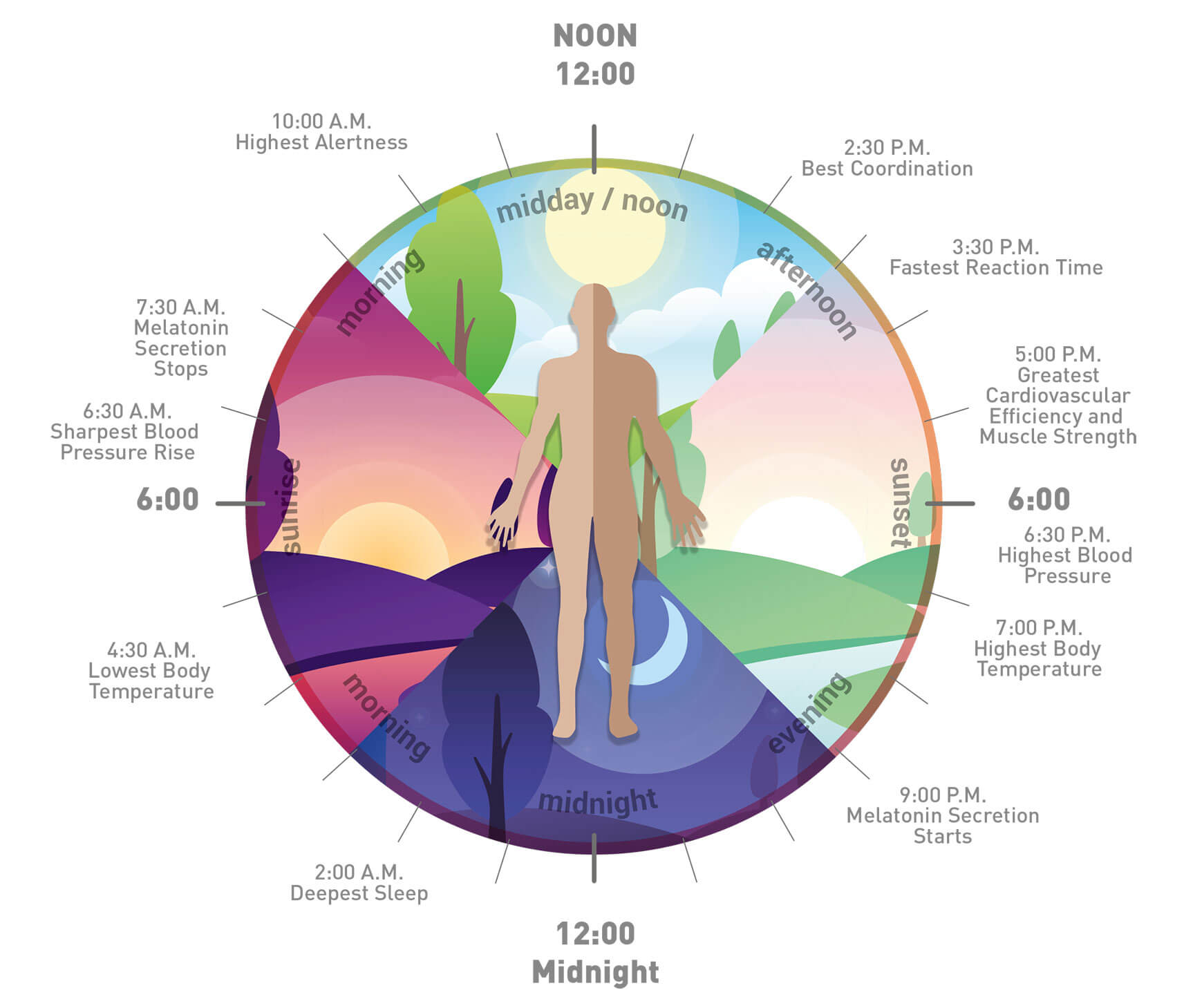
The image below provides a visual map of how various physiological processes are timed throughout a typical 24-hour cycle.
The Ayurvedic View: The Rhythm of the Doshas
Ayurveda has articulated a similar time-based system for millennia through the concept of Dosha Kala, where Vata, Pitta, and Kapha dominate different periods of the day and night, influencing physiological and mental functions.
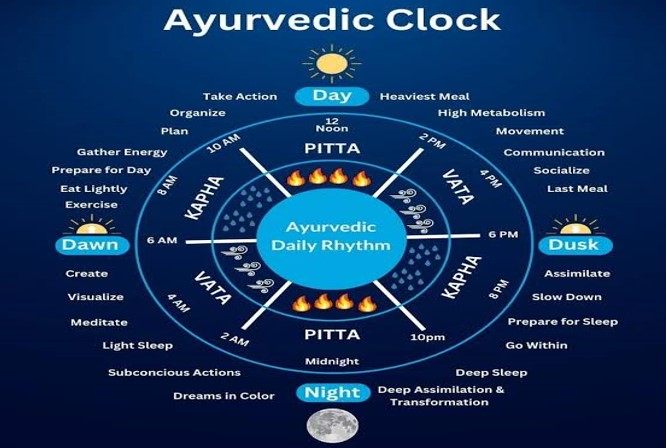
These two "clocks," while using different terminologies, show remarkable parallels. A recent research paper provides a detailed comparative analysis.
Chronobiology And Circadian Rhythm-Based Daily ...
The paper 'Chronobiology And Circadian Rhythm-Based Daily Regimen In Ayurveda - A Comparative Analysis' directly bridges the gap between ancient Ayurvedic wisdom and modern chronoscience.
Please read the 'ABSTRACT', 'INTRODUCTION', and the section 'Dosha Kala and Circadian Rhythms', paying special attention to the detailed comparative table. This table is the core of our integration, correlating specific Dosha periods with modern findings on hormonal and metabolic activities.
As you can see from the table in the paper, the Ayurvedic Pitta Kala (10 am-2 pm) corresponds to the modern finding of peak digestive enzyme activity. Similarly, the rise in cortisol before waking aligns perfectly with the qualities of the pre-dawn Vata Kala and the recommendation to wake during Brahma Muhurta.
2. Chronodisruption: The Challenge of Shift Work
A shift worker's schedule forces a profound desynchronization between their internal clocks and the external light-dark cycle. This is known as chronodisruption. From an Ayurvedic perspective, this is primarily a state of Ratrijagarana (staying awake at night), which is known to cause Vata and Pitta aggravation.
Consequences of Chronodisruption
The health consequences are significant and well-documented. Dr. Panda mentions shift work as the "biggest threat to circadian rhythm" in his talk. The paper on chronobiology also details these risks, including metabolic diseases, mood disorders, and cognitive impairment.
Ayurveda provides a clear explanation for this. Let's explore the classical understanding of sleep disruption.
A Critical Analysis On Nidranash W.S.R. Insomnia
The review article 'A Critical Analysis On Nidranash W.S.R. Insomnia' provides an excellent summary of the Ayurvedic perspective on sleep, including the consequences of staying awake at night (Ratrijagarana) and the protocol for compensatory daytime sleep (Divaswapna).
Please read the sections 'Timing of Nidra', 'Daytime Sleep (Divaswapna)', 'Ratrijagarana (Staying Awake at Night)', and the 'DISCUSSION'. Note Acharya Charaka's description of the effects of Ratrijagarana (Vata/Pitta increase) and the specific advice for compensation, including the important note that those accustomed to night shifts may adapt.
As the text highlights, Ratrijagarana leads to Rukshata (dryness), fatigue, and aggravation of Vata and Pitta. Crucially, it also provides the solution: a person who stays awake at night should sleep for half the duration of the missed sleep during the day, before eating. This classical wisdom forms the basis of our management strategy. The goal is to help the body adapt and establish a new, albeit shifted, state of homeostasis.
3. An Integrated Protocol for a Shift-Work Professional
The key to managing a shift worker is not to force them onto a solar schedule but to help them create a consistent, anchored routine that provides their body with predictable cues for activity and rest.
Let's apply this to a case.
Case Study:
A 35-year-old female nurse works a fixed night shift from 7 PM to 7 AM, three days a week. She complains of persistent fatigue, digestive issues (acidity, bloating), disturbed daytime sleep, and difficulty concentrating during her shifts. Her Prakruti is Pitta-Vata.
Our goal is to create a modified Dinacharya/Ratricharya that anchors her physiology to her work-rest schedule. The most powerful anchors are Light, Food, Sleep, and Exercise.
| Regimen Component | Standard Dinacharya (Solar Day) | Integrated Protocol for Night Shift | Rationale (Ayurvedic & Chronobiology) |
|---|---|---|---|
| Waking Time & Light | Wake at Brahma Muhurta (pre-dawn). |
Wake at 5 PM. Immediately get bright light exposure for 30 mins (use a light therapy lamp or go outside if light permits). | Light is the primary zeitgeber (time-giver) for the SCN. Bright light on waking signals the start of her "day," suppressing melatonin and initiating the cortisol awakening response (Vata's preparatory function). |
| Morning Routine | Shaucha, Dantadhavana, Nasya, Abhyanga. |
5:30 PM - 6:30 PM: Replicate the morning routine. Perform a brief, light Abhyanga with Vata-pacifying oil (e.g., sesame oil) to counter Rukshata from night work. Pratimarsha Nasya is also beneficial. |
The routine itself becomes an anchor. Abhyanga counters the Vata-aggravating nature of night shift work and stress. Nasya clears the channels (Srotas) and improves alertness. |
| Breakfast (First Meal) | Light meal during Kapha Kala (6-10 AM). |
6:30 PM: Have a light, warm, and nourishing meal. Avoid heavy, cold, or dry foods. E.g., a warm bowl of oatmeal or moong dal kitchari. | This corresponds to her "subjective morning," or Kapha Kala. The SCN has just woken up the digestive system; a heavy meal would overwhelm it. It syncs the peripheral clocks in the gut. |
| Main Meal (Lunch) | Largest meal during Pitta Kala (10 AM - 2 PM). |
12 AM - 1 AM (Midnight): This is her "subjective midday." Eat the largest and most substantial meal of her "day" now. | This aligns with her shifted Pitta Kala. Her digestive Agni and metabolic efficiency will be at their peak during this window. This is a core principle of Time-Restricted Eating (TRE). |
Exercise (Vyayama) |
Morning, during Kapha Kala. |
After waking (around 5:30 PM) or during a break (around 9-10 PM). Gentle to moderate intensity. Avoid high intensity close to sleep time. | Exercise raises core body temperature and is stimulating. Doing it after waking reinforces the "daytime" signal. For a Pitta-Vata individual, recommend calming activities like mindful walking or Chandra Namaskar. |
| Winding Down | Light dinner. Slow down during evening Kapha Kala (6-10 PM). |
4 AM onwards: Have a very light, warm snack if needed (e.g., warm milk with nutmeg). Start avoiding bright screens. Use blue-light blocking glasses on the commute home. | This signals the start of her "subjective evening." Avoiding food and bright light allows melatonin to begin its natural rise, preparing the body for sleep. |
Sleep Time (Nidra) |
Bedtime during Kapha Kala (by 10 PM). |
Aim to be in bed by 8 AM. Make the bedroom a "cave": blackout curtains, cool temperature, no electronics. Use an eye mask and earplugs. | Replicates the darkness and quiet of night to allow for quality daytime sleep (Divaswapna). This facilitates the repair and restorative functions governed by Kapha (subjective night: 10 PM - 2 AM) and Pitta (subjective deep assimilation: 10 PM - 2 AM). |
Test your understanding!
A 28-year-old IT professional works a rotating shift schedule, switching from day shifts to night shifts every two weeks. He finds the transition period the most difficult. What would be your single most important piece of advice for the first 2-3 days of his switch to the night shift?
Show answer
The single most important piece of advice would be to aggressively manage his light exposure.
- On the last day shift: Advise him to go to bed and wake up a few hours later than usual to begin shifting his clock.
- On the first night shift: He should use blue-light blocking glasses for the last 2-3 hours of his shift and on his commute home in the morning. This will prevent morning sunlight from suppressing his melatonin, making it easier to fall asleep when he gets home.
- Upon waking in the afternoon: He should immediately use a bright light therapy lamp for 30 minutes to forcefully reset his master clock to the new "wake-up" time.
While food and exercise timing are also important, light is the most potent signal for resetting the master clock in the SCN. Stabilizing the master clock first will help all the peripheral clocks (like in the gut and muscles) to fall in line more quickly, easing the difficult transition period.
Conclusion
Today, we have tackled a significant challenge of modern life through the integrated lens of Ayurveda and chronobiology. You have learned that the principles of Dinacharya and Ratricharya are not rigid rules tied to the sun, but a sophisticated system for maintaining physiological rhythm that can be adapted to even the most demanding schedules.
Key Takeaways:
- Modern chronobiology provides a scientific validation for Ayurveda's time-based regimens (
Dosha Kala). - Shift work causes chronodisruption, which Ayurveda understands as
Ratrijagarana, leading toVataandPittaimbalance. - The management strategy for a shift worker is not to fight the schedule, but to create a new, consistent rhythm by strategically using time-givers (
zeitgebers). - The four most powerful anchors for creating a new rhythm are Light, Food, Sleep, and Exercise, each timed to the person's subjective day and night.
Preview of the Next Lesson:
The consequences of chronodisruption, as we've seen, are strongly linked to metabolic disorders. In our next lesson, we will apply these principles of lifestyle and rhythm management to a specific and prevalent condition. Your learning outcome will be to: Design a comprehensive Swasthawritta-based lifestyle intervention plan for a case of Type 2 Diabetes (Madhumeha). We will see how a disturbed Kapha Kala and Pitta Kala directly contribute to the Samprapti (pathogenesis) of Madhumeha and how restoring rhythm is a cornerstone of its management.