Introduction
Welcome to our next lesson. In our previous session, we analyzed Ratricharya (the night regimen) and established its deep connection to modern chronobiology. We saw that the night is a critical anabolic period and that timely sleep is a cornerstone of this regimen. You correctly identified in our last exercise how disrupting this rhythm leads to Pitta and Vata imbalances.
Today, we elevate our focus from sleep as a component of Ratricharya to its status as a fundamental pillar of health. This lesson directly addresses the learning outcome: Analyze the concept of Nidra (sleep) as a Trayopasthambha (sub-pillar of life) and its significance in maintaining health.
We will explore why Ayurveda places sleep on par with diet (Ahara) and conduct (Brahmacharya) as one of the three essential supports for life. Our analysis will cover:
- The classical definition and benefits of Nidra.
- The physiological mechanisms of sleep according to the Samhitas.
- The clinical significance of sleep's role as a pillar, reinforced by modern research on sleep deprivation.
This exploration will provide the deep conceptual and clinical framework you seek, grounding classical wisdom in practical, evidence-informed understanding.
1. The Tripod of Life: Nidra as a Trayopasthambha
Ayurveda identifies three essential supports, or sub-pillars (Trayopasthambha), that sustain the body and mind: Ahara (food), Nidra (sleep), and Brahmacharya (regulated conduct/celibacy). While the body itself is built upon the three Doshas, it is maintained day-to-day by these three lifestyle pillars.
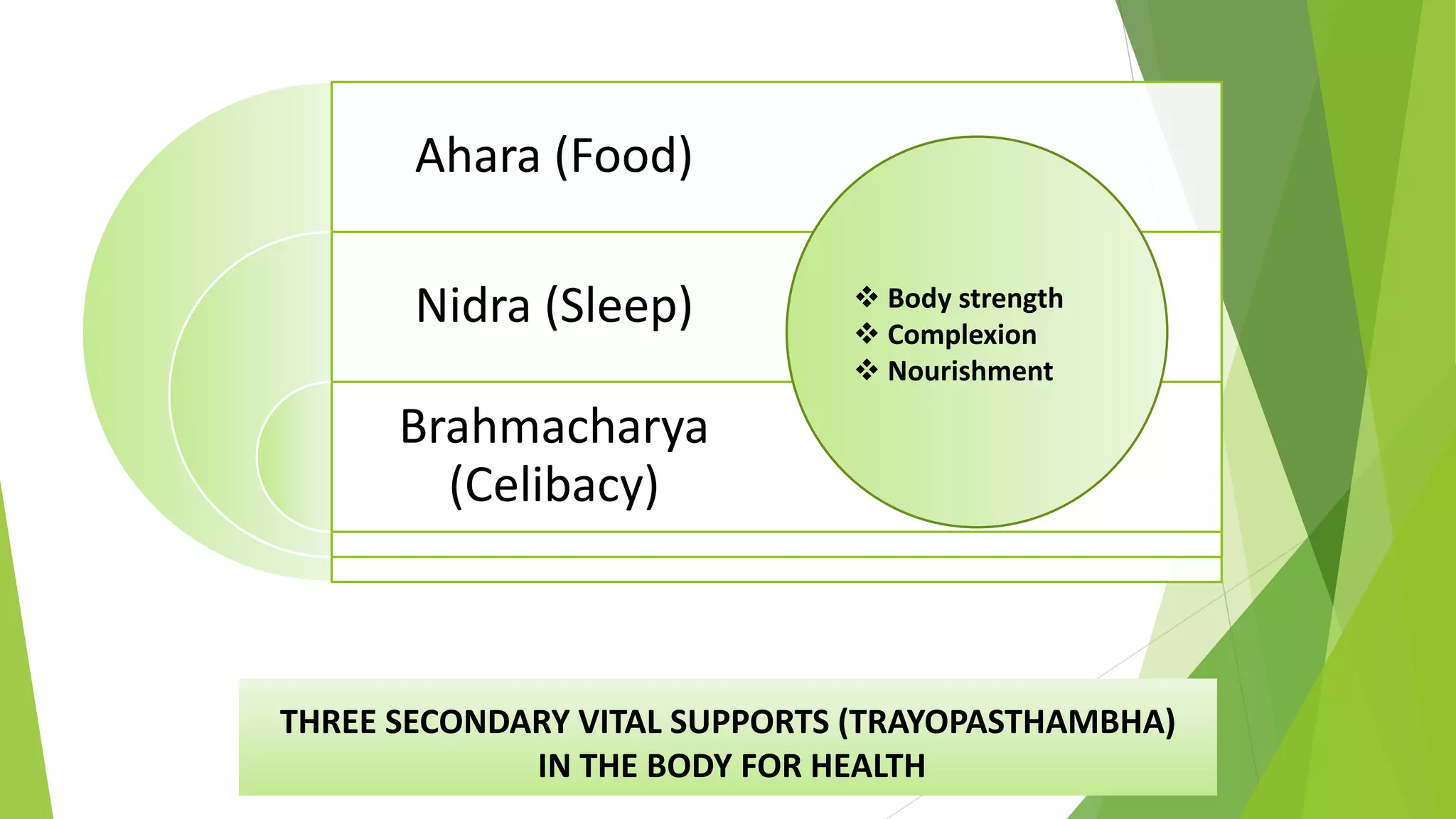
To understand the classical basis for Nidra's elevated status, let's examine what the texts say about its fundamental role.
Understanding Nidra and Nidranasha: A Comprehensive ...
The review article 'Understanding Nidra and Nidranasha' offers a concise summary from the classical texts regarding Nidra's position as a sub-pillar of life.
Please read the 'INTRODUCTION' and the section titled 'Importance of Nidra'. Pay close attention to how the 'Tripod of Life' is defined and the specific list of benefits that proper sleep confers upon an individual.
As the reading highlights, proper sleep is not merely about alleviating fatigue. Charaka Samhita describes it as a life-sustaining force with specific, tangible benefits. Let's analyze these core functions:
- Sukha (Happiness/Well-being): Restful sleep directly promotes mental and emotional equilibrium (Sattva), leading to a state of contentment.
- Pushti (Nourishment): During sleep, the body undertakes deep metabolic processes that nourish all seven Dhatus (tissues). This is the anabolic phase we discussed in our last lesson.
- Bala (Strength): This refers to both physical strength and, crucially, immunological strength (Vyadhikshamatva). Sleep is when the body repairs muscle tissue and modulates immune function.
- Vrishata (Virility/Potency): Proper sleep is essential for the healthy formation of Shukra Dhatu (reproductive tissue) and maintaining hormonal balance.
- Jnana (Knowledge/Cognition): As we saw in the Vata phase of the night, sleep is vital for memory consolidation, learning, and cognitive clarity.
- Jivita (Life): Ultimately, by supporting all the above functions, Nidra sustains life itself. Its absence or chronic disruption inevitably leads to the decay of the body and mind.
Charaka aptly uses the synonym Bhutadhatri for sleep, meaning "the mother who nourishes all beings," which perfectly encapsulates its foundational, nurturing role.
2. The Physiology of Nidra: How Sleep Occurs
Having established why sleep is a pillar, we now turn to how it occurs according to the classics. The Samhitas provide nuanced physiological explanations that complement each other.
Understanding Nidra and Nidranasha: A Comprehensive ...
Let's continue with the same article to analyze the physiological mechanisms of sleep as described by Charaka, Sushruta, and Vagbhata. Their perspectives provide a multi-faceted view of this complex process.
Please read the sections 'Definitions of Nidra' and 'Physiology of Nidra'. Your goal is to compare and contrast the different explanations. Note the key factors identified by each Acharya, such as the role of the mind (Mana), senses (Indriyas), and specific Doshas or Gunas (Tamas, Kapha).
Let's synthesize these classical perspectives:
-
Charaka's View (Functional): Sleep occurs when the Mana (mind), along with the Jnanendriyas (sensory organs) and Karmendriyas (motor organs), become fatigued (klanta) from activity and withdraw (uparati) from their objects. This is a practical, function-based explanation centered on mental and sensory exhaustion.
-
Sushruta's View (Qualitative): Sleep is induced when the Hridaya, considered the seat of consciousness (Chetana), is enveloped by Tamas Guna. Tamas is the quality of inertia, darkness, and heaviness. This perspective emphasizes the energetic shift required for the conscious mind to recede.
-
Vagbhata's View (Integrative/Channel-based): Vagbhata combines these ideas. He states that sleep occurs when the mind detaches due to fatigue AND the Manovaha Srotas (channels of the mind) become filled with Shleshma (Kapha).
This integrated view from Vagbhata provides a direct link to our previous lesson on Ratricharya. The natural increase of Kapha Dosha between 6 PM and 10 PM creates the physiological condition (occlusion of channels with Shleshma) that, combined with the day's fatigue, makes falling asleep a natural process.
3. The Clinical Significance: Consequences of a Compromised Pillar
If Nidra is a pillar supporting the structure of health, what happens when it is damaged or neglected? This is where the concept's clinical relevance becomes most apparent. Practices like intentional night-awakening (Ratrijagarana) or suppressing the urge to sleep (Nidra Vega Dharana) directly attack this pillar.
A modern clinical scenario that perfectly models chronic Ratrijagarana is night-shift work. Let's examine a study that uses Ayurvedic principles to analyze its effects.
To grasp the clinical gravity of disturbing this pillar, we'll look at a study on night-shift workers. The authors explicitly use the Ayurvedic framework of 'Ratrijagarana' and 'Trayopasthambha' to interpret their findings, providing a superb bridge between classical concepts and modern research.
First, read the 'INTRODUCTION' to see how the study grounds itself in the concept of Nidra as a Trayopasthambha. Then, focus on the 'Discussion' section, particularly subsection 'e) Sleep satisfaction', and finally, read the 'CONCLUSION'. Note how the study connects the act of Ratrijagarana to Vata Prakopa, circadian misalignment, and measurable declines in physical and psychological well-being.
This study provides a powerful, evidence-based validation of classical principles:
- Ratrijagarana causes Vata Prakopa: The study reinforces the classical statement that night awakening is Rooksha (drying) and aggravates Vata Dosha.
- Circadian Misalignment as Samprapti: The paper's conclusion identifies "circadian misalignment" as the primary cause of the observed health problems. This is the modern term for the disruption of the Dosha clock we have been discussing.
- Measurable Decline in Health: The use of the WHOQOL-BREF questionnaire shows that this Vata aggravation and circadian disruption are not theoretical. They manifest as a quantifiable decrease in physical, psychological, and social well-being—a direct attack on the Sukha (happiness) and Bala (strength) that Nidra is meant to provide.
The ill effects of suppressing the sleep urge—yawning (Jrumbha), body ache (Angamarda), drowsiness (Tandra), and headache (Shiroruja)—are all classic signs of vitiated Vata Dosha. Thus, neglecting Nidra is functionally equivalent to adopting a Vata-aggravating regimen.
Test your understanding!
A 35-year-old marketing executive presents with anxiety, bloating, dry skin, and constipation. He reports feeling exhausted but has difficulty falling asleep, often staying up until 2 AM browsing on his phone. He mentions that even when he gets 7-8 hours of sleep, he doesn't feel refreshed.
Using the concept of Nidra as a Trayopasthambha, explain the likely Samprapti (pathogenesis) of his symptoms, connecting his habits to the principles we have discussed.
Show answer
The patient's clinical picture is a classic example of a compromised Nidra Upasthambha leading to systemic Vata aggravation.
-
Undermining the Pillar: By chronically engaging in Ratrijagarana (staying awake late), he is actively damaging one of the three pillars of his health. This single habit is enough to destabilize his entire system.
-
Vata Prakopa: Ratrijagarana is inherently Rooksha (drying) and Chala (mobile), qualities that directly increase Vata Dosha. The stimulating blue light from his phone further aggravates Vata in the mind and nervous system.
-
Manifestation of Vata Vriddhi: His symptoms are direct expressions of excess Vata:
- Anxiety: Chala Guna of Vata affecting the Manovaha Srotas.
- Bloating and Constipation: Rooksha and Chala Guna disrupting the function of Apana Vayu in the colon.
- Dry Skin: Systemic Rooksha Guna affecting the Twak (skin).
-
Loss of Nidra's Benefits: He is not receiving the core benefits of sleep. The lack of Pushti (nourishment) and repair contributes to his feeling of exhaustion, despite the duration of sleep. His sleep is likely of poor quality, occurring in the Vata-dominant time of night, making it less restorative and failing to provide Sukha (well-being) and Bala (strength).
Conclusion of Samprapti: The primary etiological factor (Nidana) is Ratrijagarana, which undermines the Nidra Upasthambha. This leads to a systemic aggravation of Vata Dosha, which then manifests with its characteristic signs and symptoms in the gut, skin, and mind. His treatment must begin with restoring this broken pillar.
Conclusion
In this lesson, we have analyzed Nidra not just as a daily activity, but as a foundational sub-pillar of life, the Bhutadhatri that nourishes all beings.
Key Takeaways:
- Nidra is a Trayopasthambha: It stands alongside Ahara and Brahmacharya as one of the three indispensable lifestyle factors for sustaining health.
- Sleep is Profoundly Anabolic: Its purpose is to provide nourishment (Pushti), strength (Bala), vitality (Vrishata), cognitive function (Jnana), and happiness (Sukha), thereby sustaining life (Jivita).
- The Physiology is Multi-faceted: Sleep is induced by a combination of mental/sensory fatigue (Charaka), the influence of Tamas Guna (Sushruta), and the accumulation of Kapha in the mind's channels (Vagbhata).
- Neglecting Sleep is Vata-Aggravating: Chronic sleep disruption (Ratrijagarana) is a primary cause of Vata imbalance, leading to a cascade of physical and psychological disorders, a fact supported by both classical texts and modern clinical research.
Preview of the Next Lesson:
Now that we have firmly established the critical importance of healthy sleep, we must examine its pathologies in detail. In our next session, we will address the learning outcome: Differentiate types of Nidranasha (insomnia) based on Dosha involvement and Samprapti, and formulate the Chikitsa Sutra for each. We will dissect how Vata, Pitta, and other factors cause distinct types of sleep disturbance and outline the core principles for their management.