Introduction
Welcome to our new lesson. In our previous session, we focused on the crucial skill of evaluation, learning how to define key performance indicators (KPIs) and outcome measures for community health programs. We established that to prove the value of any Swasthawritta intervention, we must measure its implementation (process) and its impact (outcomes) systematically.
Today, we shift from the 'how to measure' to the 'what to implement' by examining a specific, potent public health intervention from the classical texts. This lesson directly addresses the learning outcome: Analyze the role of Dhupana (fumigation) and environmental purification in the context of Janapadodhwamsa and modern public health.
We will explore Ayurveda's sophisticated understanding of epidemics, known as Janapadodhwamsa, and investigate Dhupana Karma as a primary tool for environmental purification. You will analyze its classical rationale, its proposed mechanisms, and its relevance in tackling contemporary public health crises like hospital-acquired infections, air pollution, and antimicrobial resistance, all through the lens of evidence-based practice.
1. Janapadodhwamsa: The Ayurvedic Framework for Epidemics
Before we can understand the intervention, we must first analyze the problem it seeks to address. In Ayurveda, the concept of a widespread calamity affecting a large population is termed Janapadodhwamsa (destruction of communities). This is far more than just an outbreak of infectious disease; it is conceptualized as a systemic breakdown of environmental homeostasis.
Charaka Samhita (Vimana Sthana, Ch. 3) describes that despite individuals having different constitutions (Prakruti), diet, and habits, they can fall ill simultaneously with similar diseases. The cause for this must be factors that are common to all inhabitants of the region.
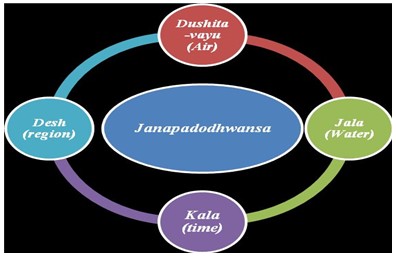
As the image shows, Acharya Charaka identifies four such factors:
- Vayu (Air)
- Jala (Water)
- Desha (Land/Region)
- Kala (Time/Season)
The simultaneous vitiation of these four pillars of the environment leads to Janapadodhwamsa. This classical concept provides a powerful ecological framework for understanding public health emergencies, mirroring modern concerns about how climate change, pollution, and environmental degradation can fuel pandemics.
To deepen your understanding of this concept and its modern interpretation, let's look at a contemporary review.
How an Ayurvedic Practitioner Can Control Industrial Pollution ...
The article 'How an Ayurvedic Practitioner Can Control Industrial Pollution...' provides a concise introduction to Janapadodhwamsa, directly linking it to modern environmental pollution and the concept of pandemics.
Please read the 'INTRODUCTION' section. Focus on how the authors define Janapadodhwamsa and connect the four factors (Vayu, Jala, Desha, Kaala) to the idea of epidemics and pandemics. Note the parallel drawn between this ancient concept and today's environmental health crisis.
2. Dhupana Karma: An Intervention for Environmental Purification
If vitiated air (Dushita Vayu) is a primary cause of Janapadodhwamsa, what is the Ayurvedic solution? The primary intervention for atmospheric purification is Dhupana Karma (therapeutic fumigation).
This is not merely about creating a pleasant aroma. Classical texts describe Dhupana as a potent Rakshoghna Karma—an action that destroys or protects from harmful invisible entities (Rakshas), a concept that can be correlated with modern germ theory (Krimi). Its applications were broad and highly specific.
To explore the classical scope and definition of Dhupana, please study the following material.
Antimicrobial effect of Vishaghna Gana Dhupana
The paper 'Antimicrobial effect of Vishaghna Gana Dhupana' offers a detailed overview of Dhupana, its definition, classical uses, and importance in toxicology (Agada Tantra).
Read the sections starting from 'Environment includes water, air, land...' up to the end of the bulleted list under 'Dhoopana Uses' and the short section 'Importance of Dhoopana in Agada'. Pay close attention to: The etymological definition of 'fumigation'. The Ayurvedic definition involving Nirjantukarana (disinfection). The extensive list of its uses, which range from sterilizing rooms (Kumaragara, Vranagara) and equipment to therapeutic applications.
As you've read, Dhupana was a cornerstone of hygiene and preventive medicine. It was used to fumigate surgical theaters (Shastra Karma Griha), post-natal care rooms (Sutikagara), and was also employed directly for treating various conditions. The selection of herbs (Dravyas) was critical and tailored to the specific purpose. Common Rakshoghna dravyas include Guggulu (Commiphora mukul), Nimba (Azadirachta indica), Vacha (Acorus calamus), and Sarshapa (Brassica campestris), often combined with Ghrita and other substances.
3. Bridging to Modern Public Health: Mechanisms and Applications
The classical concept of Rakshoghna Karma finds a direct parallel in modern microbiology and public health. The volatile phytochemicals released from medicinal herbs during fumigation possess scientifically verifiable properties. Let's analyze how this ancient practice addresses three major modern public health challenges.
a) Hospital-Acquired (Nosocomial) Infections
Modern hospitals use chemical fumigation (e.g., with formaldehyde gas) to sterilize operating theaters and ICUs. However, these chemicals have significant drawbacks, including toxicity and carcinogenicity. This has created an urgent need for safer alternatives. Dhupana presents a promising, non-toxic approach.
The paper on Vishaghna Gana Dhupana you just reviewed is set in this very context—evaluating an Ayurvedic fumigation method for use in a hospital environment to reduce microbial load and prevent the spread of nosocomial infections.
b) Antimicrobial Resistance (AMR)
The World Health Organization has declared AMR as one of the top 10 global public health threats. Overuse and misuse of single-molecule antibiotics have led to the evolution of "superbugs." Herbal formulations used in Dhupana contain hundreds of active compounds. This multi-target mechanism of action may make it much more difficult for microbes to develop resistance compared to a single-drug approach.
c) Air Pollution and Respiratory Illness
Urban and industrial air pollution is a modern form of Dushita Vayu that contributes to a wide range of respiratory and systemic diseases. The article "How an Ayurvedic Practitioner Can Control Industrial Pollution..." directly addresses this.
How an Ayurvedic Practitioner Can Control Industrial Pollution ...
This article explicitly frames Dhupana as a tool to combat modern air pollution and discusses its mode of action from an integrated perspective.
Please read the section 'Dhupana karma(fumigation)'. Note the list of dravyas and the correlation of 'Rakshogna karma' with aseptic procedures. Then, read the first paragraph of the 'DISCUSSION' section, which reinforces the connection between environmental toxicity, Janapadodhwamsa, and the preventive role of Dhupana.
The inhaled fumigated air, rich in antimicrobial and anti-inflammatory volatile oils, can have both a local effect on the respiratory tract and a systemic effect after absorption, potentially boosting immunity and mitigating the harmful effects of pollutants.
4. An Evidence-Based Analysis of Dhupana
Your goal is to integrate classical knowledge with an evidence-based perspective. Let's critically analyze the research study that forms the basis of the first article we examined. This serves as a case study in how ancient practices can be validated using modern scientific methods.
Antimicrobial effect of Vishaghna Gana Dhupana
The study on 'Vishaghna Gana Dhupana' provides a practical example of research on Dhupana. We will analyze its methodology and conclusions.
Read the sections 'Present Need For Dhoopana', 'Discussion', 'Mode of action', and 'Conclusion'. As you read, analyze the study like a researcher: Rationale: Why was this study needed? (Hint: 'Present Need For Dhoopana' section). Intervention: What specific formulation was used? (Vishaghna Gana from Charaka Samhita). Outcome Measure: What were they measuring to test effectiveness? (The paper implies it by discussing reduction of 'air microbes'. In the full study, this would be measured as a change in Colony Forming Units (CFUs) on agar plates exposed to the air before and after fumigation). Conclusion: What was the final verdict on the efficacy of the procedure?
This study demonstrates that the Dhupana procedure, using drugs from the Vishaghna Gana (group of anti-poisonous/anti-toxic substances), was effective in reducing airborne microorganisms. It concludes that this traditional, cost-effective method can be adapted as a daily practice in hospital settings to reduce nosocomial infections—a direct and powerful modern application. This is a clear example of bridging a classical concept with a pressing public health need, validated by scientific investigation.
Test your understanding!
You are tasked with advising a committee managing a temporary shelter after a flood. The crowded conditions and damp environment are leading to a rise in fungal skin infections and respiratory complaints—a classic Desha and Jala vitiation scenario. Chemical disinfectants are in short supply and are causing irritation in some children.
Outline a brief proposal for using Dhupana Karma as a complementary public health measure. Your proposal should include:
- A concise rationale linking the current situation to Ayurvedic principles (Janapadodhwamsa).
- A suggestion of at least three easily available Dravyas and a justification for their choice based on their properties (Gunas).
- How you would explain the mechanism and benefits to the shelter managers, who have no Ayurvedic background.
Show answer
-
Rationale: The current health issues in the shelter can be understood through the Ayurvedic framework of Janapadodhwamsa. The flood has vitiated the Jala (water) and Desha (environment), creating conditions ripe for disease. We propose implementing Dhupana Karma, a classical method of environmental purification, as a Rakshoghna (protective/antimicrobial) measure to counter the vitiated environment and prevent the spread of disease.
-
Proposed Dravyas:
- Nimba (Neem) leaves: Widely available. Known for its potent Tikta Rasa and Krimighna (antimicrobial/antiseptic) properties. Effective against fungal and bacterial pathogens.
- Sarshapa (Mustard) seeds: Also readily available. Its Katu Rasa and Ushna Virya give it powerful Rakshoghna properties, making it an excellent fumigant to clear the air of pathogens.
- Vacha (Calamus) rhizome: Known for its strong aroma and Krimighna properties. Its volatile oils are effective in clearing respiratory passages and purifying the air.
-
Explanation for Shelter Managers: "We recommend a traditional, safe, and cost-effective method of air purification using herbal fumigation. The smoke from burning specific dried herbs, like Neem and Mustard seeds, releases natural volatile oils into the air. These oils have proven antimicrobial and antifungal properties. This process can help reduce the load of airborne germs, lessen the damp smell, repel insects, and create a healthier environment, thereby potentially lowering the incidence of skin and respiratory issues without the harsh side effects of chemical agents."
Conclusion
Today we have explored the profound connection between environmental health and public health through the Ayurvedic lens of Janapadodhwamsa. You have analyzed how Dhupana Karma serves as a sophisticated intervention, not just for simple fumigation, but as a form of Rakshoghna Karma designed to purify the environment and protect communities.
Key Takeaways:
- Janapadodhwamsa is the classical framework for epidemics, attributing them to the vitiation of common environmental factors: air, water, land, and time.
- Dhupana Karma is the primary Ayurvedic intervention for atmospheric purification (Vayu Shodhana), acting as a Rakshoghna (antimicrobial/protective) measure.
- This ancient practice has immense modern relevance in addressing challenges such as hospital-acquired infections, antimicrobial resistance, and air pollution, offering a potentially safer and eco-friendly alternative to chemical disinfectants.
- Preliminary scientific evidence supports the antimicrobial efficacy of Dhupana, demonstrating how classical knowledge can be validated and integrated into contemporary evidence-based public health strategies.
Preview of the Next Lesson:
While we have seen promising evidence for Dhupana, this is just one piece of the puzzle. The field of Swasthawritta is vast, and many of its practices are yet to be rigorously studied. To truly advance evidence-based Ayurveda, we must become adept at identifying what we don't know. In our next lesson, we will focus on the learning outcome: Identify key research gaps in Swasthawritta-based public health and formulate three specific research questions. You will learn the critical skill of moving from clinical observation and textual knowledge to formulating precise, answerable questions that can drive future research.