Introduction
Welcome back. In our previous lesson, we focused on designing season-specific preventive protocols for healthy individuals, learning to counteract the predictable Dosha imbalances of Vasanta and Varsha Ritus. We established that the core of Swasthawritta lies in anticipation and prevention.
Today, we will elevate that clinical skill to a more complex level. The reality of clinical practice is that many patients present with pre-existing chronic conditions. Our goal is to address the learning outcome: Develop a modified Ritucharya plan for a patient with a chronic disease (e.g., Amavata) during a specific season, using a case study.
We will dissect how seasonal shifts can act as a trigger (Nidana) for exacerbating chronic ailments like Amavata (often correlated with Rheumatoid Arthritis). Using a detailed clinical case, you will learn to move beyond a standard Ritucharya and create a nuanced, personalized regimen that not only respects the season but actively manages the underlying disease process.
1. The Clinical Challenge: Amavata and Seasonal Aggravation
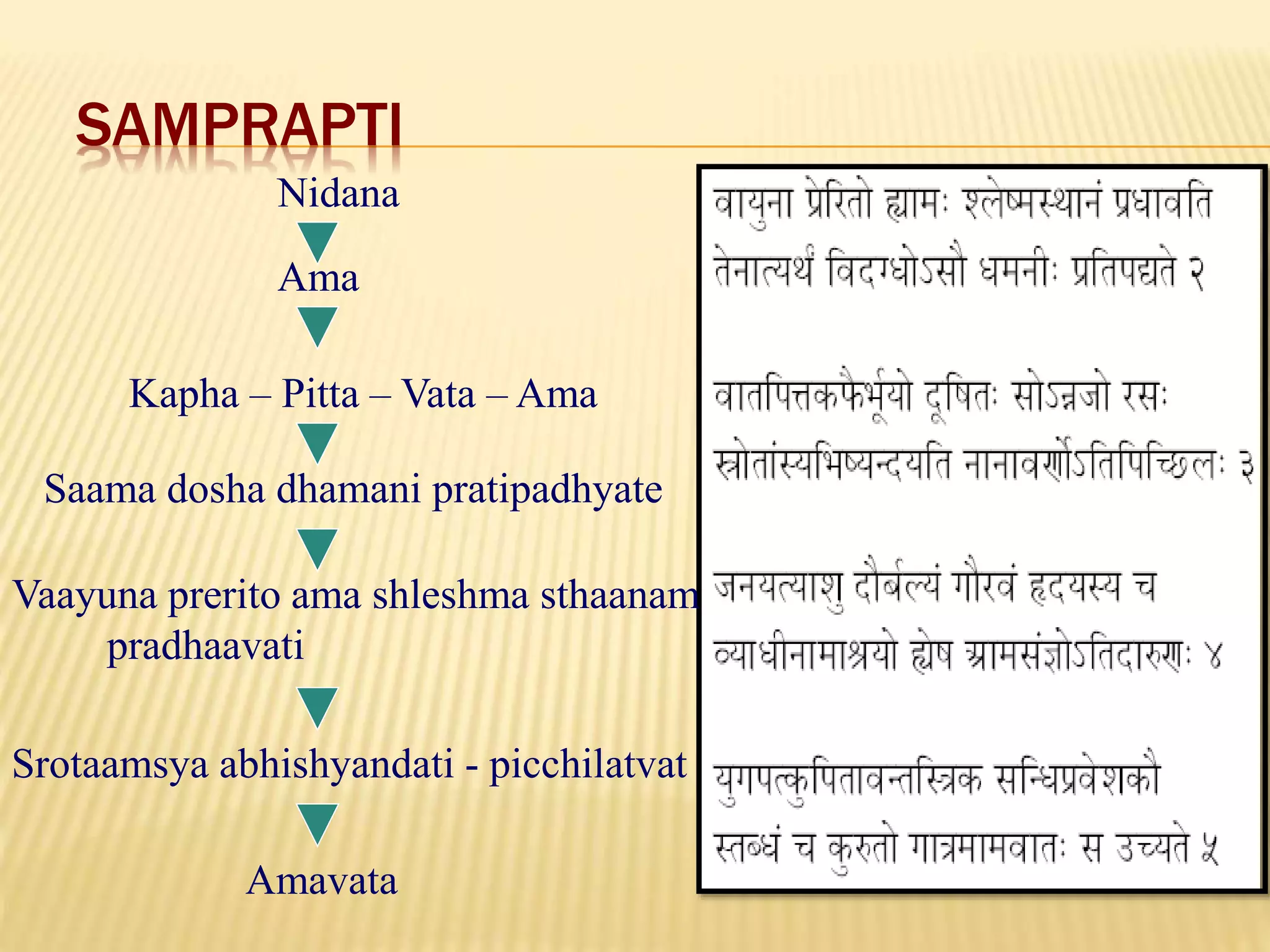
Amavata is a quintessential example of a disease deeply influenced by external factors, including seasons. To modify Ritucharya effectively, we must first have a precise understanding of its pathogenesis (Samprapti).
The classical pathogenesis involves:
- Mandagni (Weak Digestive Fire): This is the root cause, leading to improper digestion.
- Ama Formation: The undigested food particles form Ama, a metabolic toxin that is sticky, heavy, and channel-clogging.
- Dosha Vitiation: This Ama, propelled by a simultaneously aggravated Vata Dosha, circulates throughout the body. It combines with Kapha Dosha at the joints (Shleshma Sthana).
- Srotorodha (Channel Blockage): This toxic, morbid complex of Ama, Vata, and Kapha settles in the joints, obstructing channels and causing pain (Shula), swelling (Shotha), and stiffness (Stabdhata).
Given this Samprapti, which seasons present the greatest threat?
- Varsha Ritu (Monsoon): This season is characterized by natural Vata Prakopa and a damp, cloudy environment that suppresses Agni. This creates a perfect storm for both producing Ama and aggravating the Vata that drives it into the joints.
- Shishira/Hemanta Ritu (Winter): The cold (Sheeta) and heavy (Guru) qualities of winter directly increase Vata and Kapha, leading to heightened pain, stiffness, and sluggishness in patients with Amavata.
For our lesson today, we will focus on designing a protocol for the notoriously difficult Varsha Ritu.
2. Clinical Case Analysis: An In-depth Look at Amavata
To ground our theoretical discussion in clinical reality, we will now analyze a published case study. This will provide the specific data needed to build our modified Ritucharya.
Ayurvedic Approach to Rheumatologic Disorders
The paper 'Ayurvedic Approach to Rheumatologic Disorders' contains an excellent, detailed case study of Amavata. We will use this to understand the disease from presentation to management.
Please read the following sections from the article: Start with the section titled 'Aamvata (Rheumatoid Arthritis): Etiology' and 'Exacerbation of amavata' to solidify your understanding of the pathogenesis. Next, study the case in detail, starting from 'A Case study of AMVAT is attached...' through the patient's 'Personal history', 'Present complaints', 'Ashtavidha parikshana', 'Srotas Parikshana', laboratory reports, and finally the Ayurvedic diagnostic breakdown ('Itiology (Hetu)', 'Roopa', 'Dasha Involved', 'Samprapti'). Conclude by reviewing the 'Treatment' and 'DIETARY RESTRICTIONS' provided. Focus on how the patient's causative factors (Hetu) directly led to the diagnosed Samprapti and how the treatment principles target this specific pathogenesis.
Analysis of the Case
From your reading, let's distill the key clinical points:
- Hetu: The patient's history includes Vishmashana (irregular eating), consumption of stale, spicy, and fried foods, and Divaswapna (day sleep) — classic causes of Mandagni and Tridosha imbalance.
- Symptoms: The presentation is a textbook picture of Amavata with Vata dominance (migratory pain), Kapha dominance (joint effusion, stiffness, anorexia, somnolence), and Pitta involvement (fever, thirst).
- Samprapti: The diagnosis clearly links the faulty diet and lifestyle to Agnimandya, leading to the formation of Sama-Vayu which then localizes in the joints (Sandhi Ashraya).
- Treatment Principles: The management plan follows the classical line of treatment for Amavata: Langhana (implied by light diet), Swedana (hot fomentation), Tikta, Katu rasa sevan (use of bitter/pungent herbs), Deepan (stimulating digestion), and Virechana (Eranda sneha for purgation). Notice the cautious use of external oleation (Vishgarbha Taila) combined with heat, targeting pain without aggravating Ama.
This case provides a perfect template for understanding how to approach an Amavata patient. Now, let's adapt this approach to a specific season.
3. Designing a Modified Varsha Ritucharya for Amavata
Imagine the patient from the case study is entering Varsha Ritu (monsoon season). A standard Ritucharya for a healthy person in Varsha recommends Madhura-Amla-Lavana (sweet-sour-salty) tastes and Snigdha (unctuous) foods to pacify Vata. For our Amavata patient, this would be a disaster. Madhura and Snigdha foods would increase Kapha and Ama, while excessive Amla could worsen inflammation.
Our modified protocol must be a strategic balance: pacify Vata without aggravating Ama and Kapha. The primary goals are Agni Deepana (enhancing digestive fire) and Ama Pachana (digesting metabolic toxins).
Modified Ahara (Dietary Plan)
The diet must be light, warm, and easy to digest.
| Recommendation | Rationale for Modification |
|---|---|
| Dominant Tastes: Katu (pungent), Tikta (bitter). Use Lavana (salty, specifically Saindhava) in moderation. | Katu and Tikta are Agni-deepaka and Ama-pachaka. They are light and drying, countering the heavy, sticky nature of Ama and Kapha. |
| Grains: Old rice, barley (Yava), millets. | These are Laghu (light) and Ruksha (drying), preventing further Kapha and Ama accumulation. Avoid heavy wheat and new rice. |
| Soups (Yusha): Medicated soups of Mung beans, lentils, or horse gram, spiced with ginger, black pepper, and garlic. | Provides easy-to-digest protein while the spices kindle Agni. The liquid nature helps pacify Vata. |
| Vegetables: Cooked bitter gourd, pointed gourd, bottle gourd, garlic, onions. | These vegetables are generally light and do not aggravate Kapha. They must be cooked, never raw, as salads would be too cold and hard to digest. |
| Liquids: Sip warm water throughout the day. Water boiled with ginger (Shunthi) or a pinch of Trikatu is ideal. | Warmth pacifies Vata and supports Agni. Cold water is strictly contraindicated as it would extinguish the already weak digestive fire. |
| Foods to Avoid: Dairy (especially yogurt, cheese), fried foods, red meat, excessive sweets, sour foods like tamarind, and all cold/raw foods. | This is a crucial modification. Yogurt (Dadhi) is Abhishyandi (channel-clogging) and a primary cause of Ama formation, making it poison for an Amavata patient, especially in the damp monsoon season. |
Modified Vihara (Lifestyle Plan)
The lifestyle must protect against the season's inclemency while managing the disease.
| Recommendation | Rationale for Modification |
|---|---|
| Exercise (Vyayama): Gentle, indoor range-of-motion exercises and stretching. Avoid inactivity, but also avoid heavy exertion or exposure to cold wind. | Prevents stiffness (Graha) without straining the joints. This is a modification of the general advice to avoid Ati-vyayama (excessive exercise) in Varsha. |
| Warmth & Dryness: Always wear dry clothes, keep the living space warm and free of dampness. Use of Dhupana (fumigation) with Guggulu and Vacha is beneficial. | The cold and damp of Varsha directly aggravate Vata and Kapha, increasing pain and stiffness. |
| Swedana (Fomentation): Regular local application of heat using a hot water bag or Valuka Sweda (heated sand pouch) on painful joints. | This is a key therapeutic addition to the Ritucharya. Swedana is one of the primary treatments for both Vata and Kapha, relieving pain, reducing stiffness, and helping to digest Ama. |
| Abhyanga (Massage): Contraindicated in the Sama (Ama-associated) state. If the patient is in a Nirama (Ama-free) state with only residual Vata pain, a gentle massage with Ruksha (dry) and Ushna (hot) oils like Vishgarbha or Kottamchukkadi Thailam can be performed, followed by Swedana. | This is the most critical and nuanced modification. Standard Abhyanga would worsen the condition by pushing Ama deeper into the tissues. |
| Sleep: Strictly avoid Diva Swapna (day sleep). | Day sleep dramatically increases Kleda (dampness) and Kapha in the body, which would worsen joint swelling and heaviness. |
Test your understanding!
A 45-year-old patient with a known history of Amavata is entering Shishira Ritu (winter). He complains of significantly increased morning stiffness and a deep, aching pain in his joints. He tells you he has been trying to eat healthy by having a bowl of yogurt and a large raw salad for lunch every day. Based on the principles we've discussed, what are the three most critical and immediate modifications you would advise for his diet and lifestyle?
Show answer
-
Stop Yogurt and Raw Salads Immediately: This is the highest priority. Both are cold (Sheeta) in potency and heavy (Guru) to digest. Yogurt is channel-clogging (Abhishyandi). In the cold winter season, for an Amavata patient, this combination is a potent recipe for aggravating Ama, Kapha, and Vata, directly worsening his stiffness and pain. He should switch to warm, cooked meals like vegetable soups.
-
Incorporate Daily Gentle Swedana (Fomentation): The cold of winter is a primary trigger for Vata and Kapha. He should apply local heat to his stiff and painful joints for 10-15 minutes every morning after waking up. This will liquefy the stagnant Kapha, pacify Vata, and provide immediate relief from morning stiffness.
-
Replace Plain Water with Warm, Spiced Water: He should be advised to sip warm water, ideally infused with a slice of ginger (Shunthi) or cumin seeds (Jeeraka), throughout the day. This simple change helps maintain body heat, supports Agni, pacifies Vata, and aids in Ama pachana, countering the effects of the cold season on his weak digestion.
4. Integrating Deeper Concepts: Temporality in Chronic Disease
Your interest in the deeper concepts of Ayurveda and its intersection with modern science is crucial here. The practice of modifying Ritucharya is a profound application of what modern research calls spatiotemporality in chronic pain management. Ayurveda has always recognized that disease is not a static entity but a dynamic process that unfolds in time (Kala) and space (the body).
Ayurvedic protocols of chronic pain management
To appreciate the philosophical and scientific depth of this topic, let's look at a recent paper on Ayurvedic pain management. It frames our discussion in a modern research context.
Please read the section in the 'Introduction' that begins 'CIM approaches such as the Ayurvedic system of medicine...' to see how temporality is central to Ayurveda. Then, read the section 'Spatiotemporality as embodied time' and note how 'dinacharya and ritucharya' are explicitly listed as modalities to connect the body's sensations with consciousness and to balance the system.
As the paper highlights, Ritucharya is not just a list of rules; it is a tool for "fine-tuning of dinacharya with nature." For a patient with a chronic disease like Amavata, this fine-tuning becomes the primary therapeutic strategy. By consciously modifying diet and lifestyle in response to the season, the patient learns to manage the temporal expression of their disease, reducing the frequency and intensity of flare-ups and taking an active role in their own healing process.
Conclusion
Today we have made a significant leap from general prevention to specialized clinical management. You have learned how to deconstruct the needs of a patient with a chronic disease and synergize them with the demands of the season.
Key Takeaways:
- Modification, Not Replacement: Ritucharya for a chronic disease is a reasoned modification, not a replacement, of the standard seasonal protocol.
- Samprapti is the Guide: The specific pathogenesis of the disease (e.g., Ama-Vata-Kapha in Amavata) dictates the necessary modifications.
- Balance is Key: The primary clinical challenge is to balance conflicting needs, such as pacifying Vata without simultaneously aggravating Ama or Kapha.
- Prioritize Agni and Ama: In most chronic inflammatory and autoimmune conditions, the foundational strategy is always Agni Deepana and Ama Pachana, which often takes precedence over generic Dosha-pacifying measures.
Preview of the Next Lesson:
We have successfully created a modified plan for one season. The next logical step is to compare and contrast this management across different environmental conditions. In our upcoming lesson, we will directly address the outcome: "Contrast Ritucharya modifications for the same chronic disease across two opposing seasons (e.g., Grishma and Hemanta)." We will take our Amavata patient and design two distinct, detailed management plans, one for the peak of summer (Grishma) and one for deep winter (Hemanta), demonstrating the true dynamism of Ayurvedic clinical practice.