Introduction
Welcome back to our study of Ritucharya. In the last lesson, we constructed comprehensive management plans for the primary seasonal Dosha aggravations—Kapha in Vasanta, Pitta in Sharad, and Vata in Varsha. These plans were based on the classical six-season model, which is highly accurate for its region of origin in the Indian subcontinent.
However, as a clinician, your patients may live in diverse environments, from the arid deserts of the Middle East to the cold, damp climates of Northern Europe. This raises a critical question: how do we apply a season-based system when the seasons themselves are different?
This lesson directly addresses that challenge. Your learning outcome is to adapt Ritucharya principles to different geographical variations and climate zones with practical examples. We will move beyond a fixed calendar and learn to use Yukti (reasoned judgment) to analyze any environment's unique characteristics. This skill is the bridge between classical knowledge and global clinical practice.
The foundational principle we will explore is that the environment, or Desha, has its own inherent qualities (Gunas) and a dominant Doshic influence. By understanding this, we can tailor our recommendations to create balance, regardless of the patient's location.
1. The Ayurvedic Concept of Desha (Geographical Region)
Before we can adapt Ritucharya, we must first understand the Ayurvedic framework for classifying geographical regions, known as Desha. Ayurveda categorizes land based on its climate, terrain, water availability, and vegetation, which in turn influences the health and constitution of its inhabitants. The classical texts describe three primary types of Desha.
To understand these classifications in detail, please study the following resource.
An insight to Desha (Geographical area/Land) in relation to ...
The paper 'An insight to Desha (Geographical area/Land) in relation to promotion of health' provides a clear and comprehensive overview of this concept. It is foundational for today's lesson.
Please read the following sections: 'Classification of Desha', 'Jangala Desha (Dry Forest Land)', 'Anupa Desha (Marshy land)', 'Sadharana Desha (Normal land)', and review 'Table no.3: Features of different Desha'. Focus on how each land type is characterized by its climate, terrain, and the resulting predominant Doshas.
Based on your reading, we can summarize the key characteristics as follows:
| Feature | Jangala Desha (Arid Region) | Anupa Desha (Marshy Region) | Sadharana Desha (Temperate Region) |
|---|---|---|---|
| Climate | Dry, hot, windy, less rainfall | Humid, cold/cool, high rainfall | Moderate, balanced seasons |
| Terrain | Arid, sandy, sparse vegetation | Abundant water, dense forests, fertile | Mixed features of both |
| Dominant Gunas | Ruksha (dry), Laghu (light), Chala (mobile) | Snigdha (unctuous), Sheeta (cold), Guru (heavy) | Balanced qualities |
| Dominant Doshas | Vata-Pitta | Kapha-Vata | Sama (Balanced Doshas) |
| Health Impact | Inhabitants are generally sturdy but prone to Vata-Pitta disorders. Considered relatively healthy. | Inhabitants are of a more delicate constitution and are prone to Kapha disorders. Considered less healthy. | Most conducive to health; inhabitants are strong and balanced. |
Understanding these Desha profiles is the first step. For example, a person living in a Jangala Desha (like Rajasthan or Arizona) will have a baseline tendency towards Vata and Pitta aggravation, while someone in an Anupa Desha (like coastal Kerala or the UK) will have a natural tendency towards Kapha aggravation.
2. The Principle of Adaptation: Desha-Viparyaya
Now that we can classify a region, how do we adapt Ritucharya? The core principle is Desha-Viparyaya—applying diet (Ahara) and lifestyle (Vihara) with qualities opposite to those of the land and the season.
As the paper you just read mentions in its discussion section, "The acclimatization of a particular habitat is possible by adopting Ahara with opposite qualities pertaining to Desha, such as hot and unctuous substances in marshy land whereas cold and unctuous substances in dry land."
This means our clinical reasoning follows two steps:
- Assess the dominant Gunas of the Desha and the current Kala (season/weather).
- Prescribe a regimen with contrary Gunas to maintain equilibrium.
Let's see this in action:
- In a Jangala Desha (hot, dry): The baseline regimen should be cooling (Sheeta) and unctuous/hydrating (Snigdha).
- In an Anupa Desha (cold, damp): The baseline regimen should be warming (Ushna) and drying (Ruksha).
The specific Ritucharya is then layered on top of this baseline, with its intensity adjusted. For instance, the Greeshma (summer) regimen will be followed with much greater stringency in a Jangala Desha than in an Anupa Desha. Conversely, the Hemanta (winter) regimen will be more robust in a cold Anupa Desha.
3. Integrating with Modern Climate Science: The Koppen Classification
To apply this globally, we can use modern climate classifications as a proxy for Desha. The Koppen climate classification is a widely used system that categorizes climates based on temperature and precipitation patterns. This provides a practical tool for the modern Ayurvedic practitioner.
First, let's appreciate the climatic diversity that exists even within India, making adaptation a local necessity, not just an international one.
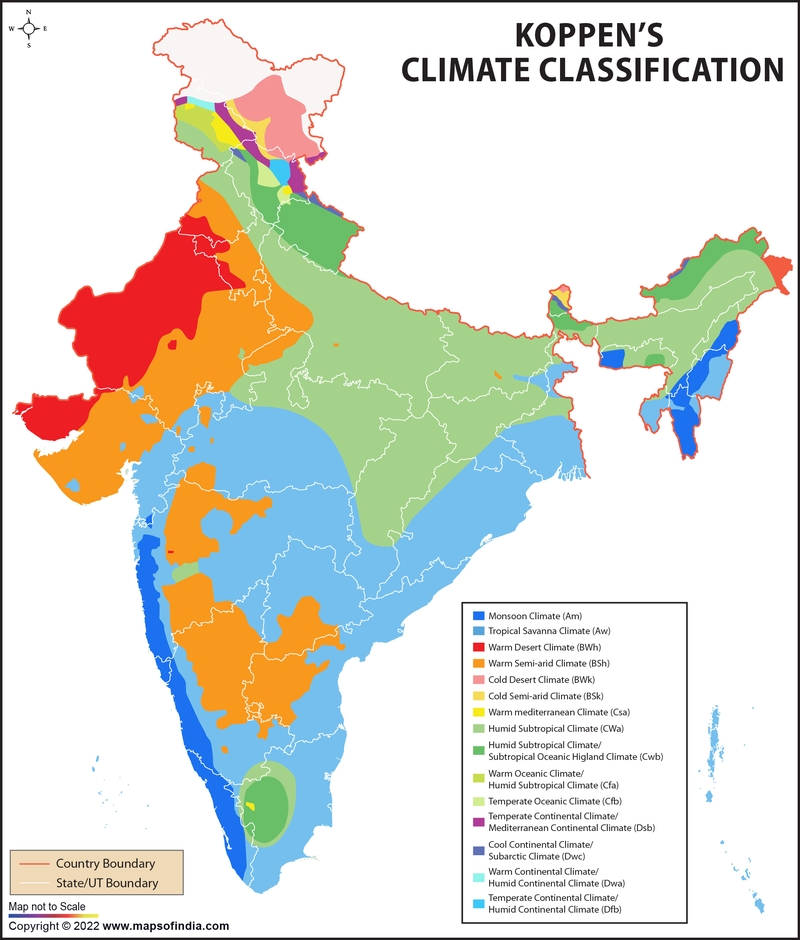
Now, let's explore how to adapt Ritucharya for different global climates, using the Koppen system as our guide.
03 | Ritucharya | Basics of Ayurveda | Dr. Gitanjali
This short video provides a quick review of the classical six seasons and their effects. Pay special attention to the end, where the speaker addresses how to adapt these principles for a place like Chennai, which has a consistently hot climate.
Watch the introduction from 00:54 to 03:02 for a recap of the six seasons. Then, watch the Q&A segment from 58:03 to 1:01:25. The speaker's advice on adapting to a place without extreme winters is a perfect example of applying Yukti over rigid rules.
As the video suggests, we don't discard Ritucharya in a place with a different climate; we adapt it. We follow the calendar months as a guide but adjust the intensity of the regimen based on the actual weather and our assessment of the patient's Agni and Bala.
Let's analyze two contrasting case scenarios.
Scenario 1: Tropical Desert Climate (Dubai, UAE)
- Koppen Classification: BWh (Hot Desert Climate)
- Ayurvedic Desha: Extreme Jangala Desha
- Dominant Gunas: Very Ushna (hot), very Ruksha (dry).
- Baseline Recommendation: Sheeta (cooling), Snigdha (unctuous), Drava (liquid).
Adapting Ritucharya:
- Summer (May-Sep): This corresponds to an extreme Greeshma Ritu. The classical recommendations—consuming sweet, liquid, cooling foods (Madhura Rasa, Sheeta Virya), avoiding sun exposure, and minimizing physical exertion—are paramount. The risk of dehydration and Pitta aggravation is extremely high.
- Winter (Nov-Feb): This is the most pleasant time, corresponding to a very mild Hemanta/Shishira. The calendar suggests a regimen for strong Agni (heavy, nourishing foods). However, in Dubai's mild winter, Agni won't be as powerful as in a truly cold climate.
- Adaptation: The diet should be nourishing but not excessively heavy. Instead of the robust Guru Ahara of a classical winter, a more balanced Sadharana diet is appropriate. One should focus on the Snigdha (unctuous) quality to counteract the pervasive dryness of the desert environment, but without the heavy-to-digest aspect.
Scenario 2: Oceanic Climate (London, UK)
- Koppen Classification: Cfb (Temperate Oceanic Climate)
- Ayurvedic Desha: Predominantly Anupa Desha
- Dominant Gunas: Sheeta (cold/cool), Snigdha (damp/unctuous), Guru (heavy, from cloud cover).
- Baseline Recommendation: Ushna (warming), Ruksha (drying), Laghu (light).
Adapting Ritucharya:
- Winter (Nov-Mar): This corresponds to a prolonged and damp Hemanta/Shishira. The cold and dampness strongly aggravate both Kapha and Vata.
- Adaptation: The classical recommendations for winter must be strictly followed, with an added emphasis on Ruksha (drying) and Deepana-Pachana (appetizer-digestive) qualities to manage the Kapha-aggravating dampness. Warm soups, spices like ginger and black pepper, and regular exercise are crucial.
- Spring (Apr-May): This is a classical Vasanta Ritu, but often colder and damper than in India. The liquefaction of accumulated Kapha can be severe.
- Adaptation: The Vasanta Ritucharya—emphasizing Katu-Tikta-Kashaya Rasa, Udvartana (dry powder massage), and vigorous exercise—is critically important to prevent respiratory allergies and colds.
- Summer (Jun-Aug): This is a mild Greeshma Ritu. The intense Pitta-aggravating heat is usually absent.
- Adaptation: A strict Pitta-pacifying diet is often unnecessary. It's more important to avoid cold, heavy foods (like ice cream and cold salads) that could dampen Agni, which is never very strong in this climate. The focus should be on light, easily digestible meals.
Test your understanding!
A patient from Helsinki, Finland, consults you in November. Helsinki has a Humid Continental Climate (Koppen: Dfb), characterized by very long, cold, dark winters and short, mild summers.
- What are the dominant Gunas of this Desha (Finland) in this Kala (November)?
- Which Dosha(s) are most at risk of aggravation?
- The classical Hemanta Ritucharya recommends consuming Guru Ahara (heavy foods) to satisfy a strong Agni. How might you need to adapt this recommendation for someone in Helsinki, considering the extreme cold but also the profound lack of sunlight (Adana Kala effect)?
Show answer
-
The dominant Gunas are extreme Sheeta (cold), Guru (heavy, from lack of sun and potential dampness), Ruksha (dry-cold), and Sthira (static, from darkness and reduced activity).
-
Vata and Kapha are most at risk. The extreme cold aggravates Vata. The cold, heaviness, and darkness (leading to inactivity) strongly aggravate Kapha. This environment is highly challenging for maintaining Dosha equilibrium.
-
While the cold stimulates Agni to some degree, the profound lack of sun (a key feature of Adana Kala which reduces Bala) and the potential for depression/lethargy (SAD - Seasonal Affective Disorder) can suppress it. A blind recommendation of very heavy foods (Guru Ahara) might overwhelm their digestive capacity, leading to Ama formation.
- Adaptation: The diet must be nourishing, warm, and unctuous (Snigdha) to counter the cold and Vata. However, it should also be easy to digest. Emphasis should be on warm, well-spiced soups, stews, and cooked whole grains rather than excessively heavy fats and meats. Spices that promote Agni and combat Kapha (ginger, pepper, cinnamon, turmeric) are essential. Regular Abhyanga and some form of indoor Vyayama would be non-negotiable to combat Vata and Kapha stagnation.
Conclusion
You have now learned the essential principles for adapting Ritucharya to any location in the world. By moving from a calendar-based approach to a Guna-based analysis, your clinical advice becomes more precise, effective, and universally applicable.
Key Takeaways:
- Ritucharya must be adapted based on the qualities (Gunas) of the specific Desha (geographical region) and the actual Kala (season/weather).
- The three main Deshas—Jangala (arid), Anupa (marshy), and Sadharana (temperate)—have distinct Doshic influences.
- The core principle of adaptation is Desha-Viparyaya: prescribing a regimen with qualities opposite to those of the environment.
- Modern tools like the Koppen climate classification can serve as a practical guide for identifying a region's Desha characteristics.
- Your clinical Yukti (reasoned judgment) is the most important tool in deciding how to intensify or moderate classical regimens for a given patient in a given location.
Preview of the Next Lesson:
Now that you can adapt the seasonal context, our next step is to create highly specific protocols for common seasonal ailments. In the next lesson, you will learn to design season-specific preventive protocols for common Ritu-related disorders (e.g., allergies in Vasanta, digestive issues in Varsha). This will involve applying your newfound understanding of geographical adaptation to create targeted interventions.