Introduction
Welcome to our new lesson. In our previous session, we mastered the art of designing a personalized weekly Aahara Rasayana protocol, focusing on how diet can be a continuous source of rejuvenation. We established that for a healthy individual, Prakruti is the guiding star for dietary choices to maintain Doshic equilibrium.
Today, we will complement the principles of Aahara (diet) with Vihara (lifestyle/activity). Our learning outcome is to analyze the principles for selecting Yoga Asanas based on an individual's Prakruti, Vikruti, and the prevailing Ritu. This lesson will explore the deep synergy between Yoga and Ayurveda, treating them not as separate disciplines but as two sides of the same coin, essential for achieving holistic health. You will learn to move beyond generic yoga sequences and instead prescribe Asanas with the precision of a clinician, tailoring the practice to the unique constitutional, pathological, and environmental context of an individual.
1. The Foundational Synergy of Yoga and Ayurveda
Before diving into specifics, it's crucial to appreciate the inseparable bond between Yoga and Ayurveda. While Ayurveda is the science of life and healing (Chikitsa), Yoga is the science of self-realization and discipline (Sadhana). For the purpose of Swasthavritta, they work together to create a balanced state of body and mind. A one-size-fits-all approach to Yoga can be ineffective or even counterproductive; personalization is the key to unlocking its full potential.
To set the stage, let's hear a perspective on this integration.
Exploring Ayurveda - On Integrating Yoga and Ayurveda
Watch this short video, 'Exploring Ayurveda - On Integrating Yoga and Ayurveda', featuring Dr. Madhuri Gokhale Gordon. It provides an excellent high-level overview of why yoga practice must be adapted to an individual's constitution.
Please watch the following segments: 00:22 - 01:14: To understand the 'body-mind' relationship between Yoga and Ayurveda. 02:56 - 03:46: Focus on the rationale for a more rigorous practice for a Kapha dominant individual. 03:46 - 04:31: Note the recommendation for a calmer practice for Pitta and Vata types.
The video highlights a core principle: the qualities (Gunas) of a yoga practice should be selected to counteract and balance the qualities of the dominant or aggravated Doshas. Just as we use substances with opposite qualities in Dravya Guna for therapeutic effect, we use Asanas with opposite qualities for balancing the body and mind.
2. Selecting Asanas for Prakruti: Maintaining Equilibrium
For a healthy individual (Swastha), the goal of yoga is to maintain the inherent balance of their Prakruti. The practice becomes a tool for Swasthasya Swasthya Rakshanam (preserving the health of the healthy).
Let's explore the specific principles for each Dosha.
INNER PEACE & OUTER VITALITY: THE AYURVEDIC ...
The article 'INNER PEACE & OUTER VITALITY: THE AYURVEDIC BENEFITS OF YOGA' provides a clear, structured guide on how to design a personalized yoga practice for each Dosha. This will form the basis of our understanding for Prakruti-based selection.
Please read the section 'Designing a Personalized Yoga Practice' and then the specific recommendations for Vata, Pitta, and Kapha-pacifying practices. Pay close attention to the types of poses recommended for each constitution.
Based on this reading, we can summarize the principles as follows:
Vata-Pacifying Practice
- Qualities to Balance: Chala (mobile), Laghu (light), Ruksha (dry), Sheeta (cold).
- Practice Principles: Grounding, warming, stabilizing, and consistent. The pace should be slow and mindful.
- Asana Characteristics:
- Seated and Supine Poses: Poses like Vajrasana (Thunderbolt Pose) and Supta Virasana (Reclined Hero Pose) provide stability.
- Forward Bends: Paschimottanasana (Seated Forward Bend) is calming and grounds apana vayu.
- Gentle Twists: To relieve tension in the lower back, a common site of Vata accumulation.
- Focus: Maintain poses for longer durations with steady breathing. Avoid rapid, jerky movements or jumping between poses.
Pitta-Pacifying Practice
- Qualities to Balance: Ushna (hot), Tikshna (sharp), Drava (liquid).
- Practice Principles: Cooling, calming, spacious, and non-competitive. The attitude should be one of surrender, not ambition.
- Asana Characteristics:
- Heart Openers & Gentle Backbends: Poses like Bhujangasana (Cobra Pose) and Ustrasana (Camel Pose) done gently can release tension from the solar plexus, a seat of Pitta.
- Side Bends & Twists: Trikonasana (Triangle Pose) and Ardha Matsyendrasana (Half Lord of the Fishes Pose) help to detoxify the liver and spleen.
- Forward Bends: These are cooling and help to calm the mind.
- Focus: Avoid overheating. Practice in a cool environment and avoid holding the breath. Moon Salutations (Chandra Namaskar) are an excellent alternative to the heating Sun Salutations.
Kapha-Pacifying Practice
- Qualities to Balance: Guru (heavy), Manda (slow), Sheeta (cold), Snigdha (oily).
- Practice Principles: Stimulating, warming, dynamic, and invigorating. The goal is to create heat and movement.
- Asana Characteristics:
- Vigorous Sequences: Surya Namaskar (Sun Salutation) practiced at a brisk pace is ideal.
- Standing Poses & Backbends: Poses like Virabhadrasana (Warrior series) and Dhanurasana (Bow Pose) build heat and strength.
- Inversions: Headstand (Sirsasana) and Shoulderstand (Sarvangasana) improve circulation and stimulate metabolism.
- Chest Openers: To counteract congestion in the lungs, a primary site of Kapha.
- Focus: Emphasize movement, light-footed transitions, and powerful breathing.
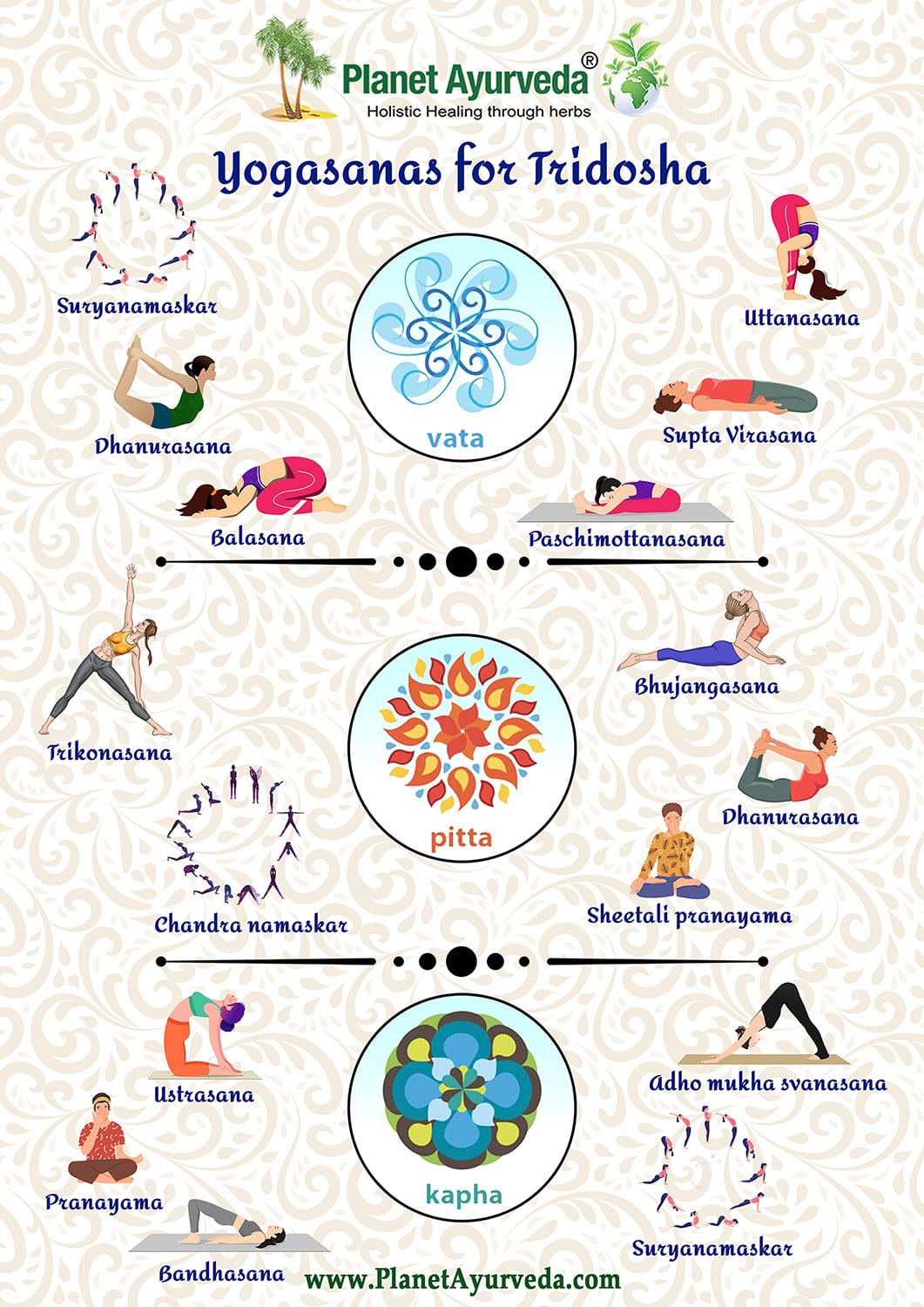
This infographic provides a helpful visual summary of Asanas for each Dosha.
3. Selecting Asanas for Vikruti: Restoring Balance
When there is a disease state (Vikruti), the selection of Asanas becomes more specific and therapeutic. The goal shifts to pacifying the aggravated Doshas and correcting the underlying Samprapti (pathogenesis). The Asanas must be chosen not just for the Prakruti, but primarily to address the imbalance.
For instance, in a condition like Amavata (Rheumatoid Arthritis), which involves Vata aggravation and Ama formation, the practice would need to be gentle enough for painful joints (pacifying Vata) but also stimulating enough to digest Ama (improving Agni).
Let's examine a clinical application in the context of metabolic syndrome.
Combining Swasthavṛtta and yoga in the management of ...
The paper 'Combining Swasthavṛtta and yoga in the management of...' provides excellent case studies demonstrating how Yoga is integrated into a treatment protocol for specific metabolic disorders. This shows the shift from a Prakruti-based approach to a Vikruti-based one.
Please read these two sections: Start with the paragraph under 'Yogic Interventions for Metabolic Regulation' that begins with 'From an Ayurvedic perspective...'. This explains the Ayurvedic rationale for selecting specific asanas like Paschimottanasana and Dhanurasana to reduce Kapha and stimulate Agni. Then, carefully analyze the 'Case Example 1' (Kapha-Prakṛti Female) and 'Case Example 2' (Pitta-Kapha Prakṛti Male). Note how the yoga protocol is designed to address their specific Vikruti (obesity, insulin resistance, diabetes, hypertension).
From this reading, we can draw key clinical insights:
- Targeting the Samprapti: The Asanas chosen for metabolic syndrome—Trikoṇāsana, Bhujangāsana, Dhanurāsana, Paścimottānāsana, Matsyendrāsana—directly target the core pathology. They work by:
- Reducing Kapha accumulation and Meda dhātu vṛddhi.
- Stimulating Jatharagni and Dhatvagni through abdominal compression and twisting.
- Opening channels (Srotas) for Ama clearance.
- Personalization within Vikruti:
- For the Kapha-Prakriti female with obesity, the protocol is robustly Kapha-pacifying, emphasizing weight reduction and stimulating metabolism.
- For the Pitta-Kapha Prakriti male with diabetes and hypertension, the protocol must be more nuanced. While twisting postures and Kapalbhati are needed to manage Kledaka Kapha and stimulate the pancreas, the practice must also be calming enough to avoid aggravating Pitta, which would worsen hypertension and irritability.
Test your understanding!
Case Profile: A 30-year-old software developer (Vata-Pitta Prakruti) presents with chronic low back pain (Kati Shula) and anxiety. The pain is dull and shifting, worse with prolonged sitting and stress. They feel restless and have trouble sleeping. This is a clear case of Vata Vikruti.
Task: Propose a sequence of 3-4 Asanas for this individual. Justify your selection by explaining how each Asana helps pacify the Vata Vikruti and addresses the specific symptoms.
Show answer
Here is a sample therapeutic sequence for this Vata Vikruti:
-
Marjaryasana-Bitilasana (Cat-Cow Pose): This gentle, dynamic sequence is an excellent starting point. It synchronizes breath with slow, controlled movement of the spine.
- Justification: It brings gentle movement to the lumbar spine, pacifying the stiffness (Stambha) caused by Vata, and its rhythmic nature is calming for the anxious mind, grounding the erratic quality of Vata.
-
Setu Bandhasana (Bridge Pose): A gentle backbend that strengthens the posterior chain without strain.
- Justification: It strengthens the lumbar and gluteal muscles, providing support to the lower back. It is also a mild inversion that can calm the nervous system, helping with anxiety and sleep.
-
Supta Matsyendrasana (Supine Spinal Twist): A restorative twist performed lying down.
- Justification: It gently releases tension in the lumbar spine and hips, a primary seat of Vata. As a passive twist, it helps to normalize the flow of Apana Vayu, which is often disturbed in cases of low back pain and anxiety.
-
Balasana (Child's Pose): A restorative forward bend.
- Justification: This is a profoundly grounding and introspective pose. It gently stretches the lower back and encourages surrender, directly counteracting the anxious, restless state of Vata. It calms the sympathetic nervous system.
This sequence is warming, grounding, and stabilizing, directly countering the cold, mobile, and light qualities of the aggravated Vata Dosha.
4. Integrating Ritu: Seasonal Adaptation of Practice
Finally, a truly holistic yoga practice must adapt to the prevailing season (Ritu). Ritucharya guidelines are designed to prevent the accumulation and aggravation of Doshas that naturally occur with seasonal changes. Your yoga practice should support this goal.

Here are the guiding principles for seasonal adaptation:
-
Hemanta/Shishira (Winter - Vata accumulation, Kapha aggravation): The environment is cold and dry/damp. The practice should be warming and vigorous. Increase the number of Surya Namaskars. Practice indoors in a warm space to pacify Vata and prevent Kapha from stagnating.
-
Vasanta (Spring - Kapha aggravation): This is the season of liquefying Kapha. The practice should be dynamic and stimulating, focusing on clearing congestion. Emphasize chest-opening backbends, twists, and inversions. This is the best time of year for a strong, energetic practice.
-
Grishma (Summer - Pitta accumulation): The environment is hot. The practice must be cooling and calming. Reduce vigorous vinyasa flows. Favor Chandra Namaskar (Moon Salutation), seated forward bends, and restorative poses. Practice during the coolest times of the day (early morning or evening).
-
Varsha (Monsoon - Vata aggravation, Pitta accumulation): The environment is damp, windy, and unstable, which aggravates Vata. The practice should be grounding, stabilizing, and warming. Focus on standing poses to build stability and gentle flows to keep the body warm and mobile without straining the joints.
-
Sharad (Autumn - Pitta aggravation): After accumulating in the summer, Pitta becomes aggravated in autumn. The practice should again be cooling and detoxifying. Emphasize twists to cleanse the liver and spleen (seats of Pitta) and forward bends to calm the mind. Avoid practices that build excessive heat.
Conclusion
In this lesson, we have systematically analyzed the principles for creating a truly personalized yoga practice. By moving beyond generic prescriptions, you can now use Asanas as a precise tool for both health maintenance and therapeutic intervention.
Key Takeaways:
- Yoga and Ayurveda are sister sciences; a personalized yoga practice is an essential component of Vihara in Swasthawritta.
- For Prakruti: The goal is maintenance. Select Asanas with qualities opposite to the dominant constitutional Dosha(s) (e.g., grounding for Vata, cooling for Pitta, stimulating for Kapha).
- For Vikruti: The goal is therapy. Select Asanas that specifically target the Samprapti, pacifying the aggravated Doshas and correcting imbalances in Dhatus and Srotas.
- For Ritu: The goal is prevention. Adapt the intensity, pace, and type of practice seasonally to counteract the environmental influence on the Doshas.
Preview of the Next Lesson:
We have addressed the physical body (Annamaya Kosha) through Asana. In our next lesson, we will go a level deeper to the energetic body (Pranamaya Kosha). We will "Analyze the principles for selecting Pranayama techniques based on their effects on Doshas and Manas (mind)." You will learn how the conscious regulation of breath can be a powerful tool to influence physiological and psychological states, further refining your ability to design holistic wellness protocols.