Welcome to the final lesson of our foundational module. In our previous lessons, you've learned to trace recursive calls on the call stack and to think at the low-level of bit manipulation. Today, we'll bring these threads together by applying recursion to solve two cornerstone problems in computer science: calculating the factorial and generating Fibonacci numbers.
This lesson is designed to do more than just show you code. It will teach you how to recognize a critical pattern in recursive algorithms—overlapping subproblems. Understanding this pattern is the key that unlocks the door to more advanced techniques like dynamic programming, which are essential for tackling complex interview problems. We will implement basic recursive solutions and, in doing so, discover their inherent inefficiencies, setting the stage for future optimizations.
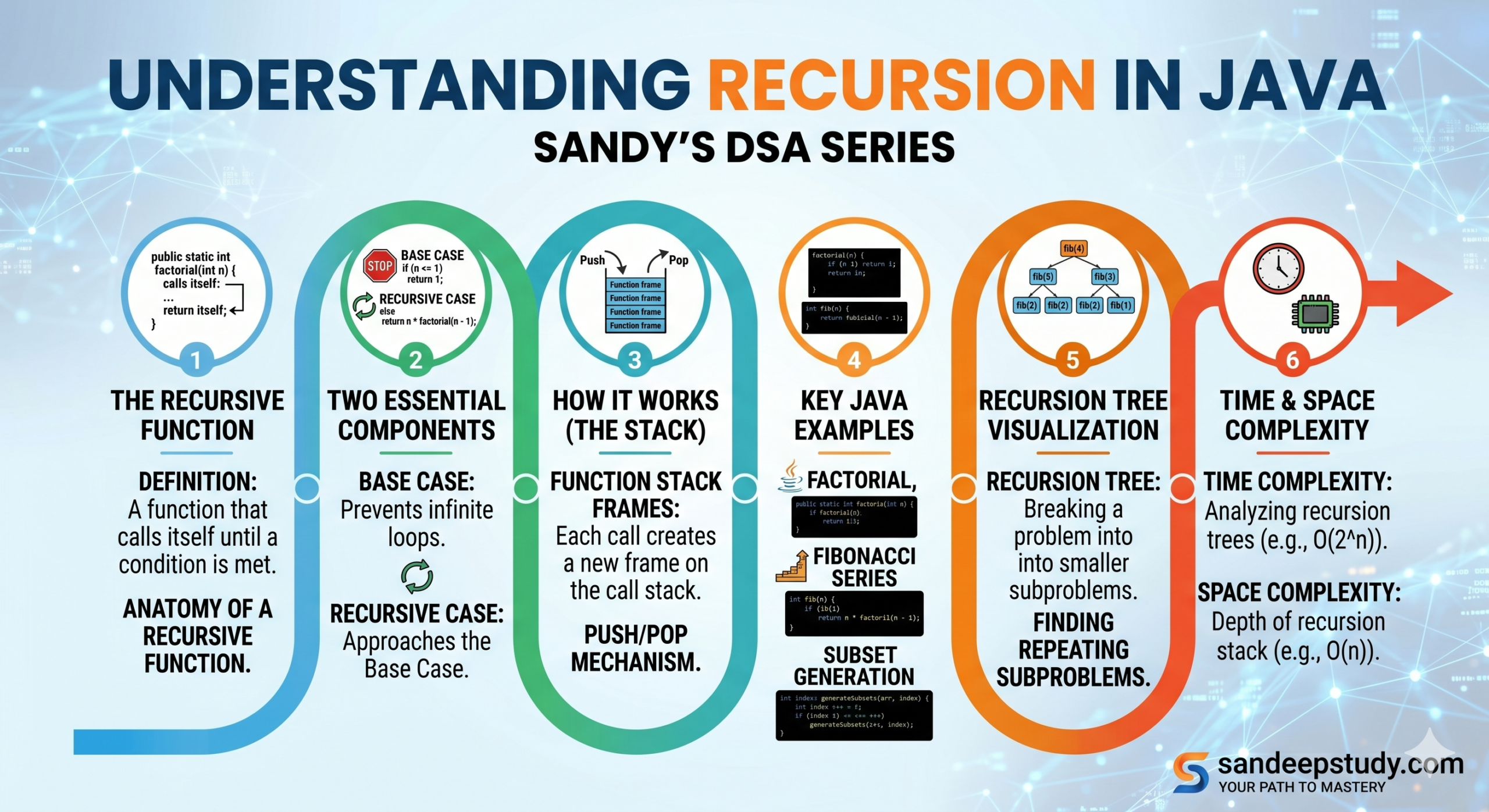
Functional vs. Parameterized Recursion
Before diving into the problems, it's useful to understand two common ways to structure a recursive function, a distinction that Striver explains well.
- Parameterized Recursion: The function doesn't return a value. Instead, it carries the answer down through the recursive calls as a parameter, and a final action (like printing) is performed in the base case.
- Functional Recursion: The function returns a value. Each recursive call returns a partial result, which is then combined with other values to compute the final answer that is returned up the call stack.
For interview preparation, functional recursion is generally more versatile, as it allows you to use the result of one function as an input to another. We'll focus on this style.
Re 3. Parameterised and Functional Recursion | Strivers A2Z DSA Course
To grasp these two patterns, we'll watch a video from Striver's A2Z DSA Course. He uses the simple problem of summing the first N numbers to illustrate the difference clearly.
First, watch the section on parameterized recursion from the parameterized way. Notice how the sum is passed down with each call. Next, watch the section on functional recursion from the functional way. Observe how the function returns a value that is built upon as the stack unwinds. Finally, see how this functional pattern is applied to calculate a factorial from factorial of n. Pay close attention to his explanation of why the base case must return 1, not 0, for multiplication.
Implementing Factorial Recursively
As you saw in the video, calculating the factorial of a number n (denoted as ) is a classic example of functional recursion. The problem is defined by a simple recurrence relation:
with the base case being .
The recursive function mirrors this definition almost perfectly:
- Base Case: If
nis 0 (or 1), return 1. - Recursive Step: Otherwise, return
nmultiplied by the result of calling the function withn-1.
Here is the Java implementation:
public class Factorial {
    public static int factorial(int n) {
        // Base case
        if (n <= 1) {
            return 1;
        }
        // Recursive step
        return n * factorial(n - 1);
    }

    public static void main(String[] args) {
        int number = 5;
        System.out.println("Factorial of " + number + " is: " + factorial(number)); // Output: 120
    }
}
The call stack for factorial(5) would look like a straight line, as each function call makes only one subsequent recursive call. This results in a time complexity of and a space complexity of due to the depth of the recursion stack.
Multiple Recursion Calls: The Fibonacci Series
Now, let's turn to a problem that introduces a new level of complexity: the Fibonacci series. This sequence starts with 0 and 1, and each subsequent number is the sum of the two preceding ones: 0, 1, 1, 2, 3, 5, 8, ...
The recurrence relation is:
with base cases and .
Unlike factorial, the recursive step here involves two recursive calls. This is a fundamental pattern known as multiple recursion.
Re 5. Multiple Recursion Calls | Problems | Strivers A2Z DSA Course
Striver's next video in the series is dedicated to this exact topic. He uses the Fibonacci problem to explain how multiple recursion calls are executed and visualized.
First, watch the introduction to multiple recursion calls and Fibonacci. This section sets up the recurrence relation and the base cases. Next, follow the detailed trace of fib(4) from how this works. This is crucial for understanding how the call stack handles branching. Then, watch him build the recursion tree from how to draw the recursion tree. This visualization is the most important part of the video for our current goal. Finally, observe the discussion on the exponential time complexity from time complexity.
Identifying Overlapping Subproblems
As you saw in the video, the recursion tree for Fibonacci is not a straight line; it's a branching tree. Let's look at the tree for fib(5).
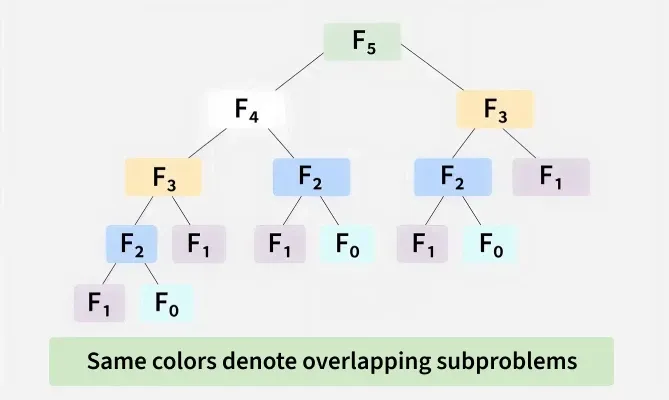
This tree reveals a massive inefficiency. To calculate fib(5), we calculate fib(3) twice. To calculate fib(4), we need fib(3) and fib(2). But the call to fib(3) will also recalculate fib(2). This redundant computation is what we call overlapping subproblems.
The naive recursive implementation in Java looks like this:
public class Fibonacci {
    public static int fib(int n) {
        // Base cases
        if (n <= 1) {
            return n;
        }
        // Recursive step with multiple calls
        return fib(n - 1) + fib(n - 2);
    }

    public static void main(String[] args) {
        int number = 5;
        System.out.println("Fibonacci of " + number + " is: " + fib(number)); // Output: 5
    }
}
Because the number of calls roughly doubles at each level of the tree, the time complexity is exponential, approximately . This is extremely slow. Calculating fib(40) would already take billions of operations.
Fibonacci Series in Java Using Recursion
This article from Scaler provides a concise summary of the complexity of the naive recursive Fibonacci solution.
Read the section titled Time And Space Complexity. It confirms the exponential time complexity and explains why this approach is impractical for larger inputs.
A First Look at Optimization: Memoization
So, how do we fix the problem of overlapping subproblems? The answer is simple in concept: if you've already computed the result for a subproblem (like fib(3)), store it somewhere. The next time you need it, just look it up instead of re-computing it. This technique is called memoization.
It's a way of trading a little bit of space (to store the results) for a massive gain in time.
Program to Print Fibonacci Series in Java
This GeeksforGeeks article demonstrates how to apply memoization to the recursive Fibonacci function.
Read Section 3, titled F****ibonacci Series Using Memoization. Analyze the provided Java code. Notice how it uses an array (memo) to store computed values and checks this array before making a recursive call.
By using memoization, we ensure that fib(k) for any k is calculated only once. The recursion tree is effectively "pruned." All the repeated branches are cut off.
The improved complexities are:
- Time Complexity: , because each
fib(i)from 0 tonis computed exactly once. - Space Complexity: , for the recursion stack depth and the memoization array.
This dramatic improvement from to shows the power of identifying and solving the issue of overlapping subproblems. This exact idea—solving recursive problems while caching results—is the core principle behind memoization-based dynamic programming, a topic we will explore in depth in a later module.
Key Takeaways
- Functional Recursion is a powerful pattern where functions return results that are combined up the call stack. It's highly applicable to many algorithmic problems.
- Simple recursive problems like Factorial have a linear call structure, leading to time complexity.
- Problems like Fibonacci that use multiple recursive calls can have a branching call structure.
- A recursion tree is an essential tool for visualizing the execution of a recursive function and identifying its performance characteristics.
- When a recursion tree shows the same subproblem being solved multiple times, you have identified overlapping subproblems. This is a major source of inefficiency, often leading to exponential time complexity.
- Memoization is the technique of storing the results of expensive function calls and returning the cached result when the same inputs occur again. It transforms exponential-time recursive solutions into linear-time solutions for problems with overlapping subproblems.
Conclusion
You have now completed the foundational module of this course. You've mastered complexity analysis, call stack tracing, bit manipulation, and now, the crucial patterns of recursion. You've seen how a seemingly simple problem like Fibonacci can expose deep algorithmic principles.
In our next lesson, we will begin Module 2: "Arrays & Hashing." We will start with a practical deep dive into ArrayList, Java's implementation of a dynamic array, understanding its operations and their associated time complexities. This will be our first step into studying concrete data structures.