Hello! In our recent lessons, we've explored the complexities that can arise from covariates in survival models, such as non-proportional hazards and values that change over time. We've learned how to stratify or model these variables to get accurate results. Now, we will shift our focus from the predictors to the outcome itself.
In many real-world scenarios, an individual is at risk of more than one type of event, and the occurrence of one event can prevent another from happening. This lesson introduces this common but challenging situation. We will define the concept of competing risks and, most importantly, explore why standard survival analysis techniques, like the Kaplan-Meier method, can produce biased and misleading results when these risks are present.
What Are Competing Risks?
In classic survival analysis, we often model a single, clear-cut transition: from an initial state (e.g., "Alive") to a final state (e.g., "Dead"). However, reality is often more complex. A competing risk is an event that prevents the primary event of interest from occurring.
For example, if we are studying time to death from breast cancer, a patient might die from a heart attack first. The heart attack is a competing risk because once it occurs, death from breast cancer becomes impossible for that individual.
The resource from Columbia Public Health provides a clear definition and several useful examples.
Competing Risk Analysis | Columbia Public Health
This article offers a concise introduction to the concept of competing risks.
Please read the first section, "What is 'competing event' and 'competing risk'?". Pay attention to the three examples provided, which illustrate how different events can be mutually exclusive.
We can visualize this concept using state transition diagrams. Your background in information systems involves modeling systems and their states, so these diagrams may feel familiar.
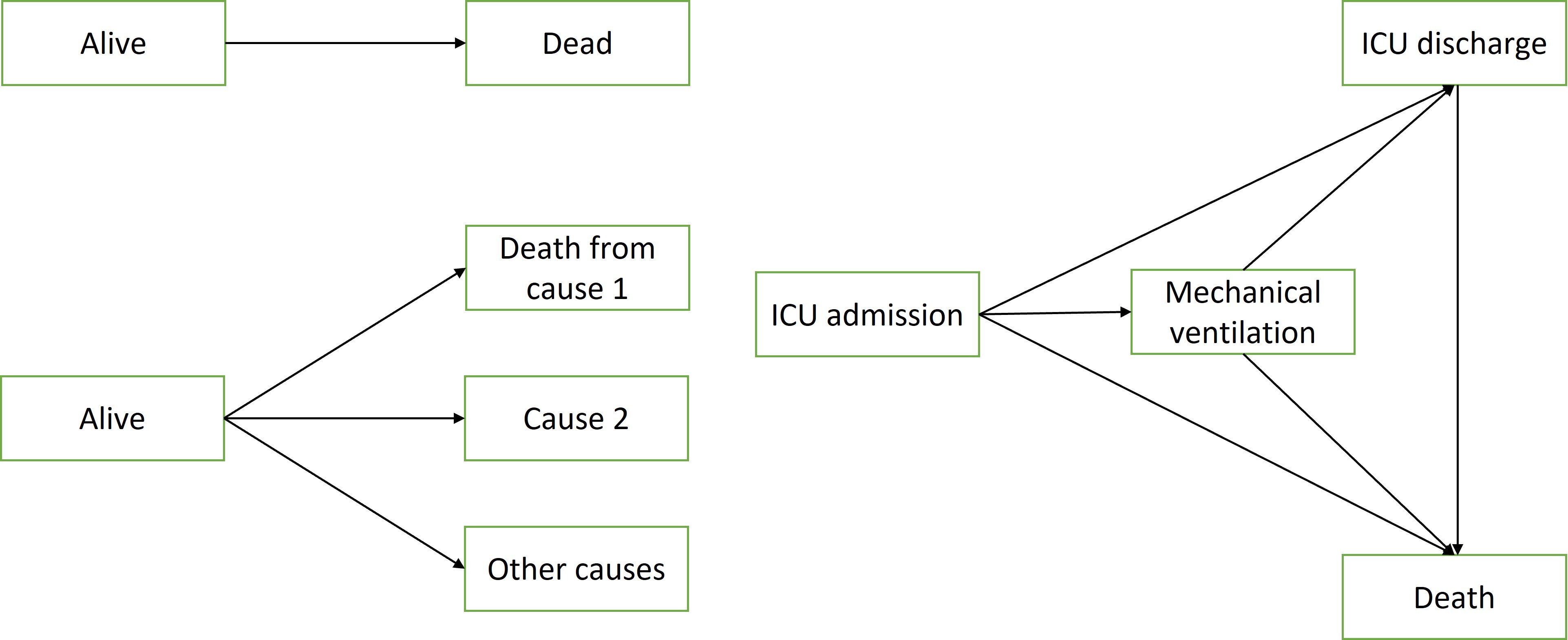
As the diagrams show, in a standard survival setup, there is one path from "Alive" to "Dead". In a competing risks scenario, there are multiple, distinct pathways out of the "Alive" state, and a subject can only follow one.
The Failure of Standard Methods
When faced with competing risks, a common but incorrect approach is to simply treat the competing events as censored observations. For instance, in our study of breast cancer mortality, if a patient dies from a heart attack, this approach would mark them as "censored" at their time of death. This seems pragmatic, but it fundamentally violates a core assumption of standard survival analysis and introduces significant bias.
Let's explore why this is the case.
1. Violation of the Non-Informative Censoring Assumption
Standard survival methods, including Kaplan-Meier and the basic Cox model, rely on the assumption of non-informative censoring. This means that a censored individual (e.g., someone who was lost to follow-up) is assumed to have the same future risk of the event as those who remain in the study.
However, individuals who experience a competing event are often systematically different from those who are lost to follow-up.
The following video from Population Data BC offers a very clear explanation of this critical point.
Competing risks in survival analysis
This video provides an excellent, intuitive explanation of the core issues in competing risks analysis.
Watch the segment from the beginning, which defines competing risks. Then, pay close attention to the explanation of why treating a competing risk as censoring is incorrect, particularly the section on violating the non-informative censoring assumption. The speaker uses the example of death from cancer competing with cardiovascular death to make the point very clear.
As the video explains, a patient who dies of cancer is not representative of a healthy person who simply moved away and was lost to the study. The cancer patient was likely older or had other health issues that also increased their risk for the primary event of interest (e.g., cardiovascular death). Censoring them assumes their risk profile is the same as those still being followed, which is almost certainly false. This violation introduces bias.
2. Overestimation of Event Probability
The direct consequence of this flawed assumption is that the Kaplan-Meier method will overestimate the probability of the event of interest.
When we censor a competing event, the analysis implicitly assumes that this person, if followed long enough, could still experience the primary event. This is logically impossible—a person who died of a heart attack cannot later die of breast cancer. By keeping these individuals in the risk pool via censoring, the (1-KM) estimate of cumulative incidence is artificially inflated.
This next clip from the same video explains this consequence beautifully.
Competing risks in survival analysis
This segment explains why the Kaplan-Meier method leads to an overestimation of risk.
Watch from this point, where the speaker explains how using the Kaplan-Meier method in the presence of competing risks results in a biased estimation of cumulative incidence. The phrase "it's going to bend my incidence curve up" is a perfect summary of the effect.
This is not a minor theoretical point; the magnitude of this bias can be substantial and can lead to incorrect clinical or policy conclusions.
The following article provides several real-world examples showing how large this overestimation can be.
Competing Risk Model in Survival Analysis
This review article reinforces the concepts and provides concrete examples of bias.
Read the introduction. Focus on the paragraph that begins "If observations are censored...". It cites several studies, including one by Wolbers et al., where a standard Cox model estimated an 18% risk, while a competing risk model estimated the true risk to be only 8%. This highlights the practical importance of using the right method.
The problem is so prevalent in medical literature that it has been studied directly, as shown in the flowchart below. Out of 100 Kaplan-Meier analyses, nearly half were susceptible to this type of bias.

A Glimpse of the Solution: The Cumulative Incidence Function (CIF)
So, if the Kaplan-Meier method (specifically, 1-KM) is wrong, what is the right way to estimate the probability of an event? The proper method involves calculating the Cumulative Incidence Function (CIF).
We will dive into the details of the CIF and its related models in the next lesson. For now, the key idea is that the CIF estimates the probability of a specific event occurring, while correctly accounting for the fact that other competing events can remove a person from being at risk.
The Columbia Public Health resource that we started with provides a good high-level description of this solution.
Competing Risk Analysis | Columbia Public Health
This article contrasts the incorrect Kaplan-Meier approach with the correct CIF approach.
Please read the sections "Why shouldn’t we use Kaplan Meier estimator?" and "What’s the solution?". The key takeaway is that the CIF provides a "marginal probability" that does not rely on the problematic assumption of independent censoring.
The CIF correctly acknowledges that to fail from Cause A at a specific time, a person must have survived all other causes up to that point. This fundamental difference is what allows the CIF to provide an unbiased estimate of risk.
Conclusion
In this lesson, we've shifted our focus to a critical challenge related to the study outcome: competing risks. Understanding this concept is essential for correctly interpreting a vast amount of research in epidemiology and medicine.
Here are the main takeaways:
- A competing risk is an event that prevents the primary event of interest from occurring. These events are common in studies where the outcome is anything other than all-cause mortality.
- Treating competing events as censored data in standard survival analysis is incorrect and leads to bias.
- This approach violates the non-informative censoring assumption, as subjects who experience competing events are often systematically different from those who are truly censored.
- The primary consequence of this error is an overestimation of the event probability, as calculated by the complement of the Kaplan-Meier (1-KM) function.
- The correct approach involves calculating the Cumulative Incidence Function (CIF), which provides an unbiased estimate of risk in the presence of competing events.
We have now established the "what" and the "why" of competing risks. In our next lessons, we will explore the "how." We'll start by examining the two main modeling strategies for analyzing data with competing risks: cause-specific hazard models and subdistribution hazard models.