In our previous lesson, we established a clear definition of confounding and the three criteria a variable must satisfy to be considered a confounder. You learned that confounding represents a "mixing of effects," where a third variable distorts the true relationship between an exposure and an outcome. This sets the stage for a critical question: how do we manage this distortion?
This lesson will focus on answering that question by addressing the learning outcome: Describe methods to control for confounding at the design stage (e.g., restriction, matching). We will explore proactive strategies that you can build into a study from its inception to prevent confounding from ever taking root. Conceptually, this is like designing a system with built-in error handling from the start, rather than trying to debug it after it has already produced faulty output.
We will cover the three primary methods for controlling confounding during study design: randomization, restriction, and matching. Understanding these techniques is fundamental, as the choices made at the design stage have profound implications for a study's validity and the trustworthiness of its conclusions.
An Overview of Control Strategies
Before diving into specifics, it's helpful to have a roadmap. Confounding can be tackled at two different points in the research process: during the study's design or during its analysis. The flowchart below illustrates this division. This lesson is dedicated to the left side of the chart: the design phase.

The core principle behind all these design-stage methods is the same: they aim to break the link between the potential confounder and the exposure. If a potential confounder is distributed equally among the exposed and unexposed groups, it cannot satisfy the first criterion of being a confounder, and its ability to distort the results is neutralized.
1. Randomization: The Gold Standard
Randomization is considered the most robust method for controlling confounding. It is the cornerstone of the Randomized Controlled Trial (RCT), a study design you'll encounter in more detail later in the course.
The idea is simple yet powerful: researchers randomly assign participants to either the exposure (e.g., a new drug) or control (e.g., a placebo) group. By using chance to allocate participants, the goal is to create two groups that are, on average, comparable in every way except for the exposure they receive. This process breaks the association between the exposure and any potential confounders, whether we know about them or not.
The following video provides an excellent explanation of why randomization is so effective. Pay close attention to the comparison between the observational study and the randomized trial.
Controlling Confounding During the Design Phase of a Study
This video by Dr. Terry Shaneyfelt clearly illustrates the power of randomization.
First, watch the segment that shows a demographic table from an observational study. Notice how the risk factors (potential confounders) are unequally distributed between the hormone users and non-users. Next, contrast this with the table from a randomized trial, where the same risk factors are almost perfectly balanced. This visually demonstrates the effect of randomization. Finally, watch the explanation of how randomization works to create equalized groups and control for both known and unknown confounders.
The true strength of randomization, as highlighted in the video, is its ability to control for unknown confounders. While we can try to measure and account for confounders we are aware of (like age or smoking), there may be other genetic, behavioral, or environmental factors we haven't even thought of. Randomization handles all of them, assuming the sample size is large enough.
However, randomization has its limits:
- Ethics: It is unethical to randomize people to a known harmful exposure, like smoking or asbestos.
- Feasibility: It may not be practical or possible to randomize certain exposures, like a person's occupation or where they live.
- Cost: RCTs are often expensive and time-consuming to conduct.
Because of these limitations, we often rely on observational studies and must use other methods to control for confounding.
2. Restriction: The Direct Approach
Restriction is arguably the most straightforward way to control for a confounder. If you believe a variable will confound your results, you can simply design your study to exclude that variation. You restrict your study population to a single category of the confounding variable.
For example, if you are studying the effect of a new medication on heart disease and believe gender is a major confounder, you could restrict your study to include only women. In this case, gender can no longer be a confounder because it does not vary among the study participants—everyone is female.
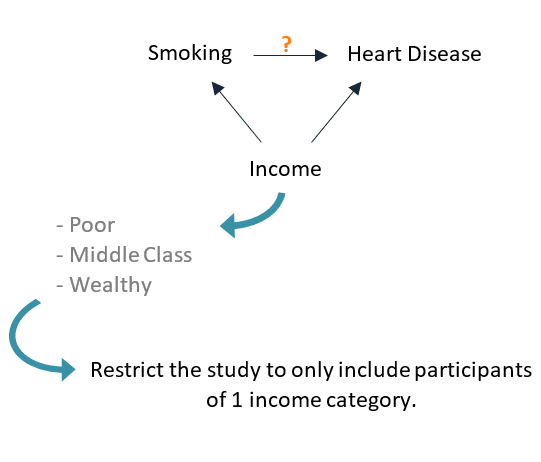
To get a more formal definition, let's turn to a reading from the University of North Carolina.
[PDF] Confounding Bias, Part II and Effect Measure Modification
This document provides concise definitions of the key methods for controlling confounding.
Read the section on Restriction. It clearly defines the method and provides an example of restricting a study to non-smokers. Pay attention to the discussion of its advantages and disadvantages.
The main advantages and disadvantages of restriction are:
- Advantage: It is simple, inexpensive, and completely effective for controlling the confounders you restrict on.
- Disadvantage: It limits the generalizability (or external validity) of your findings. If you only study women, you cannot be certain your results apply to men. It can also make it difficult to recruit enough participants for your study.
3. Matching: The Balancing Act
Matching is a more complex technique, commonly used in case-control studies. It aims to achieve the same goal as randomization—making the groups comparable—but does so in a more deliberate and manual way for specific, known confounders.
In matching, the researcher selects comparison subjects (e.g., controls) to be similar to the primary subjects (e.g., cases) with respect to the values of one or more confounding variables.
For instance, if you recruit a 55-year-old female case who is a non-smoker into your study, you would then purposefully find a 55-year-old female non-smoker to be a control. This is known as individual matching. The result is that the distribution of the matched confounders (age, sex, and smoking status in this example) is forced to be identical between the case and control groups.
[PDF] Confounding Bias, Part II and Effect Measure Modification
Let's return to the same document to read about matching.
Read the section on Matching. This part explains how matching works in both case-control and cohort studies and provides an example involving age distribution. Note the important point that analysis of matched data requires special techniques.
The following video also offers a very clear, practical example of how matching is implemented.
The channel "Epidemiology Stuff" provides a simple visual explanation of matching.
Watch the segment explaining matching. The animation showing how a person from the "fatty diet" group is paired with a person from the "healthy diet" group based on their alcohol consumption is a great way to visualize how the groups are balanced.
Key trade-offs with matching include:
- Advantages: Can increase a study's statistical power and efficiency, especially when the confounder is strong. It is more flexible than restriction and maintains better generalizability.
- Disadvantages: It can be difficult, time-consuming, and expensive to find suitable matches, especially if you match on several variables. Crucially, you cannot study the effect of the matched variable, as its association with the outcome has been artificially fixed. Matched data also requires specific statistical methods for analysis (e.g., conditional logistic regression), which we will not cover in this course but is important to be aware of.
Conclusion
In this lesson, we have shifted from identifying confounders to proactively controlling them at the study design stage. You've learned about the three primary methods for accomplishing this, each with its own strengths and weaknesses.
Here are the key takeaways:
- Controlling for confounding at the design stage involves structuring the study to break the association between the confounder and the exposure.
- Randomization is the most powerful method because it balances both known and unknown confounders, but it's not always ethical or feasible.
- Restriction is a simple method where you limit your study population to a single category of the confounder, but this reduces the generalizability of your results.
- Matching involves selecting comparison subjects to be similar to primary subjects on key confounders, offering a balance between control and generalizability, but it requires special analysis and prevents you from studying the effect of the matched variables.
These design-stage strategies are our first line of defense. But what happens when we're working with data from a study where these controls weren't implemented? In our next lesson, we will explore how to identify and control for confounding during the analysis phase by comparing crude and adjusted measures of association.