Introduction
Welcome back. In our previous lesson, we constructed a weekly scheduling framework to intentionally allocate time for professional work, dyadic intimacy, and triad connection. This structure provides the scaffolding for your complex relationship, but even the most well-designed architecture must withstand the inevitable stresses of human interaction. Conflict is not a sign of failure; it is a signal that the system needs attention.
Today, we will address this directly. The learning outcome for this lesson is to draft a conflict resolution script for a scenario where professional disagreement triggers personal insecurity. This is a frequent and potent challenge in your triad's unique structure, where professional, romantic, and friendly roles are deeply intertwined.
We will use a structured communication model to transform a potentially explosive situation into an opportunity for deeper understanding and connection. For your background in statistics, you can think of this as moving from a chaotic, unpredictable variable (unmanaged conflict) to a structured, model-based process (managed resolution) that yields more predictable and positive outcomes.
The Anatomy of a Conflict: A Concrete Scenario
To make this practical, let's establish a specific scenario we will work with throughout this lesson.
Scenario: The three of you are in a collaborative work session reviewing a proposal for a new research project.
- The Husband presents a section on statistical methodology he drafted.
- The Mentor, focused on winning the grant, provides feedback that is direct and critical: "This analysis is too superficial; it won't pass peer review."
- The Wife, also wanting the project to succeed, quickly agrees and adds, "He's right, honey. It misses the core variable we discussed. We need to redo it."
The Husband falls silent. Professionally, he feels his competence has been dismissed. Personally, he feels his wife has publicly sided with her lover against him. The professional disagreement has now triggered deep personal insecurity and feelings of isolation. The goal for the rest of this lesson is to create a script for the Husband to address this moment productively.
The Tool for Resolution: Nonviolent Communication (NVC)
To navigate this, we need a tool that separates the action from the person and the feeling from the blame. Nonviolent Communication (NVC), developed by Marshall Rosenberg, provides an excellent framework. It is a language of compassion that allows us to express ourselves and hear others by focusing on observations, feelings, needs, and requests.
Please begin by studying the principles and structure of NVC in the following resource.
Non-Violent Communication - speak up without feeling anxious
This article from Vitalis Coaching, titled 'Non-Violent Communication - speak up without feeling anxious', provides a comprehensive overview of the NVC model. We will use its four-step process as the foundation for our conflict resolution script.
First, read the section 'Avoiding Judgement to Avoid Conflict' to understand the core principle of separating observation from evaluation. Then, carefully study 'The four steps of Non-Violent Communication', as this is the model we will be applying directly. Finally, review the 'NVC example at work' to see how these steps are applied in a professional context.
The NVC process gives us a clear, four-part structure for our script.
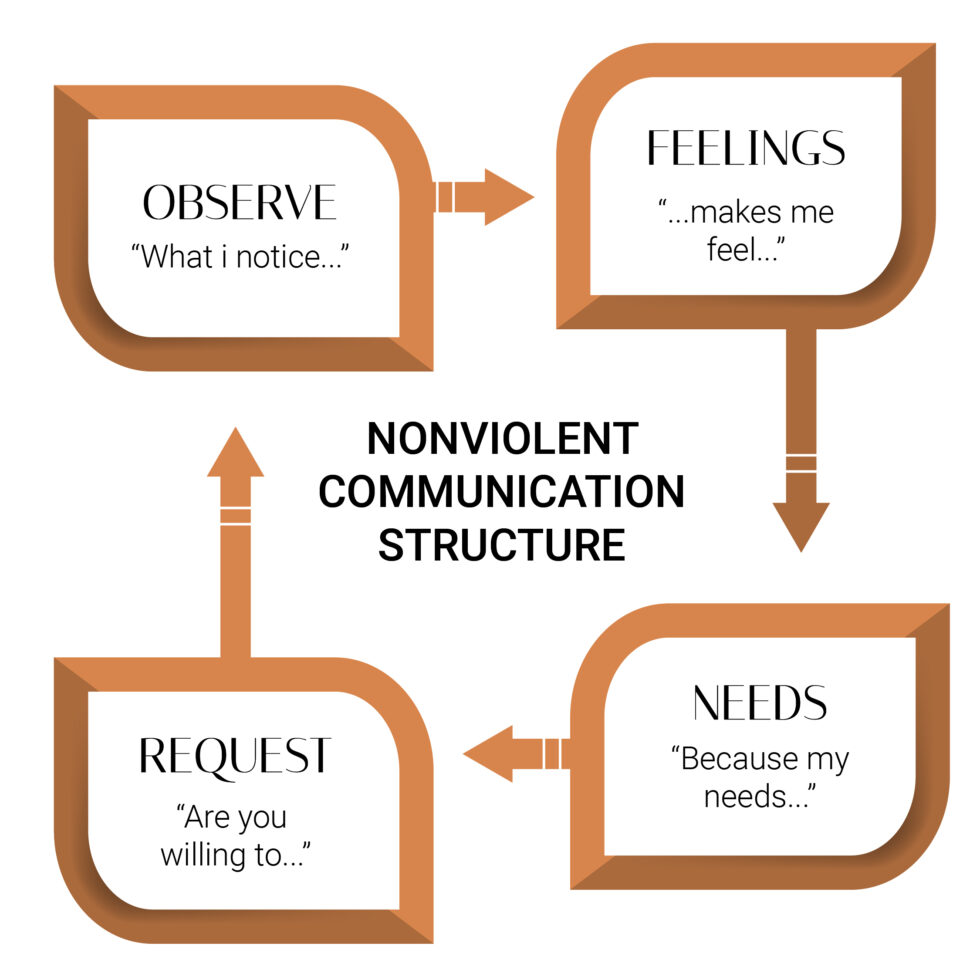
Applying NVC to Our Scenario: Deconstructing the Experience
Before writing the script, the Husband must first gain clarity on his own internal experience using the NVC framework. This is a crucial self-connection step.
-
Step 1: Observation (What did I see/hear?)
- Judgmental thought: "They ganged up on me and called my work stupid."
- NVC Observation: "During the project meeting, when I presented my methodology section, I heard [Mentor's name] say my analysis was 'too superficial.' Then I heard [Wife's name] say, 'He's right... It misses the core variable.'"
This is factual and avoids interpretation.
-
Step 2: Feelings (What emotions did I experience?)
- Blaming thought: "They made me feel worthless."
- NVC Feeling: "I felt embarrassed and defensive. I also felt hurt, lonely, and insecure."
This takes ownership of the emotions.
-
Step 3: Needs (What core needs were not being met?)
- Judgmental thought: "They don't respect me."
- NVC Need: "I have a need for my professional contributions to be met with respect. I also have a deep need to feel that my partnership with my wife is a source of safety and support, especially in a group setting."
This connects the feeling to a universal human need.
-
Step 4: Request (What specific action would help meet my need?)
- Vague demand: "You guys need to be nicer to me."
- NVC Request: "I would like to find a way for us to give professional feedback that feels constructive and maintains our sense of being a supportive team."
This is a positive, actionable, and forward-looking invitation.
Drafting the Conflict Resolution Script
Now, we can assemble these components into a script. This conversation would ideally take place during a scheduled RADAR meeting, a time designated for such discussions.
Part 1: The Husband's Opening
The Husband initiates the conversation. His goal is not to accuse, but to share his experience and open a dialogue.
Husband: "I'd like to use our time to talk about the project meeting yesterday. When I presented the methodology, and you, [Mentor's name], said it was 'superficial,' and you, [Wife's name], added that it 'missed the point' (Observation), I felt a wave of embarrassment and defensiveness. But underneath that, I felt really hurt and insecure (Feeling).
It’s because my need for professional respect got tangled up with my need to feel secure and supported in our team, especially with you, [Wife's name] (Need). It felt less like a professional critique and more like a personal pile-on.
So, I'm hoping we can talk about it. Would you be willing to explore how we can handle these moments differently in the future? (Request)"
Part 2: The Wife and Mentor's Empathetic Response
A script is a dialogue. The Wife and Mentor's response is critical. Their goal should be to listen with empathy, not to defend their actions.
Wife: (Reflecting back) "Thank you for bringing this up. Hearing you say that, it sounds like you felt exposed and isolated in that moment, as if you were being judged both as a professional and as my partner. Is that right?"
Mentor: (Acknowledging and taking responsibility) "I hear that too. Listening to you, I can see my choice of the word 'superficial' was harsh and dismissive. I was fixated on the project's success and I failed to consider the impact of my words on you and on our team dynamic. I regret that."
This response validates the Husband's feelings and signals a willingness to resolve the issue, rather than escalate it.
Part 3: The Intimate Motivation for Resolution
As per your course goals, it's vital to connect these dynamics back to the intimate layer of the relationships. The Mentor's motivation to respond with empathy might not only stem from professional courtesy but from a deeper understanding of the triad's interconnectedness, which is often most apparent in private moments.
Consider this internal monologue for the Mentor later that evening, while being intimate with the Wife:
He notices the Wife seems slightly distant. The energy from the afternoon's meeting is still lingering.
Mentor's Internal Monologue: "This distance... it's from the meeting. The way I spoke to [Husband's name]... it didn't just land on him. It's here, now, in this bed, between us. My harshness towards him has created a wall that I now feel with her. My professional role and my role as her lover are not separate. Hurting one part of this system hurts the whole thing. My loyalty isn't just to the project, or just to her; it's to the health of this entire triad. I need to make this right with him, for all our sakes."
This private reflection, rooted in a moment of sexual intimacy, becomes a powerful motivator for the Mentor to engage constructively in the conflict resolution process. It's not a detail he would share in the group meeting, but it informs the sincerity and empathy of his response.
Part 4: Co-creating a Solution (The Next Request)
After the initial feelings are heard, the conversation shifts to a concrete action plan.
Husband: "Thank you for hearing me. Yes, that's exactly it. Going forward, when you have feedback, would you be willing to focus it on the work itself? For instance, saying, 'This section could be strengthened by adding X and Y,' instead of using labels like 'superficial'?"
Wife: "I can absolutely do that. And I also realize my piling on was unhelpful. I can make a request for myself and for us: How about we agree that when one person is giving feedback, the other waits to speak, so we can address one point at a time? That might make it feel more like a dialogue and less like an ambush."
Mentor: "That's a great protocol. I agree to both requests. I will be more mindful of my language, and I will support the 'one at a time' feedback process."
This transforms the conflict into a new, agreed-upon rule of engagement for the future.
Conclusion
In this lesson, we have moved from a point of painful conflict to a structured resolution. You've learned how to draft a script using the Nonviolent Communication framework to navigate a scenario where professional disagreement triggers personal insecurity.
Key Takeaways:
- Conflict in a complex triad is inevitable and serves as a crucial feedback mechanism.
- The NVC framework (Observe, Feel, Need, Request) provides a clear, repeatable process for de-escalating conflict and fostering understanding.
- Separating factual observation from judgmental interpretation is the critical first step in preventing defensiveness.
- A successful conflict resolution script involves not only a clear opening but also empathetic listening and a collaborative effort to create a future-oriented solution.
- Private reflections, even those occurring during intimate moments, can provide powerful motivation for maintaining the health of the entire relationship system.
Preview of the Next Lesson:
We have now equipped the triad with frameworks for communication (RADAR), scheduling, and conflict resolution (NVC). Our next lesson will zoom out from these micro-interactions to a macro-level analysis. We will learn to evaluate the triad's systemic health by applying sociological Exchange Theory to the costs and rewards of each member. This will give you a new lens through which to assess the overall balance and sustainability of your triad.