Introduction
Welcome back. In our last lesson, you learned how to communicate feelings of professional rivalry to your wife constructively, using tools like the "I-Statement Sandwich" to preserve your marital bond while expressing vulnerability. We focused on the external act of communication.
Today, we turn inward. This lesson addresses the learning outcome: to develop a cognitive behavioral exercise to transform feelings of professional envy into compersion for your wife's success. We will move from managing the expression of envy to actively working to transform the feeling itself. This is about building the internal psychological machinery to not only cope with your wife's professional wins but to genuinely share in her joy. This skill is the ultimate foundation for turning a potential point of conflict into a source of shared strength.
Part 1: Naming the Emotion — Envy, Not Jealousy
To begin, we need to be precise about the emotion we are targeting. In complex dynamics, it's easy to lump negative feelings together. Your background as a statistician will appreciate the importance of precise definitions before we can measure and modify a variable.
Let's read a short excerpt that distinguishes between two often-confused emotions: jealousy and envy.
ERP 267: Four Healthy Ways to Manage Jealousy in Relationship ...
Dr. Joli Hamilton, a researcher specializing in these emotions, offers a clear and crucial distinction between jealousy and envy. Pay close attention to her definitions, as correctly identifying your feeling is the first step toward managing it.
Please read the beginning of the transcript, from the start down to the paragraph ending with '...They start from within.' Focus on the definitions of jealousy as a 'triangle' and envy as a 'dyadic experience.'
As Dr. Hamilton clarifies:
- Jealousy is the fear of a love bond being interrupted by a third party. It involves a triangle: you, your partner, and a perceived rival for affection. It's about fear of loss.
- Envy is a two-person dynamic. It's about wanting something someone else has—a quality, a possession, or in this case, a professional achievement or recognition from the mentor. It's about desire for what another possesses.
In the scenarios we've discussed, where your wife receives praise or a project lead from the mentor that you also desired, the primary emotion is professional envy. While it can be complicated by the romantic context, correctly labeling it as envy allows us to target the right psychological mechanism.
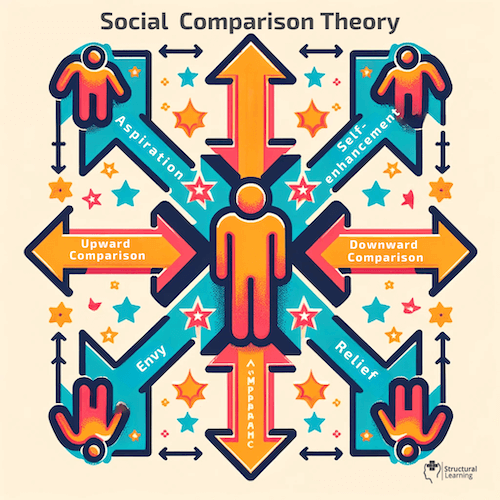
This mechanism is well-described by Social Comparison Theory.
Part 2: The Goal — Cultivating an Abundance Mindset and Compersion
Now that we've identified the problem (envy), let's define our target state: compersion. Compersion is the experience of finding joy in another's joy.
To understand how to get there, we need to examine the underlying mindset that fuels envy. The following reading introduces the concepts of a scarcity mindset versus an abundance mindset, which are central to this transformation.
Managing Jealousy and Feeling Compersion in Non-Monogamous…
This article from The Center for Growth provides an excellent breakdown of compersion and the mindset required to cultivate it. It explains how our core beliefs about resources like love and success shape our emotional responses.
Read the sections titled 'Understanding Compersion' and 'What is an Abundance Mindset?'. Focus on how an abundance mindset reframes a partner's success from a threat (scarcity) to an opportunity for mutual fulfillment (abundance).
Here is the core idea:
- Scarcity Mindset: "There is only so much recognition from the mentor. My wife's win is my loss." This is a zero-sum game that inevitably produces envy.
- Abundance Mindset: "Success and recognition are not finite. My wife's win elevates our entire team and household. Her success does not prevent my own." This is a positive-sum game that makes compersion possible.
Your task is not to eliminate envy in one fell swoop, but to build a mental pathway that allows you to consciously shift from a scarcity-based thought to an abundance-based one. This is the essence of Cognitive Behavioral Therapy (CBT).
Part 3: The Cognitive Behavioral Exercise for Transforming Envy
Here is the practical, step-by-step exercise to perform whenever you feel a pang of professional envy. This is your tool for actively rewiring your thought patterns. It is based on the cognitive restructuring activity we will now explore.
Managing Jealousy and Feeling Compersion in Non-Monogamous…
The following activity from the same article provides a template for a classic CBT exercise called a 'thought record'. We will adapt this framework specifically for transforming professional envy.
Read the section titled 'Activity'. This walks you through the steps of cognitive restructuring, from identifying the situation and negative thoughts to challenging them and generating alternatives.
Let's formalize this into a personal exercise. Imagine the scenario from our last lesson: Your wife comes home and joyfully announces she got the lead on a project you also wanted.
Follow these five steps:
Step 1: Identify the Trigger and Emotion
- Trigger: My wife received the project lead and praise from the mentor.
- Emotion: Professional Envy.
- Rate Intensity (0-100): 80/100. (It's also helpful to note the physical sensation, as Dr. Hamilton mentioned in the first reading: a jolt, heat in the chest, etc.)
Step 2: Identify Automatic Negative Thoughts (ANTs) - The Scarcity Voice
Write down the first thoughts that come to mind. Do not filter them.
- "Of course she got it. The mentor always favors her."
- "I'm falling behind in my career."
- "This proves my contributions aren't as valued as hers."
- "Our 'special relationship' with him gives her an unfair advantage."
Step 3: Challenge the ANTs - The Statistician's Cross-Examination
Look at the ANTs with a critical, evidence-based eye. Question their validity.
- Challenge to "He always favors her": "Is that statistically true? Can I recall 3 instances in the last month where he praised my work or gave me a key responsibility? Yes, I can."
- Challenge to "I'm falling behind": "Is one project a valid sample size to determine my entire career trajectory? No. My last performance review was strong. This is a single data point, not the trend line."
- Challenge to "Unfair advantage": "Her proposal was innovative on its own merits. Attributing her success solely to her intimate relationship discounts her actual talent and hard work, which is unfair to her."
Step 4: Generate Alternative, Compersive Thoughts - The Abundance Voice
Consciously formulate new thoughts grounded in an abundance mindset and your role as a supportive partner.
- "I am genuinely proud of the skill she demonstrated. Her success reflects well on our whole team."
- "This is a win for our household. Her success is our shared success."
- "I can feel happy for her joy in this moment. Her happiness is important to me."
- "This single event doesn't define my worth. I will focus on my own next opportunity to excel. Her win can even motivate me."
Step 5: Re-evaluate and Act
- Re-rate Intensity: After working through steps 3 and 4, what is the new intensity of your envy? Perhaps it's down to 30/100.
- Note New Emotions: What else do you feel? Pride? Motivation? Love?
- Choose Your Action: Now, you are in a much better position to use the communication skills from the last lesson. You can approach your wife with genuine support (the "top slice" of the sandwich) because you've already processed the initial wave of envy.
This exercise is like a mental workout. The more you practice it, the stronger the "compersion muscle" becomes, and the less power the automatic envy-thoughts will have.
Conclusion
Today, we moved from the external world of communication to the internal world of emotional regulation. You've developed a precise, actionable cognitive behavioral exercise designed to transform feelings of professional envy into compersion.
Key Takeaways:
- The emotion to target in this context is professional envy (a dyadic desire), not romantic jealousy (a triangular fear of loss).
- Envy is rooted in a scarcity mindset, while compersion is made possible by an abundance mindset.
- You can actively rewire your response using the 5-step CBT exercise: Identify, ANTs, Challenge, Alternatives, Re-evaluate.
- The goal is not to never feel envy, but to have a concrete tool to process it and consciously cultivate compersion, strengthening both you and your marriage.
Preview of the Next Lesson:
We have now done a deep dive into your experience as the husband, covering both communication and internal transformation regarding professional rivalry. In our next lesson, we will pivot to the wife's perspective. The learning outcome will be: "Identify signs of professional competitiveness affecting the emotional connection with the husband." We will explore how she navigates her position and the responsibilities that come with it.