Introduction
Welcome back. In our previous lessons within this module, we've focused on the husband's internal experience. You've analyzed the distinction between professional envy and romantic jealousy, contrasted the mentor's internal focus during intimacy with the husband's external perception of rivalry, and developed a powerful cognitive behavioral exercise to transform envy into compersion. You have built a robust internal toolkit.
Today, we shift from the internal to the external, from managing thoughts to managing time and space. This lesson addresses the final learning outcome of this module: to create a schedule that protects the husband-wife 'normal life' from being overshadowed by the mentor's omnipresence. We will explore why this "overshadowing" occurs and then build a concrete, actionable framework for carving out and protecting the foundational marital relationship. This is about building the structure that allows the internal work you've done to succeed in the long term.
Part 1: Defining the Problem of "Overshadowing"
Before we can solve a problem, we must understand its anatomy. The feeling of being "overshadowed" is common in polyamorous dynamics, especially in kitchen-table models where partners are highly integrated. It's often not about malice, but about a gradual erosion of space and time for the original dyad.
To see a vivid illustration of this, you will read a first-hand account from a husband in a similar situation.
From 'Kitchen Table' to 'Parallel' - Polyamory
The following post is from a forum on Polyamory.com. As you read, notice how the constant presence of his wife's boyfriend impacts the author not just logistically, but emotionally and physically. This is a powerful case study in 'overshadowing'.
Please read the initial post by the user 'CaptainCarrot'. Pay special attention to his description of feeling 'on edge', the comparison between the two weekend outings, and his explicit mention of the struggle to schedule 'OUR time'.
As the author, "CaptainCarrot," describes, the omnipresence of a metamour can lead to:
- Constant emotional hyper-vigilance ("constantly on edge").
- Physical and mental exhaustion.
- A logistical nightmare where scheduling dedicated couple time becomes a "much bigger struggle."
This creates a paradox. While the husband may be doing the internal work to manage envy and cultivate compersion (as you learned in the last lesson), the sheer lack of protected space and time with his wife can make that work feel impossible. The "normal life" that provides the secure base for the entire structure begins to feel secondary.
The Internal Disconnect
A key reason this overshadowing happens is a disconnect in perspective. For the husband, the mentor's presence is a constant factor that he must navigate. For the mentor, however, his focus is likely compartmentalized.
As we've discussed, during sexual intimacy with the wife, the mentor's internal world is likely intensely focused on her pleasure and their connection in that moment. He is probably not thinking, "My presence here is affecting my mentee's sense of security in his own home." This isn't due to a lack of care, but a natural human tendency to be present in an intimate experience. This very disconnect—where one person is experiencing an intrusion and the other is simply living their separate relationship—is precisely why unspoken assumptions fail. Explicit agreements and schedules are necessary to bridge this gap in perspective.
Part 2: The Foundation for a Solution: Differentiation and Communication
To build a schedule that works, the husband must first feel empowered to ask for what he needs. This requires two key psychological concepts, which are explained well in the following article.
Thriving in Polyamory: Expert Tips on Time Management and Open ...
This article from Rooted In Change Therapy discusses core principles for managing polyamorous relationships. We will focus on two of them that are essential for establishing the boundaries needed to protect your 'normal life'.
Read the sections 'The Power of Open Communication' and 'Differentiation: Balancing Independence and Intimacy'.
Let's break down these two pillars:
-
Differentiation: As the article states, this is "the process of maintaining your individual identity and independence within a relationship." In this V-structure, it means the husband must see his needs—and the needs of the marital dyad—as valid and distinct from the needs of the triad. The marriage is a system that requires its own maintenance. His need for a quiet evening alone with his wife is not a vote against the V; it is a vote for the health of a critical component of that V. Your background in social research will attune you to the importance of analyzing subsystems within a larger social structure.
-
Open Communication: Once the husband feels his needs are valid (thanks to differentiation), he must articulate them. The article highlights being "explicit in your desires" to ensure "everyone is on the same page." This is the step "CaptainCarrot" took when he "broached the subject of going 'parallel' with his wife." It's often a difficult conversation, but it's the only way to move from resentment to resolution.
Part 3: A Practical Framework for Scheduling
Armed with a sense of entitlement to his own time and the courage to communicate, the husband can now propose a new structure. A common mistake is to think in binary terms: either "Kitchen Table" (everyone together all the time) or "Parallel" (no contact). As one of the forum responders wisely noted, there is a whole spectrum in between.
The key is to disaggregate time into distinct categories. One of the forum commenters provided an excellent list of time categories that must be consciously balanced.
From 'Kitchen Table' to 'Parallel' - Polyamory
Let's return to the forum thread. The user 'GalaGirl' offers a simple but brilliant framework for breaking down a shared calendar. This moves the conversation from a vague 'we need more time' to a specific, solvable equation.
Find the post by 'GalaGirl' (post #7) and focus on the bulleted list at the end of her comment. This list provides the categories for our scheduling exercise.
Let's adapt GalaGirl's framework to your specific V-dynamic. A balanced schedule must consciously allocate time for:
- Individual Time: Time for the husband to be alone in his own home. Time for the wife to be alone.
- Dyadic Time (Protected): This is the core of the "normal life." Time for the husband and wife alone in their home. This should be treated as a sacrosanct, pre-scheduled appointment.
- Dyadic Time (Other): Time for the wife and mentor together (at home or elsewhere). Time for the husband and mentor together (for professional mentorship or friendship).
- Triad Time: Time for all three to be together socially, if desired.
Using a shared digital calendar to block out these different types of time is a highly effective, low-conflict way to manage these categories and make the agreements visible and concrete.
Part 4: Your Turn - Creating the Agreement
Now it's time to put this into practice. The goal isn't just to make a schedule, but to create a shared agreement. A worksheet can be an invaluable, non-confrontational tool for structuring this conversation.
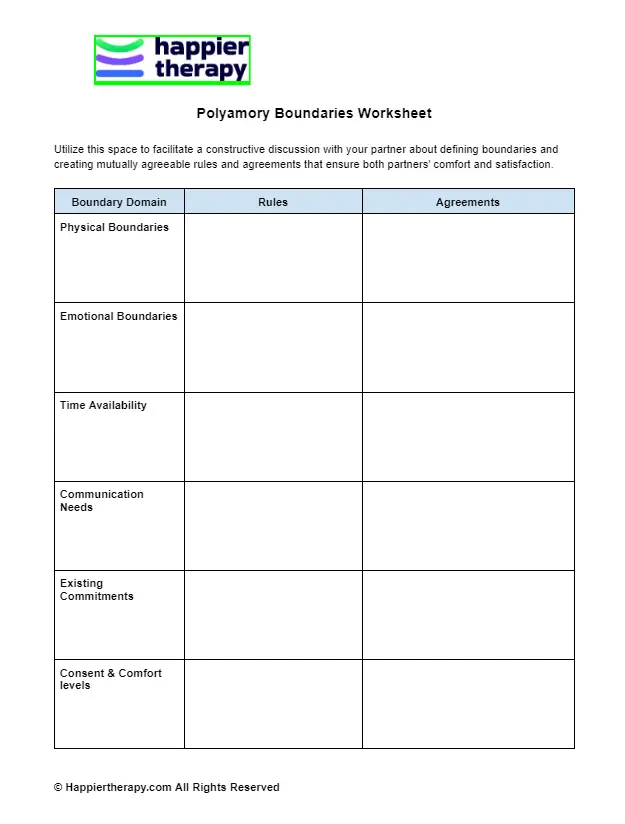
Activity: Design the Scheduling Agreement
Imagine you are the husband, preparing for a conversation with your wife. Your goal is to use the "Time Availability" domain of this worksheet to propose a structure that protects your 'normal life'.
Take 15 minutes to fill out the "Rules" and "Agreements" columns for the "Time Availability" row. Be specific and actionable.
- A Rule is often a firm boundary (e.g., "No unannounced visits").
- An Agreement is a negotiated plan of action (e.g., "We will schedule one date night per week").
Here are some prompts to get you started:
- How many nights a week should be protected "Husband & Wife Only" nights at home?
- What is the rule about the mentor sleeping over? Does it need to be scheduled in advance? Are certain nights off-limits?
- How can you ensure the husband gets time alone in his own home to decompress?
- What is the agreement for scheduling a "triad" social evening versus a "dyadic" one?
Example Answer:
| Boundary Domain | Rules | Agreements |
|---|---|---|
| Time Availability | 1. The mentor does not stay over on Sunday or Wednesday nights. 2. No professional work talk during our designated "date night." |
1. We will schedule and put on the shared calendar one protected Husband-Wife date night per week (Thursdays). 2. The wife and mentor will have their overnights on Fridays or Saturdays, agreed upon by Monday of that week. 3. The husband will take Tuesday evenings for his own hobbies outside the house, giving the wife and mentor space at home. |
Completing this exercise provides you with a concrete proposal. It shifts the dynamic from one of reactive frustration to proactive, collaborative design—a language that, given your background, should feel both empowering and effective.
Conclusion
Today, you have constructed a practical plan to address one of the most significant challenges in this dynamic: protecting the marital relationship from being overshadowed.
Key Takeaways:
- The feeling of being "overshadowed" is a common logistical and emotional problem that stems from a lack of clear boundaries around time and space.
- Solving this requires differentiation (believing your dyadic needs are valid) and open communication (voicing those needs).
- A successful schedule involves disaggregating time into categories: individual, different dyadic pairings, and triad time.
- Tools like the Boundaries Worksheet transform the difficult conversation into a structured, collaborative negotiation, leading to concrete rules and agreements.
By creating and implementing such a schedule, the husband isn't building a wall; he's building a healthy, sustainable home where the foundation is secure, allowing the more complex structures of the V to rest on solid ground.
Preview of the Next Lesson:
We have now concluded our deep dive into the husband's perspective in this module. In our next lesson, we will begin Module 5 and pivot to the wife's point of view. Our first learning outcome will be: "Identify signs of professional competitiveness affecting the emotional connection with the husband." We will explore the unique pressures she faces and how she can navigate her success without unintentionally fueling the rivalry you've learned to manage.