Introduction
In our last lesson, we established the hallmarks of a robust actuarial model, focusing on the balance between accuracy, efficiency, and transparency, all governed by rigorous controls and documentation. We are now prepared to delve into one of the most fundamental design choices an actuary makes: whether to build a deterministic or a stochastic model. This decision profoundly impacts what questions a model can answer and how its results are interpreted.
This lesson is designed to equip you to justify the choice between these two approaches for any given actuarial problem. Given your background in probability theory, you will find the concepts behind stochastic modeling familiar. Our goal is to place this theoretical knowledge within the practical context of actuarial work, focusing on when and why one approach is more suitable than the other.
By the end of this lesson, you will be able to distinguish between deterministic and stochastic models, explain their respective strengths and weaknesses in an actuarial context, and use a clear framework to justify your choice, directly addressing a key learning outcome in the CP1 syllabus.
The Core Distinction: One Path or Many?
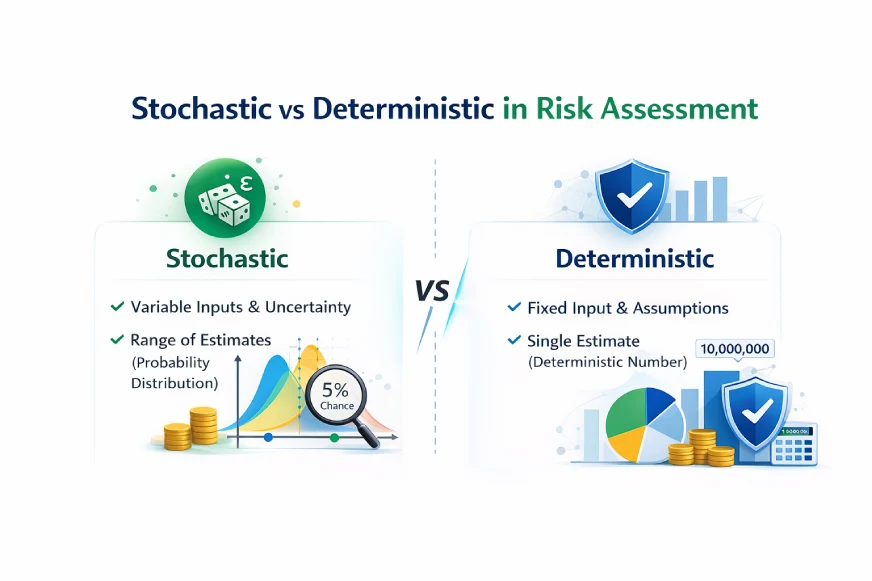
At its heart, the difference between deterministic and stochastic modeling is about how a model handles uncertainty. A deterministic model follows a single path, while a stochastic model explores thousands of possible paths.
- A deterministic model takes a set of fixed inputs and produces a single, repeatable output. If you run the model with the same assumptions, you will get the exact same answer every time.
- A stochastic model incorporates elements of randomness. Its inputs include not just fixed numbers but also probability distributions for key variables (like interest rates or mortality rates). Consequently, it produces a range of possible outcomes, each with an associated likelihood.
This image provides a helpful visual summary of the two approaches.
To solidify these definitions, let's watch a short video that explains the core concepts.
Lesson 9: Deterministic vs. Stochastic Modeling
This video from Mike Saint-Antoine provides a concise explanation of the fundamental difference between deterministic and stochastic models.
Please watch the segment from the beginning to the 2-minute mark. The speaker clearly explains how deterministic models produce a single trajectory, whereas stochastic models, by incorporating a random component, generate many different trajectories even from the same starting point.
As the video explains, the key is the presence of a random component. In actuarial work, this randomness isn't arbitrary; it's a deliberate attempt to represent the real-world uncertainty inherent in variables like investment returns, insurance claims, and policyholder behavior.
The Case for Deterministic Models
While stochastic models may seem more sophisticated, deterministic models are indispensable tools in the actuary's toolkit. Their value lies in their simplicity, transparency, and efficiency.
The primary reasons to choose a deterministic model are:
- Clarity and Communication: A single-number output is easy to understand and communicate to non-technical stakeholders like senior management or boards.
- Speed and Efficiency: They are computationally less intensive than stochastic models, allowing for quick calculations and rapid exploration of different assumptions.
- Baseline Analysis: They are perfect for establishing a "best-estimate" or base-case projection, which can serve as a benchmark.
A very common and powerful application of deterministic modeling is scenario analysis. This technique doesn't try to model all possibilities but instead asks, "What would be the financial impact of this specific, plausible event?"
[PDF] Subject CP1 - CMP Upgrade 2021/22 - Actuarial Education
The provided excerpt from the ActEd study material explains scenario analysis as a key deterministic method used in risk management.
Please read the section titled <span data-type="resource_reading_textrange" data-resource-subitem-id="a982794b" data-range-start="Scenario analysis" data-range-end="financial cost of all risks represented by the chosen scenario.">2.1 Scenario analysis. Focus on the paragraph that begins "Scenario analysis is a deterministic method...". It highlights a critical justification: deterministic approaches are useful when fitting full probability distributions is difficult or inappropriate.
As the text states, scenario analysis is valuable when the risks are hard to model mathematically, or when the required assumptions for a stochastic model would be overly subjective.
Common Actuarial Uses of Deterministic Models:
- Traditional Pricing: Calculating a premium for a life insurance product using a single set of assumptions for mortality, interest, and expenses.
- Best-Estimate Reserving: Calculating the expected present value of liabilities using one specific set of assumptions.
- Stress Testing: A form of scenario analysis where the impact of a severe but plausible event is measured (e.g., "What is the impact on our solvency if equity markets fall by 40%?").
The limitation, of course, is that these models provide no information about the probability of the outcome or the range of other possibilities. They tell you what will happen under a given scenario, but not how likely that scenario is.
Embracing Uncertainty: The Power of Stochastic Models
Stochastic models are chosen when understanding the distribution of potential outcomes is more important than knowing a single best-estimate result. Your background in probability theory is directly applicable here, as these models are built upon the principles of random variables and simulation. The goal is no longer to ask "What will happen?" but rather "What could happen, and how likely are the various outcomes?"
Decoding Stochastic Modeling in Investment Risk Assessment
This article from the Asia Pacific Actuarial Conference explains why stochastic modeling is so crucial in finance and for actuaries.
First, read the sections What Is Stochastic Modeling and Why Actuaries Rely on Stochastic Tools. These paragraphs clearly articulate that stochastic modeling is about quantifying uncertainty and exploring thousands of possible futures.
Actuaries rely on stochastic models when the answer to a question depends on the variability of outcomes, not just the average. This is especially true when dealing with:
- Tail Risk: What is the probability of an extreme, catastrophic loss?
- Optionality: What is the value of a financial guarantee or an option embedded in a product?
- Regulatory Requirements: Modern regulatory frameworks like Solvency II explicitly demand a probabilistic assessment of risk.
Common Actuarial Uses of Stochastic Models:
- Economic Capital Modeling: To determine the amount of capital a firm needs to hold to be confident of surviving an extreme loss (e.g., a 1-in-200-year event), actuaries run thousands of simulations of the company's financial results. This generates a profit/loss distribution from which the required capital can be read.
- Asset-Liability Management (ALM): To assess the long-term health of a pension fund, a stochastic model can project assets and liabilities forward under thousands of different economic scenarios. This can answer questions like, "What is the probability that our funding level will drop below 80% in the next 10 years?"
- Pricing Complex Guarantees: Consider a unit-linked savings product that guarantees the policyholder's fund will be no less than the original investment on a certain date. The cost of this guarantee depends entirely on the volatility of the underlying assets. A stochastic model is the only way to price it by simulating thousands of potential investment return paths.
However, this power comes at a cost. Stochastic models are complex, computationally expensive, and their results can be harder to interpret. Their outputs are only as reliable as the assumptions about the probability distributions that drive them.
Decoding Stochastic Modeling in Investment Risk Assessment
Now, let's consider the challenges associated with these powerful tools.
Please read the section titled Limitations and Practical Considerations. This will give you a balanced view of the drawbacks you must consider when justifying the use of a stochastic model.
A Framework for Justification: Your CP1 Cheatsheet
The choice between deterministic and stochastic modeling is a trade-off. To justify your decision for the CP1 exam, you need to weigh these trade-offs in the context of the specific problem. The following table, adapted from the article on stochastic modeling, provides a concise framework for your analysis.
| Aspect | Deterministic Model | Stochastic Model |
|---|---|---|
| Output | Single scenario / Point estimate. | A distribution of multiple outcomes. |
| Purpose | Best for base-case planning, simple projections, and communicating a single result. | Essential for understanding the range of possibilities and quantifying uncertainty. |
| Flexibility | Limited. Answers "what-if" for a specific scenario. | High. Can answer probabilistic questions (e.g., "What is the chance of..."). |
| Tail Risk | Not captured. It only shows the result of a pre-defined scenario. | Captured via simulation. Can quantify the probability of extreme events (e.g., Value at Risk). |
| Realism | Simplified. Ignores the random nature of the future. | More realistic. Reflects real-world randomness and volatility. |
| Regulatory Use | Often used for base-case reporting. | Increasingly required for risk and capital assessments (e.g., Solvency II, ORSA). |
| Complexity | Simple to build, run, and understand. | Complex to build, computationally intensive, and requires care to interpret probabilistic results. |
How to Use this Framework:
When asked to justify a modeling choice, structure your answer around these aspects. For example:
- "For calculating the statutory solvency of a small insurance company, a stochastic model is appropriate because regulatory use under Solvency II requires calculating a 99.5th percentile Value at Risk, which inherently captures tail risk. While a deterministic model could provide a best-estimate, it cannot produce the required probability distribution."
- "For the initial pricing of a simple term-assurance product, a deterministic model is justified. The purpose is to arrive at a competitive premium based on best-estimate assumptions. The model's simple output is easy to communicate, and its low complexity allows for rapid testing of different assumption sets. A stochastic model would be unnecessarily complex for this task."
Conclusion
We have explored the fundamental divide between deterministic and stochastic modeling. The choice is not about which is "better" in the absolute, but which is fit for the specific purpose at hand. Deterministic models offer clarity, speed, and simplicity, making them ideal for base-case analysis and single-scenario questions. Stochastic models provide a richer, more realistic view by embracing randomness, allowing us to quantify uncertainty, understand tail risks, and price complex features—often at the cost of greater complexity and computational effort.
Your ability to justify this choice is a hallmark of practical actuarial judgment. It demonstrates an understanding that models are tools, and the right tool must be selected for the job.
In our next lesson, we will move on to another critical aspect of the modeling process: model validation. Whether a model is a simple deterministic spreadsheet or a complex stochastic engine, we must have processes to ensure its results are reliable. We will see how techniques like back-testing and sensitivity testing help build confidence in the models we create.
Key Takeaways & Cheatsheet
| Feature | Use a Deterministic Model when... | Use a Stochastic Model when... |
|---|---|---|
| Objective | You need a single best-estimate or want to analyze a specific, pre-defined scenario. | You need to understand the range and likelihood of potential outcomes. |
| Key Question | "What is the result if we assume X, Y, and Z?" | "What is the probability of the result being less than X?" |
| Outputs | A single number or projection path. | A probability distribution of results. |
| Primary Strength | Simplicity, speed, and ease of communication. | Quantifies uncertainty and captures the impact of volatility. |
| Core Application | Basic pricing, best-estimate reserving, stress testing. | Capital modeling, ALM, pricing options/guarantees. |
| Limitation | Provides no sense of the likelihood or range of outcomes. | Complex, computationally intensive, and sensitive to distributional assumptions. |