Introduction
In our previous lesson, we explored why actuaries build models, focusing on the three pillars of pricing, reserving, and capital management. We established that models are essential tools for navigating uncertainty and making critical business decisions. Now that we understand their purpose, we will shift our focus to a question of equal importance: what makes a good model?
This lesson addresses the key features of a robust actuarial model. We will move beyond the purely mathematical correctness you are familiar with from your statistics background and examine the broader set of characteristics that make a model reliable, usable, and trusted in a professional context. We will also delve into the critical importance of documentation, not as an administrative task, but as a fundamental component of model integrity.
By the end of this lesson, you will be able to identify the key features of a robust actuarial model and explain the essential role that documentation plays in supporting its use, which directly addresses a core requirement of the CP1 syllabus.
A Framework for Model Quality
Before diving into a detailed list of features, it's helpful to have a conceptual framework. A useful analogy is Maslow's hierarchy of needs. Just as humans have a hierarchy of needs from basic survival to self-actualization, actuarial models have a hierarchy of requirements that must be met to achieve their full potential.
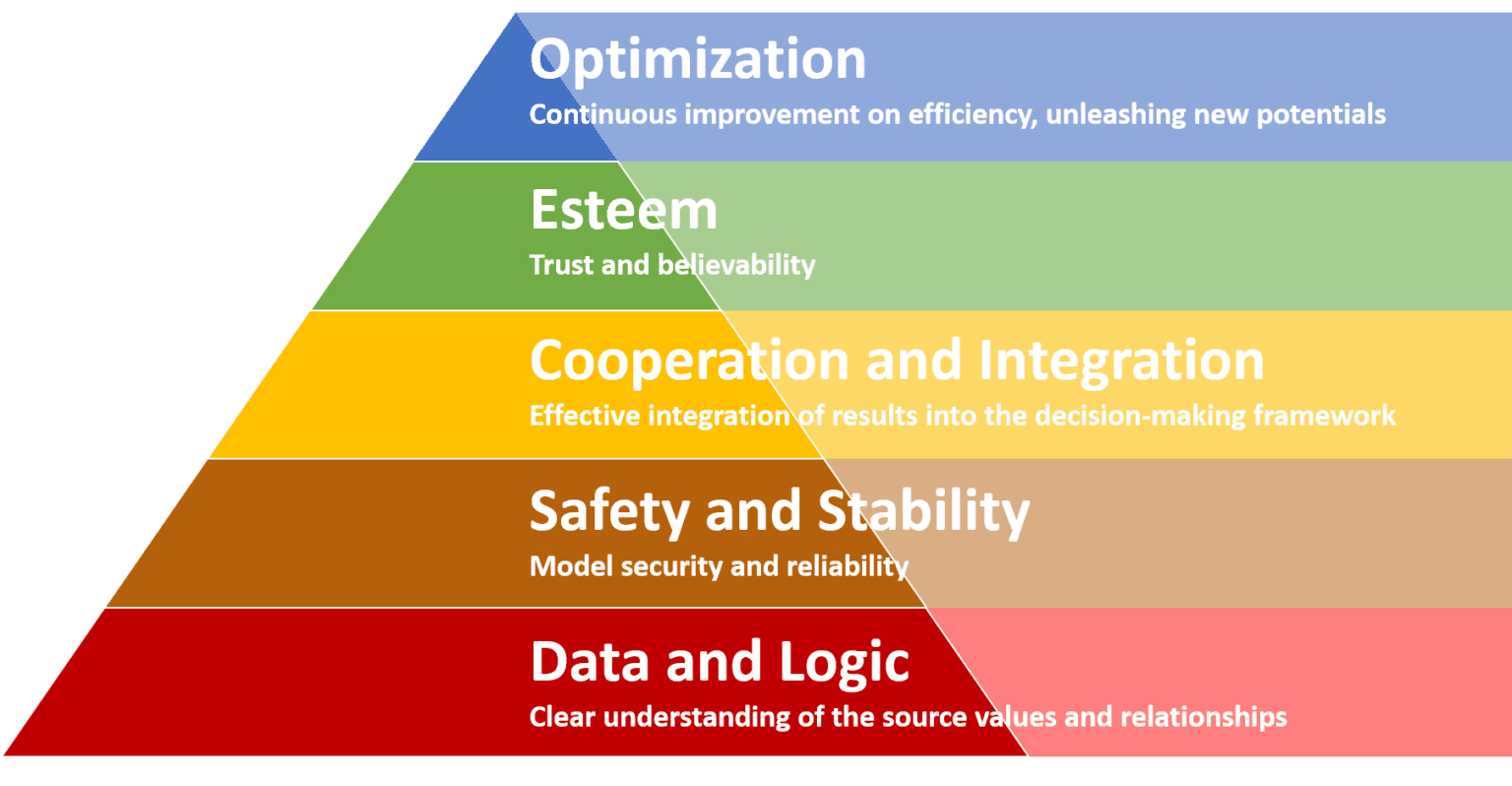
Let's briefly consider these layers, which we will use to structure our thinking:
- Data and Logic: The absolute foundation. Without clean data and sound, understandable logic, any model is worthless.
- Safety and Stability: The model must be secure from unauthorized changes and produce reliable, repeatable results.
- Cooperation and Integration: The model must not exist in a vacuum. Its outputs need to be effectively integrated into the wider business's decision-making frameworks.
- Esteem: Stakeholders—from fellow actuaries to senior management and regulators—must trust the model and find its results believable.
- Optimization: At the highest level, the model is subject to continuous improvement, unlocking new efficiencies and analytical potential.
This framework shows that a "good" model is about far more than just a clever algorithm. It's about building a tool that is robust, integrated, and trusted.
The Principles of a Robust Model
The qualities of a robust model are not just a matter of good practice; they are formally codified in professional standards. The UK's Financial Reporting Council (FRC) issues Technical Actuarial Standards (TASs) that set out the requirements for actuarial work. TAS 100 provides the core principles for all technical actuarial work.
Let's examine the central principle governing models.
[PDF] General Actuarial Standards - Version 2.0 - CAalley.com
This document sets out the mandatory professional standards for UK actuaries. Principle 5 specifically addresses the requirements for models.
Please read Principle 5 and its five sub-points (P5.1 to P5.5). Pay close attention to the key requirements: being 'fit for purpose', having 'appropriate model governance', and identifying 'material biases' and 'limitations'.
This principle establishes several non-negotiable foundations for a robust model:
- Fit for Purpose: The model's design must align with its intended use. A model designed for annual reserving, focusing on best-estimate outcomes, may be entirely unfit for capital modeling, which must explore extreme, low-probability events.
- Model Governance: This refers to the entire framework of controls around the model. It includes who has ownership, how changes are tested and approved (change control), and how the model is validated. A robust model is not a file on a single person's desktop; it's a managed and controlled asset.
- Understanding of Biases and Limitations: No model is a perfect representation of reality. A key feature of a robust modeling process is the active identification of potential biases and limitations. A bias could be a tendency to consistently overestimate or underestimate results, or a systematic error in how it represents a real-world process. Recognizing these limitations is crucial for interpreting the model's output correctly.
These principles from TAS 100 give us the "what"—the high-level requirements. To understand the "how," we can look at more detailed design criteria.
Key Design Criteria for Actuarial Models
When an actuary builds or modifies a model, they must balance several competing characteristics. A paper from the Society of Actuaries provides an excellent breakdown of these practical criteria.
[PDF] Actuarial Model Component Design - SOA
This article offers a practical guide to designing actuarial models, moving from high-level principles to specific, tangible characteristics.
Please read the section titled KEY DESIGN CRITERIA. As you read, focus on the inherent trade-offs discussed. For example, how might increasing 'Accuracy' negatively impact 'Efficiency'?
The criteria discussed in this article can be grouped into a few key themes that you should be familiar with for your CP1 exam.
Reliability and Correctness
- Accuracy: While seemingly obvious, the pursuit of perfect accuracy can lead to overly complex and slow models. A key skill is judging the level of accuracy that is material for the decision at hand.
- Controls: This relates directly to the "Safety and Stability" layer of our pyramid. Controls are the processes that prevent unauthorized or untested changes, ensuring the model's integrity.
- Testability: A good model allows its workings to be inspected. Can you check intermediate calculations? Or is it a "black box" that only provides a final answer? The ability to test and validate components is crucial for building trust.
Usability and Maintainability
- Flexibility: How easily can the model be adapted to answer new questions or run with different assumptions? A rigid model quickly becomes obsolete.
- Transparency & User-Friendliness: Can someone other than the original developer understand how the model works? A model that only one person understands represents a significant "key-person" risk to the company. Transparency is the antidote to the black box problem.
- Standardization: Using consistent approaches and layouts across a company's models makes them far easier to review, maintain, and update. It reduces the learning curve for new users and developers.
Performance
- Efficiency: This refers to both computer run-time and the human effort required to operate the model. There is often a direct trade-off between efficiency and other characteristics like accuracy, testability, and transparency. A model that runs overnight (10 hours) versus one that takes a week (100 hours) can fundamentally change the pace of business analysis.
A truly robust model is one that strikes an appropriate balance between these competing criteria, guided by its specific purpose.
The Critical Role of Documentation
If a model is a complex engine, then documentation is its technical manual. Without it, the engine cannot be safely operated, inspected, repaired, or improved by anyone other than its original creator. TAS 100 places a heavy emphasis on this.
[PDF] General Actuarial Standards - Version 2.0 - CAalley.com
Let's return to the professional standards to understand the formal requirements for documentation.
First, read Principle 6 and its sub-points. Then, look at Application 6, specifically A6.3, which links documentation directly to managing model risk.
As Principle 6 makes clear, documentation is not an optional extra. It is a professional requirement. It must contain enough detail for another qualified person to understand the work and assess the judgements made.
Here’s why the elements listed in P6.1 are so important:
- Judgements and justifications: Actuarial work is full of professional judgement. Documenting this thinking is essential for accountability and review.
- Data and assumptions: These are the raw ingredients of the model. A reviewer must be able to trace where they came from and why they were chosen.
- Fitness for purpose, uses, and limitations: This is the model's "user manual." It tells others what the model should be used for and, just as importantly, what it should not be used for.
- Model governance, controls, and testing: This provides the evidence that the model is managed robustly and its results can be relied upon.
In essence, good documentation is the primary mechanism for ensuring transparency, enabling peer review, facilitating model maintenance, and satisfying regulators. A model with poor documentation fails the "Esteem" and "Safety" layers of our hierarchy and presents a significant risk to the business.
Conclusion
In this lesson, we have moved from the why of modeling to the what—what defines a high-quality, robust actuarial model. We've seen that it's a careful balance of many factors, extending far beyond pure mathematical precision. A robust model is fit for its purpose, well-governed, and strikes a sensible balance between competing characteristics like accuracy, efficiency, and transparency.
Crucially, we have established that documentation is not a peripheral task but a core component of a model's robustness. It is the key that unlocks transparency, enables effective governance, and builds the trust necessary for a model to be a valuable business asset.
In our next lesson, we will examine one of the most fundamental design choices in modeling: the decision between a deterministic and a stochastic approach. We will explore the characteristics of each and learn how to justify which is appropriate for a given actuarial problem.
Key Takeaways & Cheatsheet
Here is a summary of the key features of a robust actuarial model, structured to help you revise for the CP1 exam.
| Feature Category | Key Characteristics | Why it's Important |
|---|---|---|
| Foundation | Accuracy: Appropriate for the task, not necessarily perfect. Controls: Secure, with a formal change process. |
Ensures the model is mathematically sound and its integrity is protected from accidental or unauthorized changes. |
| Usability | Flexibility: Easily adapted for new scenarios/assumptions. User-Friendliness: Intuitive to operate by non-developers. Transparency: The inner workings are understandable, not a "black box." |
Makes the model a useful and long-lasting tool for the business, reducing reliance on a single expert. Builds trust with users. |
| Governance | Testability: Intermediate calculations can be verified. Standardization: Follows consistent design conventions. Documentation: Comprehensive, clear, and complete. |
Allows for effective review, validation, and maintenance. Satisfies professional and regulatory requirements and manages model risk. |
| Performance | Efficiency: Balances run-time and resource use with other needs. | Ensures results can be produced in a timely manner to support business decisions. |