In our last lesson, we examined derivatives as powerful tools for implementing investment strategy and managing risk. We saw how they could be used to hedge currency exposure or quickly gain market exposure. Today, we shift from the tools of investment to the theories that seek to explain the very nature of financial markets. Understanding these theories is fundamental to deciding which tools to use and what overarching strategy to follow.
This lesson explores two powerful, and largely opposing, frameworks for understanding market behaviour: the Efficient Markets Hypothesis (EMH) and Behavioral Finance. We will discuss their core tenets and, most importantly, their profound implications for designing an effective investment strategy for an institution like a pension fund or an insurer. Given your background in social research, you will find the discussion on behavioral finance particularly interesting, as it essentially applies the principles of cognitive psychology to the world of economics.
The Efficient Markets Hypothesis: The Rational View
The central pillar of traditional finance is the Efficient Markets Hypothesis (EMH), a theory largely developed by Nobel laureate Eugene Fama. The core idea is that asset prices, at any given time, "fully reflect" all available information. This concept of "informational efficiency" is distinct from operational efficiency (like low transaction costs). In an informationally efficient market, prices are always "fair" in that they represent the best possible estimate of intrinsic value, given the information at hand.
Let's begin by watching a short video that introduces Eugene Fama's contributions and the core concept of informational efficiency.
Market Efficiency (2025 Level I CFA® Exam – Equity – Module 3)
The video "Market Efficiency (2025 Level I CFA® Exam – Equity – Module 3)" by AnalystPrep provides a clear introduction to the EMH.
Please watch the first few minutes to understand: How informational efficiency is defined and why it's a testable hypothesis. The example of a takeover announcement illustrates how new, relevant information is rapidly incorporated into stock prices, which is the cornerstone of the EMH.
The EMH is not a single, monolithic theory. It is typically broken down into three distinct forms, each corresponding to a different level of "available information."
[PDF] The Efficient Markets Hypothesis - Actuarial Education
This chapter from an Actuarial Education (ActEd) course note provides a concise and structured explanation of the three forms of the EMH, written specifically for actuarial students.
Please read the introduction and the section on the three forms of the EMH. Focus on understanding the definitions of each form and the type of analysis that each one renders ineffective. Specifically, read from the introduction and then the detailed descriptions of the three forms.
To summarize the key distinctions you've just read about:
- Weak-form Efficiency: Current prices reflect all information from past price and trading volume data.
- Implication: Technical analysis, which seeks to find predictable patterns in historical price charts, is useless. You cannot predict future prices by looking at past prices.
- Semi-strong-form Efficiency: Current prices reflect all publicly available information. This includes past prices, but also company financial statements, economic news, analyst reports, etc.
- Implication: Fundamental analysis, which involves analyzing public data to find undervalued or overvalued stocks, is useless. By the time you read a company's positive earnings report, the price has already adjusted.
- Strong-form Efficiency: Current prices reflect all information, both public and private.
- Implication: Even insiders with privileged information (e.g., a CEO who knows about an upcoming merger) cannot earn excess returns. Most researchers agree that markets are not strong-form efficient, which is why laws against insider trading are necessary and generally effective.
Implications for Investment Strategy: Active vs. Passive
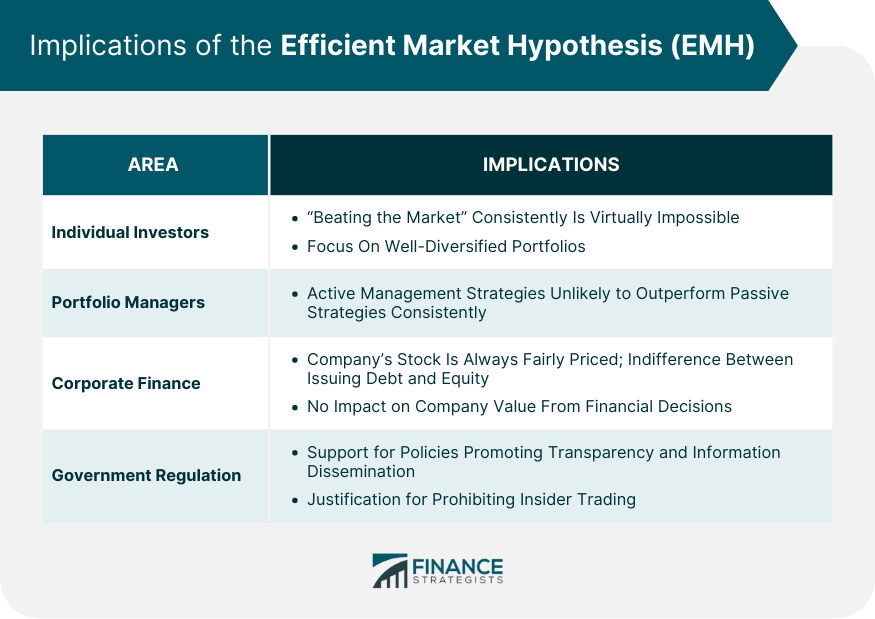
The primary implication of the EMH for an institutional investor is profound. If markets are semi-strong efficient, then trying to "beat the market" by picking stocks is a fool's errand. An active fund manager, who spends significant resources on research and incurs transaction costs trying to find mispriced securities, cannot consistently outperform the market on a risk-adjusted basis. Any success is down to luck, not skill.
This leads directly to the rationale for passive investment management. A passive strategy does not try to outperform the market; it aims to match it. This is typically done by holding a diversified portfolio that replicates a market index, such as the FTSE 100. The primary advantages are much lower fees and transaction costs.
The Challenge from Behavioral Finance: The Human View
While the EMH provides a powerful and elegant model, empirical evidence has uncovered "anomalies"—persistent patterns in asset returns that appear to contradict the hypothesis.
Market Efficiency (2025 Level I CFA® Exam – Equity – Module 3)
Let's return to the AnalystPrep video, which provides an excellent overview of some of these famous market anomalies.
Watch the section from "market anomalies", which discusses phenomena like the January effect, the size effect (small companies outperforming large ones), and the value effect (value stocks outperforming growth stocks). You don't need to memorize every detail, but appreciate that these represent statistical challenges to the EMH.
If the EMH can't fully explain these anomalies, what can? This is where behavioral finance comes in. It challenges the EMH's core assumption: that investors are rational. Instead, it applies cognitive and social psychology to understand how biases, emotions, and rules of thumb (heuristics) affect financial decisions.
Your work as a social researcher on personal relationships gives you a unique lens here. The same cognitive shortcuts and emotional patterns that influence how people form attachments, assess partners, and make relationship decisions are at play in the financial markets. Investors are not cold, calculating machines; they are human.
Let's explore some of the most critical behavioral biases.
Prospect Theory and Loss Aversion
One of the cornerstones of behavioral finance is Prospect Theory, developed by psychologists Daniel Kahneman and Amos Tversky. A key finding is loss aversion: people's emotional response to a loss is about twice as intense as their response to an equivalent gain. This asymmetry explains why investors might hold on to losing stocks for too long (hoping to avoid the pain of realizing a loss) or become risk-seeking when in a losing position, taking wild gambles to get back to even.
Applied Portfolio Management - Class 5 - Behavioral Finance
Patrick Boyle's lecture on Behavioral Finance offers a fantastic deep dive into these concepts.
Watch the segment on Prospect Theory. Pay close attention to the S-shaped value function he presents, which visually demonstrates how we perceive gains versus losses, and the experiments that reveal how our risk appetite changes depending on whether a choice is framed as a gain or a loss.
Overconfidence
Overconfidence is the tendency for people to overestimate their own knowledge and abilities. As a researcher, you know this is a well-documented bias. In finance, it leads investors to trade too frequently, underestimate risks, and believe they can pick winning stocks better than others, often to their detriment.
[PDF] making actuaries less human - lessons from behavioural finance
This paper from the Staple Inn Actuarial Society is an excellent resource connecting these psychological concepts directly to actuarial practice.
Please read Section 7 on Overconfidence. Note the finding that overconfidence is often greatest in one's own area of expertise and for difficult tasks with unclear feedback—a description that fits much of actuarial work perfectly.
Other Key Biases
Many other biases influence investor behavior:
- Herding: The tendency for individuals to follow the actions of a larger group, leading to market bubbles and crashes (e.g., the GameStop saga mentioned in the AnalystPrep video).
- Anchoring: Relying too heavily on an initial piece of information (the "anchor") when making decisions. An investor might "anchor" on the price they paid for a stock, influencing their decision to sell.
- Confirmation Bias: The tendency to search for, interpret, and recall information that confirms one's preexisting beliefs. An investor who is bullish on a company will seek out positive news and dismiss negative reports.
Implications for Investment Strategy: The Case for Active Management
If investors are systematically irrational and driven by biases, then market prices can and do deviate from their fundamental values. These deviations are not just random noise; they are predictable patterns created by human psychology.
This provides the core justification for active investment management. A skilled and disciplined active manager can potentially exploit these behavioral biases. They might, for example:
- Buy "unloved" value stocks that overly pessimistic, loss-averse investors have sold down too far.
- Short-sell "glamour" stocks that have been pushed to irrational highs by overconfident, herding investors.
- Systematically profit from the momentum anomaly, where past winners continue to win for a time.
Crucially, behavioral finance also implies that investors and their advisors must be acutely aware of their own biases to avoid falling into the same traps.
Synthesis: Efficiently Inefficient Markets
So, which view is correct? Are markets rational calculators or are they driven by irrational emotion? The modern consensus is that they are a bit of both.
Large, liquid markets like US large-cap equities are highly efficient. Information is disseminated rapidly, and tens of thousands of professional analysts are looking for any edge, which means opportunities are arbitraged away almost instantly. In these markets, the EMH is a very good approximation of reality, and passive management is often the most sensible approach.
However, in less-researched areas (e.g., smaller companies, emerging markets) or during periods of extreme market stress, behavioral biases can have a much greater impact, creating inefficiencies that a skilled active manager might exploit.
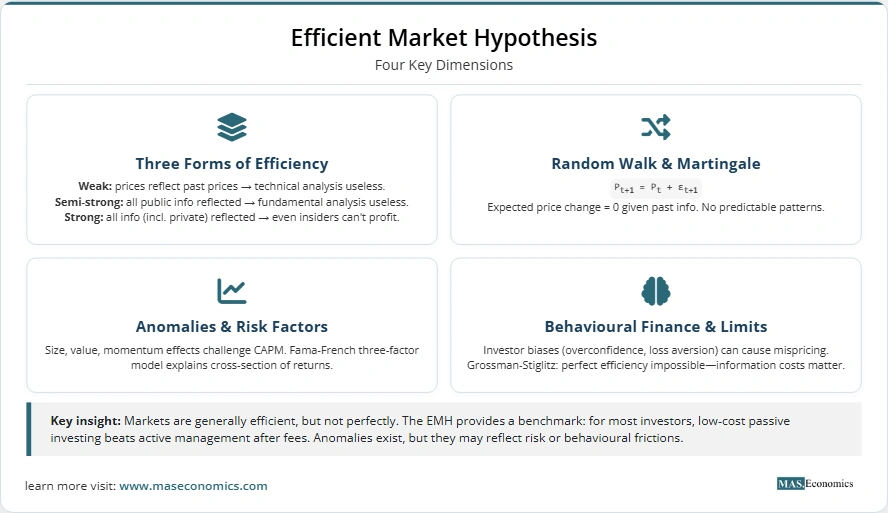
The most practical takeaway for an institutional investor is that market efficiency is not an all-or-nothing concept. The optimal strategy may involve a core-satellite approach: a large, low-cost passive core for exposure to efficient markets, complemented by smaller, active "satellite" investments in specific areas where skill and an understanding of behavioral dynamics can add value.
Conclusion
In this lesson, we contrasted two dominant theories of market behavior. The Efficient Markets Hypothesis posits that markets are rational and prices reflect all information, making it nearly impossible to consistently outperform and providing a strong justification for low-cost passive investing. In contrast, Behavioral Finance argues that human psychology—with its biases like loss aversion, overconfidence, and herding—creates predictable mispricings and market anomalies, opening the door for skilled active managers to profit.
For an actuary advising an institution on investment strategy, the key is to recognize that reality lies somewhere in between. Your role is not to prove one theory right, but to understand the implications of both. You must appreciate the power of markets to process information while also recognizing the potential for human error and emotion to create both risk and opportunity.
Key Takeaways & Cheatsheet:
| Feature | Efficient Markets Hypothesis (EMH) | Behavioral Finance |
|---|---|---|
| Core Assumption | Investors are rational; prices reflect all available information. | Investors are not fully rational; decisions are influenced by psychological biases. |
| Market Prices | Prices are always "correct" and reflect fundamental value. | Prices can deviate from fundamental value due to irrational behavior. |
| Anomalies | Are temporary, due to chance, or reflect unmeasured risk. | Are predictable outcomes of persistent psychological biases. |
| Key Concepts | Weak, Semi-strong, Strong forms of efficiency; Random Walk. | Prospect Theory, Loss Aversion, Overconfidence, Herding, Anchoring, Framing. |
| Investment Implication | Passive Management. It's futile to try and beat the market, so minimize costs by matching it. | Active Management. Skilled managers can identify and exploit mispricings caused by others' biases. |
| Actuarial Relevance | Justifies the use of index funds for long-term asset growth. Core of traditional asset pricing models. | Explains market volatility and bubbles. Stresses the need to manage one's own biases in assumption-setting. |
In our next lesson, we will dive deeper into a critical component of the investment landscape: the factors driving the term structure of interest rates. This will be crucial for understanding how bonds are valued and how the value of long-term actuarial liabilities fluctuates.